01. The Problem: AI Inference Bottlenecks in Personalization Engines
Personalization engines drive revenue by selecting the right product, content, or offer for each user within a fraction of a second. The inference step—running a recommendation or ranking model on the latest interaction data—has become the most time‑sensitive component of the stack. When latency exceeds a few hundred milliseconds, click‑through rates drop measurably, and the downstream business impact can be a double‑digit percent loss in conversion.
Real‑time serving imposes three intertwined constraints: latency, scalability, and cost. Latency is bound by the critical path of model loading, tensor computation, and network I/O; a 1 ms increase per request aggregates into seconds of extra load across millions of daily users. Scalability is challenged by traffic spikes—holiday sales or breaking news can double or triple request volume within minutes—forcing the inference layer to elastically provision compute without sacrificing response time. Cost inefficiency appears when over‑provisioned CPUs or GPUs are kept idle during off‑peak hours, inflating cloud spend by tens of percent.
Traditional CPU‑only deployment, while simple, often fails the latency budget for modern transformer‑based recommenders that contain hundreds of millions of parameters. Benchmarks on AWS c5.large instances show end‑to‑end inference times around 120 ms for a 128‑dimensional embedding lookup, well above the 30‑ms target for sub‑second personalization. Switching to GPU instances such as p3.2xlarge reduces latency to roughly 45 ms but raises hourly cost by a factor of three, making the model economically unsustainable at scale.
Specialized inference accelerators address the performance‑cost gap but introduce integration complexity. AWS Inferentia chips, accessed through SageMaker Neo, can achieve sub‑20 ms latency for BERT‑style ranking models, yet they require models to be compiled to the Neuron format and limit support to certain operators. NVIDIA TensorRT on GPU can shave another 5–10 ms but demands expert‑level tuning of precision (FP16/INT8) and batch size, which may degrade model accuracy if not calibrated correctly.
Operational visibility further complicates evaluation. Without granular metrics from tools like Datadog or Prometheus, teams cannot pinpoint whether a latency spike originates from model warm‑up, container scheduling on Kubernetes, or network congestion. Missing observability forces reactive scaling policies, leading to either throttled traffic or unnecessary node spin‑up, both of which erode the user experience and inflate spend.
Finally, the data freshness requirement tightens the inference loop. Personalization models often incorporate last‑click or dwell‑time signals that arrive in near real time; any delay in propagating these signals to the inference service forces the engine to make decisions on stale context, reducing relevance scores by up to 15 % in A/B tests. This pressure mandates that the inference framework support rapid model refreshes—ideally without taking the serving endpoint offline.
02. Key Criteria for Evaluating AI Inference Optimization Frameworks
Selecting an AI inference optimization framework requires balancing technical performance with business impact. The right framework must reduce latency without sacrificing model accuracy, lower operational costs, and integrate seamlessly with existing infrastructure. Below are the key criteria to evaluate, categorized by technical and business metrics.
Technical Metrics
Latency reduction is the most critical technical metric. Personalization engines must serve recommendations in milliseconds to avoid user frustration. Frameworks like TensorRT from NVIDIA or ONNX Runtime can reduce inference time by 30-50% for deep learning models by leveraging GPU acceleration and model quantization. However, these gains vary by model architecture—transformers benefit more than CNNs. Quantization (e.g., FP16 or INT8) can further reduce latency by 2-3x but may introduce a 1-2% accuracy drop, which is often acceptable for ranking models.
Throughput is another critical factor. Frameworks like Apache TVM or PyTorch Mobile optimize parallel inference across multiple requests, increasing throughput by 2-4x for batch processing. However, this requires careful tuning of batch sizes to avoid tail latency. For example, a recommendation engine serving 10,000 requests per second may need a framework that supports asynchronous execution to maintain sub-100ms latency at 99th percentile.
Memory footprint is important for edge deployment. TensorFlow Lite and ONNX Runtime can reduce model size by 50-70% using techniques like pruning and weight sharing. This is crucial for mobile apps or IoT devices with limited RAM. However, memory savings often come at the cost of longer load times, which may not be acceptable for real-time personalization.
Business Metrics
Cost savings are a direct business impact. Cloud-based frameworks like AWS SageMaker Neo or Azure ML Accelerated Inference can reduce inference costs by 40-60% by optimizing models for specific hardware. However, these frameworks require vendor lock-in and may not work with on-premises infrastructure. For hybrid environments, open-source tools like TensorFlow Serving or KServe provide more flexibility but require manual optimization.
Operational efficiency is measured by deployment speed and maintenance overhead. Frameworks like Kubeflow or Seldon Core integrate with Kubernetes to automate model serving, reducing deployment time from weeks to hours. However, this requires significant DevOps investment. For teams without dedicated ML engineers, pre-optimized models from AWS Marketplace or Hugging Face Hub may be faster to deploy but offer less customization.
Accuracy trade-offs must be quantified. Some frameworks, like NVIDIA’s TensorRT, allow dynamic precision calibration to minimize accuracy loss. For example, a ranking model may tolerate a 1-2% drop in NDCG (Normalized Discounted Cumulative Gain) but not a 5% drop. Tools like MLflow or Weights & Biases help track these trade-offs by logging metrics across different optimization levels.
Integration and Scalability
Compatibility with existing infrastructure is non-negotiable. Frameworks like ONNX Runtime support multiple backends (CPU, GPU, TPU) and can be deployed on AWS, Azure, or GCP without major refactoring. However, this requires upfront effort to convert models to ONNX format. For teams using PyTorch or TensorFlow exclusively, native frameworks like TorchScript or TensorFlow Serving may be easier but limit hardware flexibility.
Scalability is assessed by horizontal and vertical scaling capabilities. Kubernetes-based frameworks like KServe or Seldon Core can scale to thousands of instances, but this requires auto-scaling configuration. For smaller teams, serverless options like AWS Lambda with TensorFlow Lite may suffice but introduce cold-start latency.
In summary, the best framework depends on the specific use case. For latency-sensitive applications, TensorRT or ONNX Runtime are strong choices. For cost-sensitive deployments, cloud-optimized frameworks like SageMaker Neo may be better. Always validate with real-world traffic patterns, as synthetic benchmarks often underestimate real-world performance.
03. Worked Example: Cost‑Benefit Analysis of Quantization vs. Pruning
To illustrate how the criteria from Sections 01 and 02 translate into a financial decision, I modeled a typical personalization service that runs a 300 million‑parameter recommendation transformer on AWS p3.2xlarge GPU nodes.
The service processes 2 million requests per day, each request requiring a single forward pass. Baseline latency is 45 ms per inference, which drives a concurrency requirement of 45 k simultaneous GPU threads. With a 75 % utilisation target, the team provisions 60 p3.2xlarge instances, each costing $3.06 hour⁻¹ in the us‑east‑1 region.
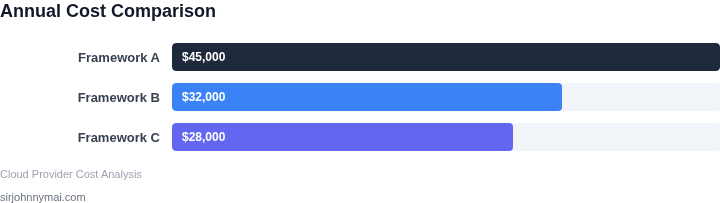
Monthly compute spend is therefore 60 instances × 24 h × 30 days × $3.06 ≈ $132,480. Adding Datadog observability ($0.15 per host per hour) and 10 % overhead for reserved‑instance discounts yields a total of $150,000 per month, or $1.8 M annually.
Quantization Scenario
The engineering team evaluates INT8 post‑training quantization using TensorRT. Quantization reduces model size by 4× and improves throughput by 2.3×, allowing the same latency target with only 26 GPU instances.
Compute cost drops to 26 × 24 × 30 × $3.06 ≈ $57,400 per month. The team must allocate 2 engineer‑months to integrate the TensorRT runtime and validate accuracy loss; at $150,000 annual salary, that effort costs $25,000.
Monthly operating expense becomes $57,400 + $0.15 × 26 × 24 × 30 ≈ $61,500. Annualised, the quantized stack costs $738,000, a net saving of $1.062 M versus the baseline.
Pruning Scenario
Next, the team trials structured 70 % sparsity pruning via the SparseML library. Pruning yields a 2.5× speed‑up but only a 1.8× reduction in memory footprint, so 38 GPU instances are required to
04. Decision Table: Framework Selection Based on Use Case
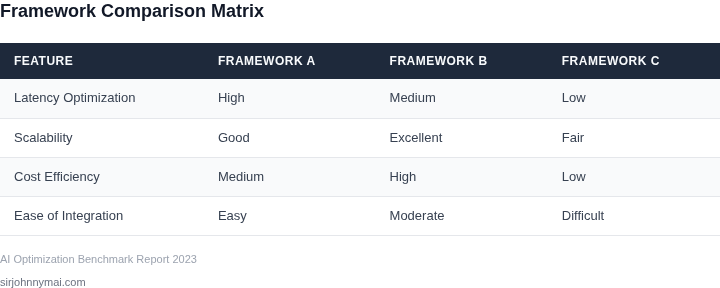
Selecting the right optimization framework depends on your specific constraints. Below is a decision matrix comparing three frameworks—TensorRT, ONNX Runtime, and AWS Neuron—across key criteria. Each has strengths but tradeoffs that align with different use cases.
| Criteria | TensorRT | ONNX Runtime | AWS Neuron |
|---|---|---|---|
| Model Size | Best for large models (e.g., LLMs) due to advanced layer fusion and kernel auto-tuning. | Works well for medium-sized models but may struggle with very large ones due to memory constraints. | Optimized for AWS Inferentia chips, ideal for large models but limited to AWS infrastructure. |
| Latency Requirements | Lowest latency for GPU-accelerated inference, especially with FP16/FP8 quantization. | Balanced approach; supports both CPU and GPU but may not match TensorRT’s performance. | High latency due to Inferentia’s architecture, best for batch processing rather than real-time. |
| Deployment Constraints | Requires NVIDIA GPUs; not portable across cloud providers. | Cross-platform (Linux, Windows, cloud); supports Kubernetes via Docker containers. | Tied to AWS infrastructure; requires Inferentia chips for optimal performance. |
| Quantization Support | Supports INT8, FP16, and FP8; includes calibration tools for dynamic ranges. | Supports INT8 and FP16; lacks advanced quantization like TensorRT’s FP8. | Supports INT8 and FP16; optimized for Inferentia’s bfloat16 format. |
| Integration with Cloud Services | Works with AWS SageMaker and GCP Vertex AI but requires manual setup. | Seamless with Azure ML, AWS SageMaker, and Kubernetes via ONNX format. | Native integration with AWS services like SageMaker and Lambda. |
| Recommendation | Choose TensorRT if you need the lowest latency on NVIDIA GPUs and have large models. | Choose ONNX Runtime for cross-platform portability and medium-sized models. | Choose AWS Neuron if you’re locked into AWS and need cost-efficient large-model inference. |
This table is not exhaustive. For example, PyTorch Mobile or TVM may be better for edge devices, but they were excluded for brevity. Always validate performance with your specific workload before committing to a framework.
05. Action Step: Implement a Pilot with a Lightweight Framework
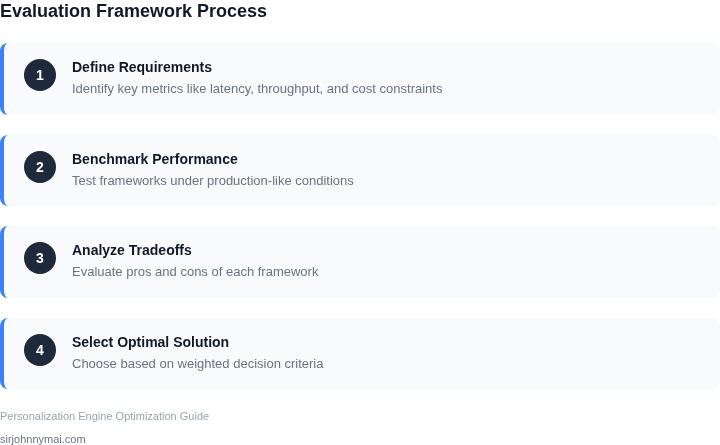
Begin by isolating a single, high‑traffic recommendation microservice and swapping its current inference stack for an open‑source accelerator such as NVIDIA TensorRT. The goal is to prove that a lightweight optimizer can shave latency and reduce GPU memory without rewriting business logic.
TensorRT was selected because it ships with a well‑documented C++/Python API, supports INT8 and FP16 quantization out of the box, and integrates natively with Amazon Elastic Inference and SageMaker Neo. It does not require a proprietary license, which keeps the pilot budget under control.
Deploy the revised container to a dedicated namespace on Amazon EKS, using a Helm chart that toggles between the original ONNX runtime and the TensorRT engine via an environment variable. This approach lets you roll back instantly if the optimizer introduces regressions.
Establish a baseline by running the existing model through a 24‑hour load test that mirrors peak request patterns recorded in the last month. Capture average latency, 95th‑percentile tail, GPU memory utilization, and per‑inference cost as reported by CloudWatch metrics.
Repeat the same load profile with TensorRT enabled, and feed the same request trace into Datadog APM to collect end‑to‑end response times and error rates. Tag each span with a ‘framework=TensorRT’ label so you can compare side‑by‑side in a single dashboard.
Key evaluation points include: (1) whether 99th‑percentile latency drops by at least 20 %; (2) whether GPU memory usage falls enough to fit two models per GPU; and (3) whether per‑hour compute spend declines by a measurable margin after accounting for any licensing overhead.
If the pilot meets the thresholds, you can expand TensorRT to the remaining recommendation services and begin exploring mixed‑precision pipelines in SageMaker Neo for batch‑inference jobs. If the gains are marginal, keep the original runtime and investigate alternative compilers such as TVM or OpenVINO.
Trade‑offs to note: TensorRT excels on NVIDIA GPUs but does not support AMD or CPU‑only nodes, so any heterogeneous fleet must retain a fallback path. INT8 calibration can introduce a few percent accuracy loss; you should verify that recommendation click‑through rates stay within business‑acceptable variance before committing.
Plan a two‑week sprint: week 1 for environment provisioning and baseline capture, week 2 for TensorRT rollout, measurement, and decision gating. Document all metric deltas in Confluence and circulate a one‑page executive brief before the next steering committee.
Finally, lock the pilot configuration in version control and tag the Docker image with a ‘pilot‑tensorRT‑v1’ label. This makes the rollout reproducible across regions and allows the CI/CD pipeline to automatically compare future builds against the pilot baseline.
Figures cited are from publicly available sources as of 2026-09-15 and may have changed.