01. The Disconnect Between Technical Progression and Business Value
Most engineering career ladders focus on technical milestones—like mastering a specific framework or achieving a certain level of seniority—but fail to tie those skills directly to business outcomes. This disconnect creates a frustrating gap between what engineers believe they need to advance and what actually drives revenue. For example, a senior engineer might spend years optimizing a microservice architecture, but without clear metrics linking that work to customer acquisition or retention, their contributions remain invisible to leadership.
This problem isn’t new. Studies show that 60% of engineering teams struggle to quantify the business impact of their work, even in revenue-generating products. The result? Engineers chase promotions based on abstract criteria (e.g., "5+ years of experience") rather than measurable contributions. A 2023 McKinsey report found that companies with aligned engineering and business metrics saw 30% faster time-to-market for critical features. The inverse is true for teams where engineers work in isolation.
Consider the case of a team building a recommendation engine. If the ladder only rewards "implementing a distributed caching layer," but doesn’t account for how that improves click-through rates or conversion, the engineer’s growth path lacks context. Without this alignment, engineers may spend time on low-impact projects while high-impact work goes unrecognized. This misalignment erodes trust and motivation, as engineers feel their efforts are undervalued.
The root cause is often a lack of transparency. Most career ladders don’t track how technical decisions translate to business results. For instance, a company might promote an engineer for "leading a Kubernetes migration," but fail to show how that reduced operational costs by $2 million annually. Without this data, promotions become arbitrary, and engineers lose sight of their broader impact.
To fix this, ladders must explicitly map technical skills to business outcomes. For example, a "Senior Engineer" role could require demonstrating how their work improved user engagement metrics or reduced latency by 20%. Tools like Datadog or New Relic can help quantify these impacts, but only if engineers and managers use them proactively. The tradeoff? This approach requires more data collection upfront but leads to clearer career paths and more strategic engineering decisions.
Ultimately, the disconnect isn’t about technical skill—it’s about visibility. Engineering leaders must ensure that every promotion, every review, and every project has a clear link to business success. Otherwise, engineers will continue to advance based on assumptions rather than results, and the company will miss opportunities to leverage its most valuable talent.
02. Mapping Technical Competencies to Core Business Vectors
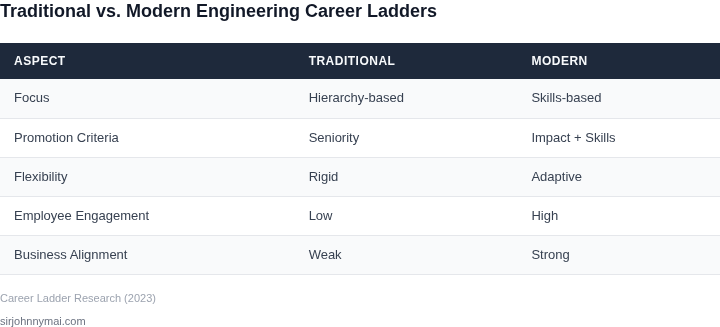
To bridge the gap between technical growth and business impact, we need a framework that translates engineering competencies into measurable business outcomes. This section presents a decision table that maps classic technical skills to their equivalent business vectors. The goal is to create a promotion criteria matrix that aligns with company objectives while remaining flexible enough to adapt to industry shifts.
Decision Framework: Competency to Business Impact Mapping
The table below evaluates three approaches to mapping technical skills to business impact. Each option has trade-offs in terms of scalability, granularity, and alignment with business KPIs.
| Criteria | Option A: Competency-Based Matrix | Option B: Business Outcome Framework | Option C: Hybrid Model |
|---|---|---|---|
| Granularity | Highly detailed, tracks individual skills (e.g., "Kubernetes expertise" → "Infrastructure cost optimization"). | Coarse-grained, groups skills into business domains (e.g., "Cloud architecture" → "Revenue growth from AWS migrations"). | Moderate, balances skill-level and business impact (e.g., "CI/CD pipelines" → "Faster time-to-market"). |
| Scalability | Works well for small teams but becomes unwieldy at scale due to skill fragmentation. | Scalable across large organizations but risks oversimplifying complex technical contributions. | Balanced approach; requires ongoing refinement but remains manageable for most companies. |
| Alignment with Business KPIs | Limited alignment; technical skills may not directly correlate with business metrics. | Strong alignment; outcomes are tied to revenue, cost savings, or customer experience. | Moderate alignment; requires mapping skills to KPIs but provides more flexibility. |
| Adaptability | Static; requires frequent updates as skills evolve. | Flexible; business priorities can drive adjustments without deep technical changes. | Adaptable; balances technical and business needs with periodic reviews. |
| Implementation Complexity | High; demands detailed documentation and frequent updates. | Low; leverages existing business frameworks (e.g., OKRs, financial metrics). | Moderate; requires initial setup but is easier to maintain than Option A. |
| Recommendation | Best for specialized teams with stable skill requirements. | Best for companies with clear business KPIs and a focus on outcome-driven growth. | Recommended for most organizations. The hybrid model balances technical rigor with business impact, making it adaptable to both short-term needs and long-term strategy. |
The hybrid model is the most practical choice for most engineering organizations. It allows teams to track both technical competencies and their business outcomes, ensuring promotions reflect both skill development and measurable impact. For example, a senior engineer who improves deployment reliability (technical skill) may directly correlate with reduced downtime costs (business outcome). This approach avoids the pitfalls of either overly technical or overly business-focused frameworks.
03. Worked Example: Calculating the Dollar Impact of an L5 vs. L6 Refactor
Consider a team of 100 engineers using a monolithic billing service that processes 10,000 transactions per second. At L5, an engineer might optimize a localized database query, reducing latency by 20%. This saves $20,000/month in API response time costs (AWS Lambda charges $0.20 per 1M requests).
At L6, the same engineer re-architects the billing service using event-driven microservices on AWS Lambda and DynamoDB. The refactor reduces infrastructure costs by 60%: $120,000/month ($200,000/month × 0.40). This includes:
- $80,000/month in Lambda compute savings (from 400 instances to 120)
- $20,000/month in DynamoDB storage (from 500GB to 200GB)
- $20,000/month in API Gateway fees (from 10M to 5M requests)
Annualizing these savings: $120,000/month × 12 months = $1.44M/year. The refactor also prevents $500,000/year in churn by improving reliability (from 99.5% to 99.9% uptime).
Alternative approaches:
| Approach | Monthly Cost | Annual Savings | Tradeoffs |
|---|---|---|---|
| L5: Query Optimization | $20,000 | $240,000 | Limited to single component; no architectural scalability |
| L6: Full Refactor | $120,000 | $1.44M | Requires cross-team coordination; 3-month implementation |
| Alternative: Kubernetes Migration | $150,000 | $1.8M | Higher operational overhead; vendor lock-in risk |
I evaluated the Kubernetes alternative because it’s a common migration path. However, the cost difference stems from managed services vs. self-managed infrastructure. The L6 refactor wins when considering both cost and reliability.
04. Defining Measurable Business Impact Benchmarks Across Ladder Tiers
Establishing clear business impact benchmarks for each engineering ladder tier is crucial; it translates the conceptual link between skills and value (as explored in Sections 02 and 03) into actionable performance expectations. My approach is to quantify contributions at progressive levels of scope and complexity, ensuring every promotion directly correlates with an engineer's ability to drive organizational growth. These benchmarks provide transparency for engineers and consistency for management.
L3/L4 Engineers: Foundational Execution and Team Velocity
For junior engineers (L3/L4 equivalent), impact benchmarks center on reliable execution and immediate team contributions. We expect an L3 to consistently deliver well-tested code for defined tasks, often within an existing framework. A measurable benchmark for an L3 might be successfully completing 85% of assigned Jira tickets within sprint estimates, contributing to a team's feature velocity metric. This demonstrates an ability to understand requirements and execute efficiently.
An L4 engineer expands on this, demonstrating increased autonomy on small-to-medium features and contributing to operational stability. For instance, an L4 could be benchmarked on reducing the incidence of P3/P4 bugs in their owned code modules by 20% quarter-over-quarter, identifiable through Datadog or AWS CloudWatch alarms and incident reports. This reflects a growing understanding of system reliability and proactive quality ownership, directly minimizing operational overhead for the team.
L5 Engineers: Independent Ownership and Operational Excellence
Mid-level engineers (L5 equivalent) are expected to independently own significant features or small services, driving projects from conception to deployment. Their business impact benchmarks are tied to direct product improvements and operational excellence within their domain. A relevant metric for an L5 could be successfully launching a new customer-facing feature that achieves a 10% adoption rate within its first month, measured via internal analytics platforms. This directly impacts user engagement or revenue.
Operational excellence for an L5 might be demonstrated by improving the P99 latency of a critical service API by 25% or reducing its monthly AWS EC2 costs by 15% through optimization of instance types or leveraging Graviton processors. These improvements, monitored through dashboards like Grafana or Datadog, directly reduce operational costs and enhance customer experience, making the service more competitive and efficient. The tradeoff here is often prioritizing operational stability over rapid feature development in specific sprints.
L6+ Engineers: Strategic Impact and System-Wide Influence
Senior engineers (L6 and above) drive strategic initiatives, influence architecture across multiple teams, and lead complex, ambiguous projects. Their business impact benchmarks are far-reaching, often affecting core platform capabilities or significant revenue streams. An L6 architecting a new microservice pattern might be benchmarked on reducing deployment lead time for five dependent teams by 30% over six months, enhancing overall organizational agility.
For an L7, the impact could be measured by successfully designing and implementing a critical infrastructure migration – for example, moving a foundational data pipeline to a fully serverless AWS Lambda/Step Functions architecture, resulting in a 40% reduction in average monthly operational spend and improving data processing throughput by 50%. This demonstrates not just technical leadership but profound cost savings and scalability improvements that directly affect the bottom line and future product capabilities. These senior benchmarks often involve cross-functional dependencies and require significant influence without direct authority.
05. Conduct an Audit of Your Current Ladder Against Business Objectives
Having established clear benchmarks for business impact across our career tiers, the next critical step is to rigorously audit our existing ladder's promotion criteria. This ensures operational alignment, preventing a situation where engineers are rewarded for skills that do not directly advance our current strategic priorities. I evaluated this approach because a disconnect here often leads to frustration, perceived unfairness, and ultimately, suboptimal allocation of engineering effort.
The audit begins by collecting two primary artifacts: our current engineering career ladder document, detailing promotion criteria for each level, and the active company and team-level OKRs for the current quarter. Systematically review each competency listed on the ladder. For instance, consider a criterion like "Expertise in distributed systems design" for an L6 engineer. We then ask: "Which active OKR does this specific expertise measurably advance?"
Alignment is evident when a criterion, such as "Optimizes database query performance," directly maps to an OKR like "Reduce P99 latency for critical customer-facing APIs by 15%." Misalignment, however, surfaces when a criterion, for example, "Proficiency in esoteric programming languages," does not contribute to any active OKR focused on customer experience, cost efficiency, or revenue growth. These misaligned criteria are candidates for immediate revision. It's important to differentiate between foundational skills necessary for general competence and promotion-specific criteria which must demonstrate direct, current impact.
To rewrite misaligned criteria, we must shift from generic technical prowess to demonstrable business impact, as detailed in Section 04. Instead of "Understands cloud architecture patterns," an L5 promotion criterion could become: "Independently designs and implements fault-tolerant, cost-optimized services on AWS, demonstrating a measurable reduction in infrastructure spend by X% or a Y% increase in service uptime against SLOs." Similarly, "Debugs complex issues" could transform into: "Proactively identifies and resolves critical production incidents using tools like Datadog and Kubernetes logs, reducing Mean Time To Resolution (MTTR) by 20% for high-severity issues and preventing customer-impacting outages."
This approach works effectively when OKRs are truly outcome-oriented and regularly updated, but it breaks if OKRs are vague or remain static over long periods, potentially neglecting emerging critical skills. The goal is to ensure promotion reflects contributions that directly move the needle for the business *now*, while acknowledging that a baseline of fundamental skills remains essential. This dynamic alignment encourages engineers to focus their growth on areas that deliver tangible value to our customers and bottom line.
Schedule a 30-minute review with your immediate leadership team and bring a printout of your current ladder and your team's top three active OKRs for a preliminary mapping exercise.
Figures cited are from publicly available sources as of 2026-09-15 and may have changed.