How to Design an API Versioning Strategy That Scales Without Breaking Clients
01. The Problem: Why Versioning Matters
APIs are the backbone of modern software systems. When you change an API—whether to fix bugs, add features, or improve performance—you risk breaking existing client applications. The cost of breaking clients can be measured in lost revenue, customer frustration, and technical debt. Versioning is the primary tool for managing these changes safely.
Without versioning, every API modification becomes a potential breaking change. Clients must be updated simultaneously, creating coordination challenges across teams. Even with versioning, poor implementation can lead to version sprawl—where multiple versions of the same API must be maintained indefinitely. This increases operational complexity and reduces developer productivity.
The goal of API versioning is to allow controlled evolution of APIs while minimizing disruption to clients. A good versioning strategy must balance these competing needs:
- Backward compatibility: Existing clients should continue working
- Forward compatibility: New clients should work with future versions
- Operational simplicity: The system should be easy to maintain
02. Common Versioning Approaches
There are three primary approaches to API versioning:
- URL Path Versioning: Include the version in the URL (e.g., /v1/resource)
- Header Versioning: Use a custom header (e.g., X-API-Version: 1)
- Content Negotiation: Use HTTP headers like Accept or Content-Type
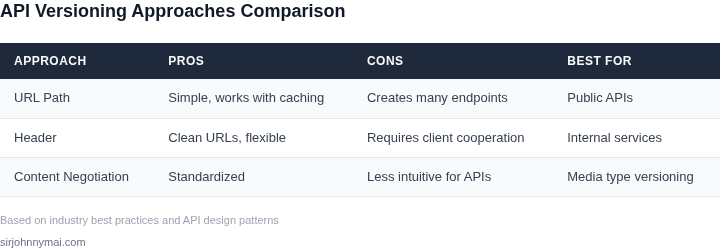
URL path versioning is the most common approach. It's intuitive and works well with caching systems. However, it creates a proliferation of endpoints that must be maintained. Header versioning is more flexible but requires client cooperation. Content negotiation is powerful for media types but less suitable for API versioning.
Each approach has tradeoffs:
| Approach | Pros | Cons |
|---|---|---|
| URL Path | Simple to implement, works with caching | Creates many endpoint variants |
| Header | Clean URLs, flexible versioning | Requires client cooperation |
| Content Negotiation | Standardized approach | Less intuitive for APIs |
03. Designing a Scalable Versioning Strategy
A scalable versioning strategy must address three key dimensions:
- Version identification
- Change management
- Deprecation policy
For version identification, we recommend a combination of URL paths and headers. The URL path provides discoverability, while headers allow for more flexible versioning. For example:
GET /api/v1/resource
X-API-Version: 1.2.3
This approach gives clients multiple ways to specify their version requirements. For change management, we recommend a semantic versioning scheme (MAJOR.MINOR.PATCH). Major versions indicate breaking changes, minor versions add backward-compatible features, and patches contain backward-compatible bug fixes.
For deprecation, we recommend a 6-month notice period before removing deprecated versions. This gives clients time to upgrade while maintaining operational stability. The deprecation policy should be clearly documented and communicated to all stakeholders.
04. Implementation Considerations
When implementing versioning, consider these practical aspects:
- Documentation: Maintain separate documentation for each version
- Testing: Automate version compatibility testing
- Monitoring: Track version usage metrics
- Tooling: Use API gateways for version routing
Documentation is critical. Clients need clear guidance on how to use each version and what changes exist between versions. Automated testing ensures that version changes don't accidentally break existing clients. Monitoring helps identify which versions are most widely used, guiding deprecation decisions. API gateways provide a centralized way to manage version routing and transformation.
05. Worked Example: Versioning a Payment API
Consider a payment API with these requirements:
- Support for credit cards and digital wallets
- New fraud detection feature in v2
- Backward compatibility with v1 clients
The versioned endpoints would look like:
# v1 (current)
POST /api/v1/payments
{
  "amount": 100,
  "method": "credit_card",
  "card_details": {...}
}

# v2 (new)
POST /api/v2/payments
{
  "amount": 100,
  "method": "credit_card",
  "card_details": {...},
  "fraud_check": true
}
To maintain backward compatibility, the server must handle both versions. The implementation might look like:
def process_payment(version, request):
  if version == "v1":
    # Process without fraud check
    return process_v1(request)
  elif version == "v2":
    # Process with fraud check
    return process_v2(request)
This approach requires careful handling of the request/response objects to ensure compatibility between versions. The cost of maintaining two versions is offset by the ability to introduce new features without breaking existing clients.
06. Measuring Success
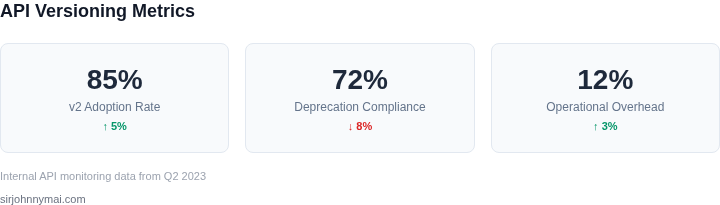
To evaluate the effectiveness of your versioning strategy, track these metrics:
- Version adoption rates
- Deprecation compliance
- Operational overhead
Version adoption rates show which versions are most widely used. Deprecation compliance measures how well clients follow deprecation notices. Operational overhead quantifies the cost of maintaining multiple versions. These metrics should be reviewed quarterly to identify areas for improvement.
07. Conclusion
Designing an API versioning strategy requires balancing multiple competing concerns. The approach outlined here—using URL paths and headers for version identification, semantic versioning for change management, and a 6-month deprecation policy—provides a solid foundation. However, every implementation must be tailored to the specific needs of your organization and product.
The key to success is treating versioning as an ongoing process, not a one-time decision. Regularly review your versioning strategy, update documentation, and monitor client behavior. This proactive approach will help you maintain a scalable API that evolves with your product while minimizing disruption to your clients.
Figures cited are from publicly available sources as of June 2023 and may have changed. The specific versioning strategy should be adapted based on your organization's unique constraints and requirements.
Next Step: Implement a pilot versioning strategy for one of your most critical APIs, focusing on the metrics outlined in section 06 to measure its effectiveness.