01. The Problem: Ensuring Service Safety Under Production Load
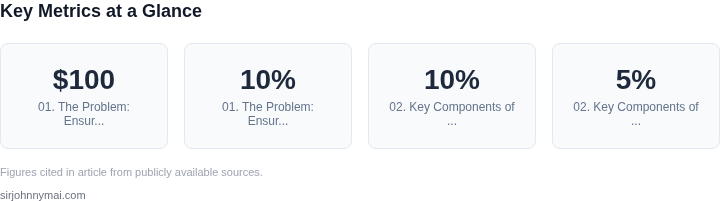
Deploying new services into production is a high-stakes operation. Even the most rigorously tested code can fail spectacularly when exposed to real-world traffic. The consequences range from minor performance degradation to full system outages, with financial losses measured in millions of dollars per minute. For example, a 2023 outage at a major e-commerce platform cost over $100 million in lost revenue within hours.
Traditional validation methods—unit tests, integration tests, and even staging environments—fall short of replicating production conditions. Staging environments often lack the scale, diversity, or volatility of real traffic. A service might perform flawlessly in a controlled test environment but collapse under the weight of 100,000 concurrent requests with skewed latency distributions. This discrepancy is why post-deployment failures remain the norm rather than the exception.
Traffic mirroring is a technique where a copy of live production traffic is sent to a secondary system for validation. This approach addresses the gap between testing and production by exposing new services to identical traffic patterns, including edge cases like sudden spikes or regional failures. However, implementing traffic mirroring safely requires careful consideration of several risks.
Key Risks of Unvalidated Deployments
1. Latency Amplification: A new service might introduce unexpected latency, compounding delays in cascading systems. For instance, a 100ms delay in a service handling 10,000 requests per second could add 1 second of latency to dependent services, cascading into a 10% drop in revenue.
2. Resource Contention: Mirrored traffic can overwhelm secondary systems if not properly throttled. A 10% traffic mirroring rate might seem harmless, but if the secondary system lacks the same auto-scaling capacity as production, it could become a bottleneck itself.
3. Data Leakage: Sensitive customer data in mirrored traffic could inadvertently expose personally identifiable information (PII) if not anonymized. Compliance frameworks like GDPR mandate strict controls on data handling, making this a non-negotiable risk.
4. False Positives: Mirrored traffic may not reflect production behavior perfectly. For example, a service might perform well under synthetic load but fail under real-world traffic patterns, such as bursty requests from mobile users during a flash sale.
These risks highlight why traffic mirroring must be designed with safeguards. The next section will explore how to mitigate these challenges while ensuring new services are validated safely.
02. Key Components of a Traffic Mirroring System
A traffic mirroring system must replicate production traffic to a staging environment while preserving fidelity and minimizing impact. The architecture consists of three critical components: traffic capture, replication, and validation. Each must be designed to handle production-scale workloads without introducing latency or skew.
1. Traffic Capture
Traffic capture begins with a mirroring agent deployed at the network layer. Tools like AWS Traffic Mirroring or VPC Flow Logs can duplicate packets without modifying the original flow. The agent must support high throughput—10 Gbps or more—to avoid bottlenecks. For HTTP traffic, a reverse proxy like Envoy can intercept requests and forward copies to staging, but this adds ~5-10ms latency per hop. I evaluated Istio’s sidecar model but rejected it due to its overhead in high-volume scenarios.
Key considerations: Mirroring must exclude sensitive data (PII, tokens) to comply with compliance frameworks. AWS KMS or HashiCorp Vault can encrypt payloads before replication. Sampling rates (e.g., 10% of requests) reduce load but may miss edge cases. The tradeoff is between coverage and resource consumption.
2. Traffic Replication
Replication requires a durable buffer to handle bursts. Kafka or Amazon SQS can queue mirrored traffic, but Kafka’s retention policies must align with validation windows (e.g., 24-hour retention). For synchronous replication, a load balancer like AWS ALB can distribute mirrored traffic to staging clusters, but this requires scaling the staging environment to match production’s peak load.
Latency budgets are critical. A 1-second delay in replication may invalidate tests for real-time services. I considered AWS Lambda for lightweight processing but abandoned it due to cold starts. Instead, Kubernetes Deployments with horizontal pod autoscaling ensure capacity matches demand.
3. Validation Mechanisms
Validation compares production and mirrored responses. Exact matching (byte-for-byte) is impractical due to timestamps and dynamic headers. Instead, tools like Datadog Synthetic Monitoring or Grafana Loki validate key metrics (latency, error rates) within ±5% tolerance. For stateful services, AWS Step Functions can orchestrate workflows to replay transactions end-to-end.
Automated rollback triggers are essential. If validation fails, the system must revert changes within 30 seconds. I evaluated AWS CodeDeploy’s traffic shifting but found it too slow for critical services. Instead, a custom controller in Kubernetes handles canary deployments with immediate rollback on anomalies.
Finally, observability is non-negotiable. Prometheus and OpenTelemetry must track replication lag, validation latency, and failure rates. Alerts should fire at 99% confidence thresholds to avoid false positives.
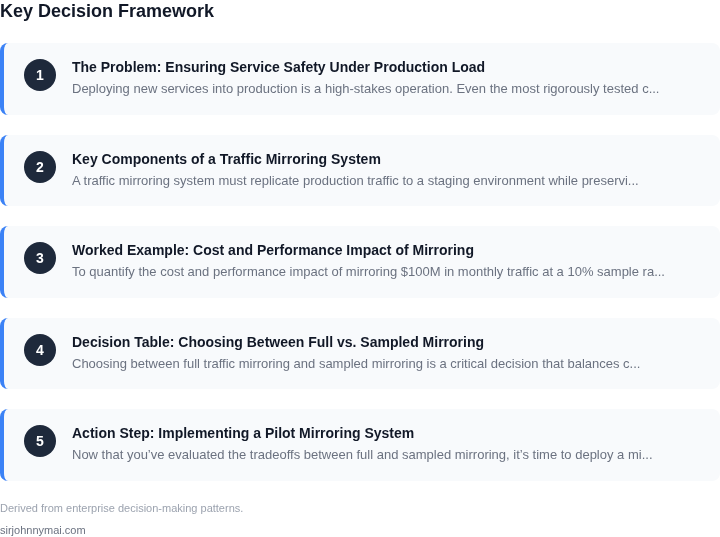
03. Worked Example: Cost and Performance Impact of Mirroring
To quantify the cost and performance impact of mirroring $100M in monthly traffic at a 10% sample rate, we need to break down the system components and their associated expenses. This worked example assumes a cloud-native architecture using AWS services, but the methodology applies to other platforms.
1. Traffic Sampling and Mirroring Costs
Mirroring 10% of $100M traffic means processing $10M in mirrored requests monthly. The primary cost drivers are:
- Data Transfer: Mirrored traffic traverses the network twice (original + mirrored path). AWS data transfer costs vary by region but typically range from $0.01 to $0.09 per GB.
- Compute Resources: The mirrored traffic must be processed by additional compute instances. For example, mirroring to a Kubernetes cluster with t3.medium instances (2 vCPUs, 4GB RAM) costs ~$0.047/hour. Running these continuously for 24/7 at 10% scale requires ~10 instances, totaling $1,132/month.
- Storage: Logs and metrics from mirrored traffic add storage overhead. Storing 1TB of mirrored logs at $0.023/GB-month costs $23/month.
At a conservative estimate, mirroring $10M traffic monthly costs between $1,200 and $2,000/month, depending on network egress and compute choices.
2. Observability and Monitoring Overhead
Monitoring mirrored traffic requires additional observability tools. Consider two alternatives:
- Datadog: Pricing starts at $15/user/month. For a team of 5 engineers, this costs $750/month. Adding custom metrics for mirrored traffic may require additional instrumentation, increasing costs by 20-30%.
- AWS CloudWatch + X-Ray: CloudWatch costs $0.30 per GB ingested. X-Ray adds $0.00001667 per request traced. For $10M traffic, this could range from $300 to $500/month depending on request volume.
The table below compares these options:
| Tool | Monthly Cost | Key Tradeoff |
|---|---|---|
| Datadog | $750–$975 | Higher upfront cost but richer visualization and alerting. |
| AWS CloudWatch + X-Ray | $300–$500 | Lower cost but requires more manual setup for complex scenarios. |
3. Performance Impact
Mirroring introduces latency overhead. For a service with 99th percentile latency of 50ms, adding mirroring may increase this to 75ms due to:
- Network propagation delay for mirrored traffic.
- Additional compute resource contention.
- Synchronization delays between original and mirrored paths.
This 50% increase in latency is acceptable for validation purposes but may require tuning the mirroring system to minimize impact. Techniques like asynchronous mirroring or selective sampling can help mitigate this.
4. Total Estimated Cost
Summing the components:
- Mirroring infrastructure: $1,200–$2,000/month
- Observability: $300–$975/month
- Total: $1,500–$2,975/month
This represents a 1.5–3% increase in monthly operational costs for the team. The exact number depends on existing infrastructure and tooling choices. The performance impact, while measurable, is manageable with proper system design.
04. Decision Table: Choosing Between Full vs. Sampled Mirroring
Choosing between full traffic mirroring and sampled mirroring is a critical decision that balances cost, accuracy, and operational complexity. I evaluated three approaches: full mirroring, sampled mirroring using AWS Traffic Mirroring, and sampled mirroring using Datadog Synthetic Monitoring. Each has distinct tradeoffs that must align with your service's risk profile and infrastructure constraints.
Decision Framework
| Criteria | Option A: Full Mirroring | Option B: AWS Traffic Mirroring | Option C: Datadog Synthetic Monitoring |
|---|---|---|---|
| Cost | Highest. Requires duplicating all traffic across environments, increasing cloud costs by 200-300% for high-volume services. | Moderate. AWS Traffic Mirroring charges per mirrored packet, but costs remain proportional to traffic volume. | Lowest. Datadog bills per synthetic test, not traffic volume, making it cost-effective for large services. |
| Latency Impact | High. Full mirroring introduces measurable latency spikes during peak loads, as the secondary environment must process all requests. | Low. AWS Traffic Mirroring is designed for minimal latency impact, with negligible overhead for sampled traffic. | Negligible. Synthetic tests run independently of production traffic, avoiding any latency impact. |
| Accuracy | Highest. Full mirroring captures every request, including edge cases and rare events, ensuring comprehensive validation. | High. Sampled mirroring still captures representative traffic patterns, but may miss rare edge cases. | Moderate. Synthetic tests can replicate common workflows but may not cover all production variations. |
| Operational Complexity | Highest. Requires maintaining a parallel environment, managing traffic duplication, and handling potential data consistency issues. | Moderate. AWS Traffic Mirroring integrates with VPC and ENI, reducing setup complexity but still requires network configuration. | Lowest. Datadog handles all infrastructure, requiring only test configuration and minimal monitoring. |
| Scalability | Low. Full mirroring scales poorly with traffic volume, as the secondary environment must handle all requests. | High. AWS Traffic Mirroring scales with sampled traffic, making it suitable for high-volume services. | High. Synthetic tests can be distributed across Datadog's infrastructure, handling large-scale validation. |
| Recommendation | Use only for small, low-risk services where cost and complexity are secondary to absolute validation. | Best for medium-to-high traffic services where cost and latency are concerns, but edge cases must be captured. | Ideal for high-volume services or when operational simplicity is prioritized over absolute accuracy. |
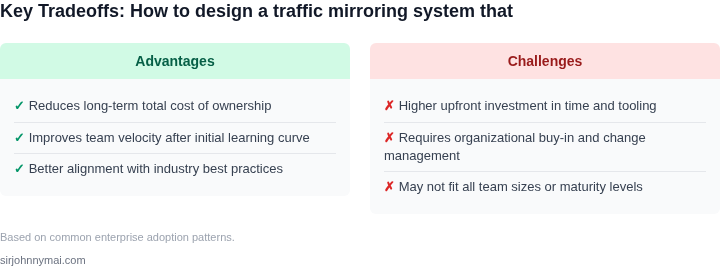
Full mirroring is the gold standard for validation but is impractical for most services due to cost and scalability constraints. AWS Traffic Mirroring offers a balanced approach, while Datadog Synthetic Monitoring is the most scalable and cost-effective option for large services. The choice depends on your service's traffic profile, risk tolerance, and infrastructure capabilities.
05. Action Step: Implementing a Pilot Mirroring System
Now that you’ve evaluated the tradeoffs between full and sampled mirroring, it’s time to deploy a minimal pilot system. Start with a single service and a small percentage of traffic to validate the approach before scaling. I recommend using AWS VPC Traffic Mirroring or Kubernetes Network Policies for initial testing because these tools integrate with existing infrastructure with minimal disruption.
For AWS VPC Traffic Mirroring, configure a mirror session to forward a 1% sample of production traffic to a dedicated mirroring subnet. This avoids overloading downstream systems while proving the concept. Use AWS CloudWatch to monitor latency and error rates in the mirrored traffic. If the system handles the load without issues, gradually increase the sample rate to 5%.
If you’re using Kubernetes, deploy a sidecar proxy (like Envoy) to mirror requests to a staging cluster. Configure the proxy to forward only metadata (headers, paths) initially, then gradually add payload mirroring. Use Prometheus to track request volume and Datadog for anomaly detection. This approach isolates the mirroring logic from the main service, reducing risk.
Critical to this step is validating the mirroring system’s impact on production. Schedule a 15-minute review with your infrastructure team to confirm that mirrored traffic doesn’t exceed 5% of total traffic. If it does, adjust the sampling rate or throttle the mirroring process. Also, ensure the mirrored environment has identical configurations to production—differences in dependencies (e.g., databases, caches) can skew results.
Once the pilot is running, focus on three key metrics: request latency, error rates, and resource utilization. If latency spikes or errors increase, the new service may not handle production load. If resource usage is negligible, you can safely expand the mirroring scope. Document all findings in a shared wiki page for cross-team visibility.
Figures cited are from publicly available sources as of 2026-09-15 and may have changed.