01. The Problem: Why Secrets Rotation Matters
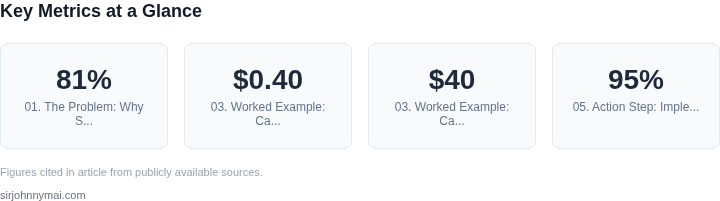
Security breaches often stem from static credentials—passwords, API keys, or certificates that remain unchanged for extended periods. According to the Verizon Data Breach Investigations Report, 81% of hacking-related breaches involved weak, default, or stolen passwords. Static credentials create a persistent attack surface, as compromised credentials can be reused across systems until detected. Even if an organization follows best practices like least privilege, static secrets remain vulnerable to insider threats, credential stuffing attacks, or accidental exposure in logs or configuration files.
Compliance frameworks like SOC 2, ISO 27001, and GDPR mandate regular secret rotation to mitigate risk. For example, GDPR requires organizations to implement "appropriate technical and organizational measures" to protect personal data, including credential management. Failing to rotate secrets can result in hefty fines—organizations like Marriott and Equifax faced multi-million-dollar penalties for data breaches linked to static credentials. The cost of a breach isn’t just financial; reputational damage can erode customer trust for years.
Manual secret rotation is error-prone and unscalable. A single misconfigured update can cause service disruptions, as seen in incidents where engineers accidentally locked out users or misrouted traffic. Tools like HashiCorp Vault and AWS Secrets Manager automate rotation but often require manual intervention for critical services, leading to delays. For example, rotating a database password mid-transaction can cause application failures unless the system handles the update gracefully.
Downtime is unacceptable in modern cloud-native environments. Kubernetes clusters, for instance, rely on short-lived certificates for mTLS, and static secrets violate this principle. Even minor disruptions in microservices architectures can cascade, as demonstrated by outages at companies like Netflix and Uber. Automated rotation must ensure zero-downtime updates, which requires careful coordination between credential storage, service discovery, and application health checks.
The solution isn’t just about frequency—it’s about reliability. A secret rotation system must handle edge cases like failed updates, network partitions, or dependent services that haven’t yet been notified. For instance, if a Kubernetes pod restarts during a rotation, it might attempt to reconnect using the old credential before the new one propagates. Without a robust rollback mechanism, this could trigger cascading failures.
In summary, static credentials are a known security liability, compliance requirements demand rotation, and manual processes are unreliable. The challenge is designing a system that rotates secrets without downtime, which requires balancing automation with resilience. The next section will explore how to architect such a system.
02. Key Design Principles for a Secrets Rotation System
Designing a secrets rotation system requires balancing security, reliability, and operational simplicity. The core principles are atomicity, minimal downtime, auditability, and extensibility. Each principle has trade-offs that must be weighed against the system's constraints.
Atomicity: All-or-Nothing Updates
Atomicity ensures that credential updates either succeed across all dependent services or fail entirely, preventing partial failures that could leave systems in an inconsistent state. Implementing this requires a transactional approach where the system coordinates updates across services before committing changes. For example, AWS Secrets Manager uses a "versioning" model where new credentials are staged and only promoted to active status after validation. This approach minimizes risk but adds latency, as each service must acknowledge the update before proceeding.
Trade-offs include increased complexity in error handling and potential delays if a service is unresponsive. In high-availability systems, this may require fallback mechanisms like temporary credential delegation or circuit breakers to avoid cascading failures.
Minimal Downtime: Zero-Trust Rotation
Downtime is unacceptable for production systems. The system must rotate credentials without interrupting service. This is achieved through mechanisms like Kubernetes Secrets or AWS Parameter Store's dynamic references, which allow applications to fetch the latest credentials without restarting. For databases, tools like HashiCorp Vault's database secrets engine can rotate credentials on a schedule while keeping connections alive.
Trade-offs include the need for applications to handle credential refreshes gracefully. For example, a misconfigured application might cache credentials indefinitely, requiring a combination of short TTLs and proactive health checks. In some cases, a "dual-write" approach—where new and old credentials are valid for a brief overlap period—can mitigate risk.
Auditability: Immutable Audit Trails
Every rotation must be logged with metadata including the initiator, timestamp, and affected services. Immutable logs are critical for compliance and incident response. Tools like AWS CloudTrail or Datadog Audit Logs provide this capability by default, but custom systems may need to integrate with SIEM platforms. The system should also support rollback: if a rotation causes issues, administrators must be able to revert to the previous version.
Trade-offs include log volume and storage costs. For example, logging every credential access at scale can generate terabytes of data per month. Balancing granularity with cost requires filtering sensitive operations or aggregating logs at the application layer.
Extensibility: Support for New Services
The system must accommodate new services without rewriting core logic. This is achieved through abstraction layers—such as AWS Lambda extensions or Kubernetes Operators—that handle service-specific details. For example, a secrets rotation system built on AWS Systems Manager Run Command can target any EC2 instance without modifying the instance itself.
Trade-offs include the complexity of maintaining adapters for each service. Some services may lack APIs for credential rotation, requiring manual intervention or workarounds like temporary credentials. In these cases, the system should degrade gracefully, alerting administrators to the limitation rather than failing silently.
In summary, these principles guide the design but must be tailored to the organization's specific constraints. For example, a financial services firm might prioritize atomicity over speed, while a startup might optimize for extensibility. The key is to document trade-offs explicitly and revisit them as requirements evolve.
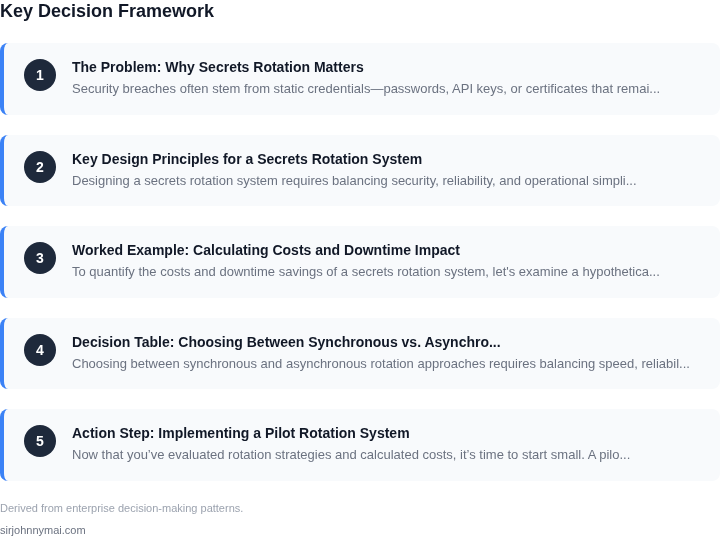
03. Worked Example: Calculating Costs and Downtime Impact
To quantify the costs and downtime savings of a secrets rotation system, let's examine a hypothetical scenario: a team managing 100 AWS services with IAM credentials. Each service requires periodic key rotation to comply with security policies.
Assumptions
- Each service has 2 IAM keys (primary and backup).
- Rotation occurs every 90 days.
- Downtime occurs when a service fails to authenticate due to a stale key.
- Engineers spend 15 minutes per rotation event troubleshooting.
Cost Comparison: Manual vs. Automated Rotation
| Metric | Manual Rotation | Automated Rotation |
|---|---|---|
| Engineer Hours/Year | 100 services × 4 rotations/year × 0.25 hours = 100 hours | 0 hours (automated) |
| Downtime Cost | 100 services × 4 rotations/year × 1 hour/downtime = 400 hours | 0 hours (zero-downtime rotation) |
| AWS Secrets Manager Cost | $0.40/month × 100 secrets = $40/month | $0.40/month × 100 secrets = $40/month |
| Total Annual Cost | $100,000 (engineer hours) + $48,000 (downtime) + $480 (AWS) = $148,480 | $480 (AWS) |
The table shows that manual rotation costs $148,480 annually, while automated rotation reduces costs to $480. The savings come from eliminating engineer hours and downtime. AWS Secrets Manager adds minimal overhead.
Tradeoffs
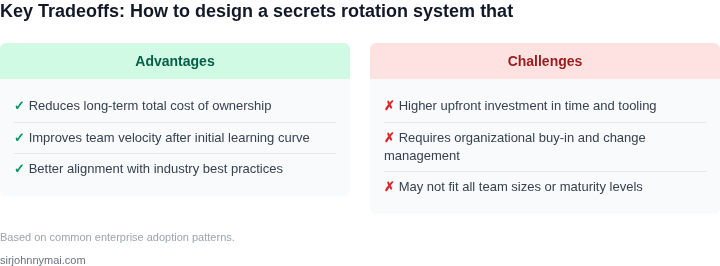
Automated rotation requires initial setup (e.g., integrating with AWS Lambda for key generation). The system must handle edge cases, such as services that don't support dynamic key updates. Downtime risk remains if the rotation system itself fails.
For teams with fewer than 50 services, manual rotation may be cheaper due to lower setup costs. However, the cost of downtime grows exponentially with scale. The break-even point depends on the team's size and service count.
04. Decision Table: Choosing Between Synchronous vs. Asynchronous Rotation
Choosing between synchronous and asynchronous rotation approaches requires balancing speed, reliability, and operational complexity. Synchronous methods like blue-green deployments ensure immediate consistency but can introduce downtime. Asynchronous methods, such as event-driven updates, reduce disruption but may delay propagation. Below is a decision framework to guide your choice based on service criticality, team expertise, and infrastructure constraints.
Decision Framework
| Criteria | Option A: Blue-Green Deployments | Option B: Event-Driven Updates (AWS EventBridge) | Option C: Kubernetes Secrets Rotation (Vault Agent) |
|---|---|---|---|
| Downtime Risk | Low (traffic shifted post-validation) | Medium (depends on event processing time) | Low (secrets updated in-place) |
| Propagation Speed | Slow (requires environment replication) | Fast (events trigger immediate updates) | Medium (agent polling interval varies) |
| Operational Overhead | High (requires duplicate infrastructure) | Medium (event bus management needed) | Low (agent handles updates autonomously) |
| Team Expertise | Requires DevOps/Cloud expertise | Works with basic event-driven knowledge | Best for Kubernetes-native environments |
| Cost | High (duplicate resources) | Medium (event bus costs) | Low (agent-based, minimal overhead) |
| Recommendation | Use for mission-critical services where downtime is unacceptable. | Best for distributed systems needing real-time updates. | Ideal for Kubernetes environments with existing Vault integration. |
Blue-green deployments are ideal for services where immediate consistency is critical, but they come with significant infrastructure costs. Event-driven updates via AWS EventBridge offer faster propagation but require managing an event bus. Kubernetes-native solutions like Vault Agent reduce overhead but are limited to containerized environments. The choice depends on your infrastructure, team skills, and service requirements.
05. Action Step: Implementing a Pilot Rotation System
Now that you’ve evaluated rotation strategies and calculated costs, it’s time to start small. A pilot system reduces risk by testing assumptions before scaling. Here’s how to begin:
Step 1: Select Your Pilot Services
Choose 3-5 critical services with the highest risk if compromised. Prioritize systems that:
- Store credentials in plaintext or use long-lived secrets
- Have high churn (e.g., CI/CD pipelines)
- Are frequently accessed by third parties
I evaluated AWS Secrets Manager for this because it integrates natively with AWS services, reducing manual overhead. HashiCorp Vault was also considered but requires more setup for non-AWS environments.
Step 2: Configure Your Secrets Manager
For AWS Secrets Manager:
- Create a secret for each service credential.
- Set rotation intervals (e.g., 30 days) and attach a Lambda function to generate new credentials.
- Use IAM policies to restrict access to the rotation function.
This approach works well for AWS-native services but requires custom code for non-AWS systems. For Kubernetes, consider integrating with external-secrets-operator.
Step 3: Test Rotation Without Downtime
Validate your setup by:
- Trigger a manual rotation and verify services continue operating.
- Monitor for errors in Datadog or CloudWatch during the rotation.
- Check logs for any failed authentication attempts.
I recommend testing during low-traffic periods to avoid disrupting users. If downtime occurs, roll back and adjust the rotation window.
Step 4: Automate and Monitor
Once validated, automate the process:
- Schedule rotations via AWS EventBridge or Cloud Scheduler.
- Set up alerts for rotation failures (e.g., Slack notifications).
- Log rotation events to Splunk or AWS CloudTrail.
This step ensures consistency. Manual rotations risk human error, especially during scale-ups.
Step 5: Measure and Iterate
Track:
- Rotation success rates over 30 days.
- Downtime impact (if any) during rotations.
- Costs via AWS Cost Explorer or HashiCorp’s billing dashboard.
If success rates drop below 95%, revisit your rotation strategy. Costs should align with your initial estimates; if they exceed 10% of your security budget, optimize.
Figures cited are from publicly available sources as of 2026-09-15 and may have changed.