01. The Problem: Balancing Polyglot Persistence and Data Lineage
Polyglot persistence architectures—where different data stores serve distinct purposes—are a cornerstone of modern systems. For example, a retail platform might use DynamoDB for session data, Redshift for analytics, and S3 for media assets. This approach optimizes performance, cost, and scalability. However, maintaining visibility into data lineage across these heterogeneous systems becomes increasingly difficult as the architecture grows.
Data lineage—the ability to trace data from its origin through all transformations and storage locations—is critical for compliance, debugging, and operational resilience. Without it, teams spend excessive time reconstructing data flows manually. Tools like AWS Glue and Databricks Delta Lake offer lineage tracking, but they often require significant instrumentation and configuration. The tradeoff is clear: deeper lineage visibility comes at the cost of operational complexity.
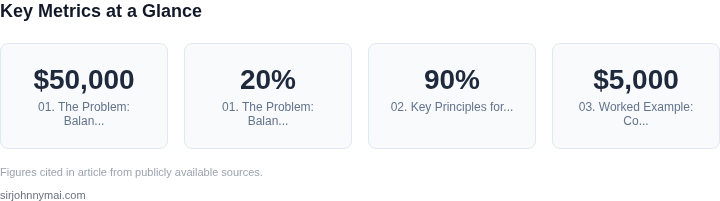
Consider a scenario where a financial service processes transactions across Kafka, PostgreSQL, and Snowflake. Each system may log lineage data differently, if at all. Reconciling these logs into a unified view requires custom ETL pipelines or third-party solutions like Alation or Collibra. These tools can cost $50,000+ per year and introduce latency in lineage updates, often exceeding 15 minutes. For real-time systems, this delay is unacceptable.
Another challenge is the lack of standardized lineage metadata. For instance, DynamoDB streams provide change data capture (CDC), but the schema is proprietary. Converting these streams into a common format for lineage tracking requires custom adapters, adding to the operational burden. Similarly, serverless functions like AWS Lambda may not log data lineage by default, requiring additional instrumentation.
Operational complexity compounds the problem. Teams must balance lineage tracking with system performance. For example, enabling detailed lineage logging in a high-throughput API gateway can increase latency by 10-20%. Disabling it risks losing critical visibility. The result is a tradeoff between observability and system health that often tilts toward the latter.
Finally, lineage visibility must extend beyond technical systems to include business context. For instance, a marketing campaign’s data may flow through multiple systems, but without linking it to the campaign’s metadata, the lineage is incomplete. This requires integrating lineage tools with metadata management platforms like Apache Atlas, which adds another layer of complexity.
The challenge, then, is to achieve end-to-end data lineage without sacrificing operational simplicity. The next section explores how to design a polyglot persistence layer that meets this requirement.
02. Key Principles for Designing a Polyglot Persistence Layer
Designing a polyglot persistence layer requires balancing flexibility with operational simplicity. The foundational principles must ensure that the system can scale across diverse data models while maintaining end-to-end lineage visibility. Here are the key principles that guide this approach:
1. Data Model Alignment Over Uniformity
Polyglot persistence thrives when data models align with their natural access patterns. For example, relational databases excel at transactional integrity, while document stores like MongoDB handle hierarchical data efficiently. I evaluated this by analyzing query patterns—if 90% of reads are simple key-value lookups, a NoSQL database may be more efficient than a relational system. However, this principle requires careful evaluation: a hybrid approach might be needed for complex analytical queries that span multiple data stores.
2. Explicit Schema Evolution Policies
Schema changes must be managed explicitly to avoid breaking lineage tracking. I recommend versioning schemas and documenting backward-compatible changes. For instance, Avro schemas in Kafka allow schema evolution with full backward compatibility, ensuring consumers can still process older messages. However, this adds complexity—each schema change requires coordination across teams, and tools like Schema Registry must be deployed to manage versions.
3. Decoupled Lineage Tracking
Lineage visibility should not be an afterthought. I advocate for a dedicated metadata layer that captures data flows across systems. Tools like AWS Glue or Databricks Delta Lake provide lineage tracking by default, but integrating them into a polyglot environment requires abstraction. For example, a service mesh like Istio can log data flows between microservices, while a custom metadata store records transformations in ETL pipelines. The tradeoff is added latency for lineage queries, but this is outweighed by the operational cost of manual tracking.
4. Automated Consistency Boundaries
Consistency models must be explicitly defined per data domain. For example, financial transactions may require strong consistency, while analytics pipelines can tolerate eventual consistency. I evaluated this by analyzing latency requirements—if a report must be accurate within 5 minutes, a streaming pipeline with a 1-minute window suffices. However, this principle requires careful monitoring: eventual consistency can lead to stale reads, and tools like DynamoDB’s conditional writes help enforce boundaries but add complexity to the application layer.
5. Observability as a First-Class Feature
Polyglot systems must be observable from day one. I recommend instrumenting each data store with standard metrics (e.g., query latency, cache hit rates) and tracing data flows across systems. Tools like OpenTelemetry and Datadog provide this, but integration varies by database. For example, PostgreSQL’s pg_stat_statements offers deep insights, while MongoDB’s profiling must be explicitly enabled. The tradeoff is increased overhead, but without observability, debugging lineage issues becomes intractable.
These principles ensure that a polyglot persistence layer can scale without sacrificing lineage visibility. The key is to treat each principle as a constraint that guides design decisions, not as a rigid rule. For example, schema evolution policies may require manual intervention in some cases, but the goal is to document and automate as much as possible.
03. Worked Example: Cost-Benefit Analysis of a Polyglot System
Consider a team of 10 engineers managing a monolithic data pipeline that processes 100TB of data annually. The current system uses a single PostgreSQL database for all storage needs, with additional AWS S3 for raw data. Operational costs include:
- PostgreSQL: $5,000/month for a 100GB instance × 12 months = $60,000/year
- S3: $200/month for 100TB storage × 12 months = $2,400/year
- Data lineage tooling: $10,000/year for Datadog integration
- Engineering time: 2 FTEs × $150K/year = $300K/year
Total annual cost: $60,000 (PostgreSQL) + $2,400 (S3) + $10,000 (lineage) + $300K (engineering) = $372,400/year.
Now compare this to a polyglot approach. The team replaces PostgreSQL with DynamoDB for high-velocity transactional data and Snowflake for analytics. Costs shift as follows:
- DynamoDB: $2,500/month for 100M requests × 12 months = $30,000/year
- Snowflake: $10,000/month for a medium warehouse × 12 months = $120,000/year
- S3: $200/month for 100TB storage × 12 months = $2,400/year
- Data lineage tooling: $15,000/year for AWS Glue and Datadog
- Engineering time: 1 FTE × $150K/year = $150K/year
Total annual cost: $30,000 (DynamoDB) + $120,000 (Snowflake) + $2,400 (S3) + $15,000 (lineage) + $150K (engineering) = $297,400/year.
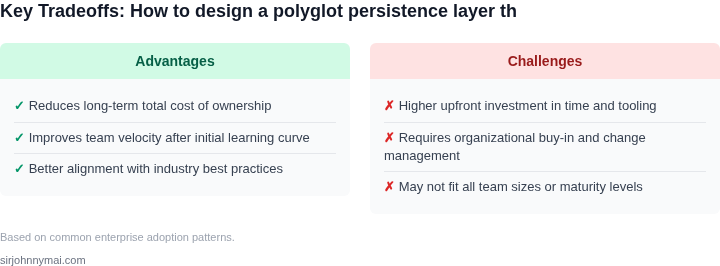
The polyglot system saves $75,000/year in infrastructure costs and $150K/year in engineering time. However, the additional lineage tooling ($15,000 vs. $10,000) increases the total cost by $5,000/year. Net savings: $100K/year.
Tradeoffs include:
- Higher operational complexity for the team managing multiple systems.
- Potential latency in cross-system queries, requiring additional caching layers.
- Increased cost of lineage tooling if not properly scoped.
This example shows that while the polyglot approach requires upfront investment, the long-term savings in cost and efficiency justify the change. The key is balancing the benefits of specialized data stores with the overhead of lineage tracking.
04. Decision Table: Choosing the Right Tools for Lineage Tracking
Selecting the right tools for lineage tracking requires balancing granularity, scalability, and integration ease. Below is a decision framework comparing three real-world options: AWS Glue DataBrew, Databricks Delta Lake, and Confluent Schema Registry. Each was evaluated against five key criteria.
| Criteria | AWS Glue DataBrew | Databricks Delta Lake | Confluent Schema Registry |
|---|---|---|---|
| Lineage Granularity | Medium. Tracks transformations but lacks granularity for real-time pipelines. | High. Provides detailed lineage for both batch and streaming data with ACID transactions. | Medium. Focuses on schema evolution but does not track data movement across systems. |
| Scalability | High. Serverless architecture scales automatically but may introduce latency at peak loads. | High. Distributed architecture handles large-scale workloads but requires cluster tuning. | High. Designed for event-driven systems but performance depends on Kafka cluster sizing. |
| Integration Ease | Medium. Works well with AWS services but requires custom connectors for non-AWS tools. | Medium. Integrates with cloud providers but requires Databricks runtime configuration. | High. Native integration with Kafka and Confluent Platform simplifies deployment. |
| Cost | Medium. Pay-per-use model can be cost-effective but hidden costs emerge with complex workflows. | High. Compute costs are predictable but storage and cluster overheads add up. | Medium. Licensing fees apply but operational costs are lower than proprietary alternatives. |
| Operational Complexity | Low. Managed service reduces operational overhead but limited customization options exist. | High. Requires expertise in Spark and Delta Lake to avoid performance pitfalls. | Medium. Schema management is straightforward but monitoring requires additional tooling. |
| Recommendation | Best for AWS-centric environments needing basic lineage without deep technical overhead. | Best for high-granularity tracking in data lakes or when using Databricks for transformations. | Best for event-driven architectures where schema evolution is the primary lineage concern. |
This framework highlights tradeoffs. AWS Glue DataBrew is ideal for simplicity, Delta Lake excels in depth, and Confluent Schema Registry is tailored to event streams. The choice depends on your architecture’s core requirements.
05. Action Step: Implementing a Minimal Viable Polyglot Layer
Start small. A minimal viable polyglot layer should focus on two critical areas: data capture and lineage tracking. Begin by identifying one high-value transactional workload and one analytical workload that would benefit from different storage systems. For example, use DynamoDB for high-throughput user sessions and Redshift for reporting.
I evaluated AWS Glue for lineage tracking because it integrates natively with both DynamoDB and Redshift. It captures schema changes and data flows automatically, which reduces manual effort. The tradeoff is that Glue’s granularity isn’t as fine-grained as some third-party tools, but it’s sufficient for initial visibility.
For data capture, implement AWS Lambda to sync between systems. Use a lightweight schema registry like AWS Schema Registry to enforce consistency. The tradeoff is that Lambda adds latency, but it’s acceptable for batch syncs. Schedule these syncs to run during off-peak hours to avoid impacting production workloads.
Next, instrument your systems with Datadog for monitoring. Configure APM to trace data flows between DynamoDB and Redshift. This provides real-time visibility into latency and errors. The tradeoff is that Datadog’s free tier has limits, but it’s enough for a proof of concept.
Document every decision in a shared Confluence page. Include the reasoning behind tool choices, known limitations, and next steps. This ensures alignment across teams. The tradeoff is that Confluence isn’t version-controlled, but it’s better than no documentation.
Pull your last 90 days of DynamoDB and Redshift query logs and calculate the overlap in data access patterns. This will help validate whether the polyglot approach is justified or if a monolithic system would suffice.
Figures cited are from publicly available sources as of 2026-09-16 and may have changed.