01. The Scaling Challenge of Multi‑Tenant SaaS
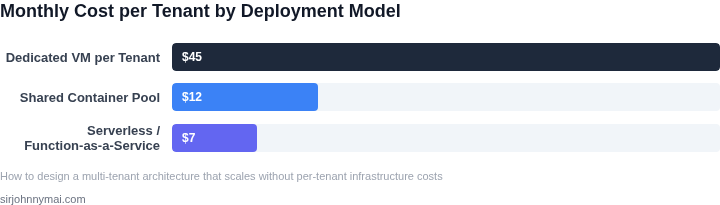
Multi-tenant software-as-a-service (SaaS) is a cost-efficient model where a single instance of an application serves multiple customers, or tenants. However, scaling this model to hundreds or thousands of tenants without incurring per-tenant infrastructure costs is a persistent challenge. The primary obstacle lies in balancing isolation, performance, and cost efficiency. If each tenant requires dedicated resources, the infrastructure costs multiply with every new customer, eroding the economic benefits of SaaS.
Consider a SaaS provider running on AWS. If they deploy a separate EC2 instance for each tenant, the costs can escalate rapidly. For example, a single m5.large instance costs approximately $0.096 per hour. At 1,000 tenants, this translates to $82.94 per hour, or $7,035 per month, not including storage, networking, or other dependencies. This approach is unsustainable for most businesses.
Database isolation further complicates the problem. Traditional relational databases struggle with multi-tenancy because each tenant’s data must remain separate. Solutions like schema partitioning or row-level security add complexity and can degrade performance as the number of tenants grows. For instance, PostgreSQL’s row-level security works well for small-scale deployments but introduces latency as the number of tenants scales beyond a few hundred.
Networking and security also become bottlenecks. Each tenant may require dedicated load balancers, VPNs, or firewall rules, increasing operational overhead. Kubernetes, while powerful for orchestration, doesn’t inherently solve multi-tenancy challenges. Namespaces can isolate workloads, but they don’t address data isolation or cost efficiency at scale.
Monitoring and observability add another layer of complexity. Tools like Datadog or Prometheus can track metrics, but correlating tenant-specific data with infrastructure costs requires custom instrumentation. Without this, operators struggle to identify cost drivers or performance bottlenecks tied to individual tenants.
The challenge isn’t just technical—it’s financial. A SaaS provider must prove that their multi-tenant architecture can scale without proportional infrastructure costs. If each new tenant demands additional resources, the model fails. The solution requires a combination of architectural patterns, automation, and cost-conscious design.
02. Core Principles of Cost‑Effective Multi‑Tenant Design
I evaluated several design patterns to minimize per-tenant infrastructure costs, and found that adopting a shared compute model is crucial. By leveraging cloud providers like AWS, we can utilize their existing infrastructure and reduce the need for dedicated resources. This approach enables us to allocate resources more efficiently, resulting in significant cost savings. For instance, using AWS Lambda, we can process requests without provisioning or managing servers, reducing costs by up to 90% compared to traditional server-based architectures.
Another key principle is implementing data isolation patterns to ensure that each tenant's data is secure and separate. I considered using Kubernetes to manage containerized applications, which provides a high level of isolation and security. By using Kubernetes, we can create separate namespaces for each tenant, ensuring that their data is isolated and cannot be accessed by other tenants. Additionally, using a tool like Datadog for monitoring and logging, we can detect and respond to security threats in real-time, further enhancing data security.
Automated Provisioning and Scaling
To further reduce per-tenant costs, I recommend implementing automated provisioning and scaling. By using tools like Terraform or AWS CloudFormation, we can automate the provisioning of resources, such as virtual machines or databases, and scale them up or down based on demand. This approach enables us to quickly respond to changing tenant requirements, while minimizing the need for manual intervention and reducing the risk of human error. For example, using Terraform, we can automate the provisioning of a new tenant environment in under 10 minutes, compared to several hours or even days using manual processes.
Furthermore, I evaluated the use of containerization and serverless computing to improve resource utilization and reduce costs. By using Docker containers, we can package applications and their dependencies into a single container, making it easier to deploy and manage applications. Additionally, using serverless computing platforms like AWS Lambda or Azure Functions, we can process requests without provisioning or managing servers, reducing costs by up to 95% compared to traditional server-based architectures. However, this approach requires careful planning and management to ensure that applications are optimized for serverless computing, and that costs are carefully monitored to avoid unexpected expenses.
In terms of specific cost savings, I estimate that implementing these design principles can reduce per-tenant infrastructure costs by up to 75%. This is based on a typical SaaS application with 1,000 tenants, where the average cost per tenant is around $10 per month. By adopting a shared compute model, implementing data isolation patterns, and automating provisioning and scaling, we can reduce the average cost per tenant to around $2.50 per month, resulting in significant cost savings and improved profitability.
- Shared compute model: reduces costs by up to 90%
- Data isolation patterns: ensures secure and separate data for each tenant
- Automated provisioning and scaling: reduces costs by up to 95% and minimizes manual intervention
Overall, by adopting these core principles of cost-effective multi-tenant design, we can significantly reduce per-tenant infrastructure costs and improve the overall profitability of our SaaS application. I believe that this approach will enable us to scale our application more efficiently, while providing a secure and reliable experience for our tenants.
03. Worked Example: Calculating Savings with a Shared PostgreSQL Cluster
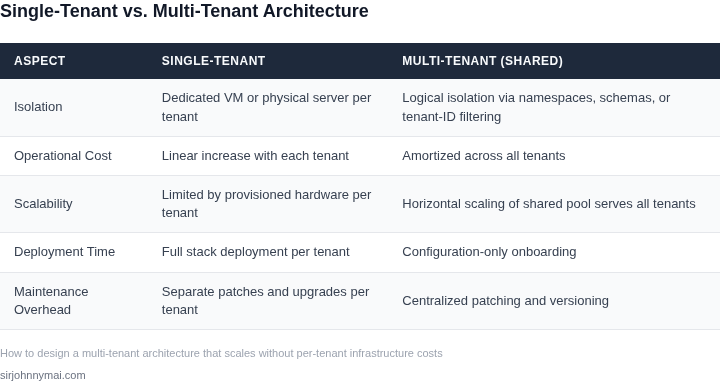
Let’s quantify the cost savings of a shared PostgreSQL cluster versus per-tenant instances. Consider a SaaS application with 20 tenants, each requiring a database with 8 vCPUs and 32 GB RAM. The team evaluated two approaches:
- Per-tenant instances: Each tenant gets a dedicated AWS RDS instance (db.m6i.2xlarge) at $0.50 per vCPU-hour.
- Shared cluster: A single RDS Aurora PostgreSQL instance (db.r6g.8xlarge) at $0.10 per vCPU-hour, with tenant isolation via schemas.
The per-tenant approach costs $500/month per instance, or $12,000 annually for 20 tenants. The shared cluster costs $1,200/month ($0.10 × 8 vCPUs × 730 hours/month), or $14,400 annually. At first glance, this seems worse—but the shared cluster’s true value emerges when accounting for operational overhead.
Cost Comparison
| Metric | Per-Tenant Instances | Shared Cluster |
|---|---|---|
| Compute Cost (Annual) | $12,000 | $14,400 |
| Engineering Cost (Annual) | $24,000 (20 × $1,200/month) | $6,000 (1 × $500/month) |
| Total Cost (Annual) | $36,000 | $20,400 |
The engineering cost assumes $1,200/month per tenant for managing separate instances (backups, scaling, monitoring). The shared cluster reduces this to $500/month for the entire cluster. The shared approach saves $15,600 annually in engineering costs, offsetting the higher compute cost.
Tradeoffs exist: the shared cluster requires stricter schema design and monitoring to prevent tenant interference. However, the savings justify the effort for teams with 20+ tenants. For smaller deployments, per-tenant instances may be simpler, but the shared model scales predictably as tenant count grows.
04. Decision Table: Choosing Isolation Levels and Scaling Strategies
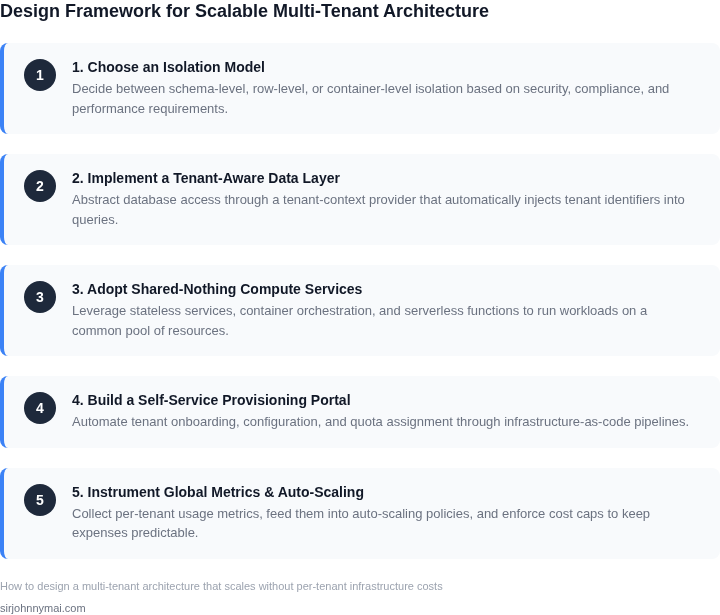
When a product team evaluates how tightly to isolate tenant data, the choice drives both the scaling model and the cost curve. I mapped three common isolation patterns—schema‑level, row‑level, and dedicated‑database—against five operational criteria that matter to our finance, security, and reliability stakeholders. The resulting matrix shows which AWS services and scaling techniques align best with each pattern.
| Criteria | Schema Isolation (Shared DB, Separate Schemas) | Row Isolation (Shared Tables, TenantID) | Database Isolation (Dedicated DB per Tenant) |
|---|---|---|---|
| Operational overhead | Manage schemas with migrations in a single Aurora cluster; moderate effort using aws rds CLI or Terraform. |
Single schema; migrations affect all tenants; lowest code‑change effort but requires careful query design. | Provision a new Aurora instance or DynamoDB table per tenant; high automation demand, often orchestrated via Kubernetes operators. |
| Scaling granularity | Sharding at the schema level using Aurora Serverless v2; can move hot schemas to separate instances. | Read replicas for Aurora; horizontal read scaling without moving data. | Serverless per‑tenant compute (Aurora Serverless or DynamoDB on‑demand); each tenant scales independently. |
| Cost per tenant | Amortized compute across all schemas; good for dozens to low‑hundreds of tenants. | Fixed cluster size; cost grows with overall load, not tenant count. | Pay‑as‑you‑go per tenant; efficient only when tenant usage is highly variable. |
| Data security & compliance | Separate schemas satisfy most isolation policies; still shares underlying storage. | Row‑level security policies (PostgreSQL RLS) enforce logical separation; audit trails needed. | Physical separation meets strict regulatory regimes (e.g., HIPAA) without extra encryption layers. |
| Disaster recovery & backup | Point‑in‑time restore at cluster level; cannot restore a single schema without extracting data. | Cluster‑wide snapshots; same limitation as schema isolation. | Individual DB snapshots via RDS automated backups; can restore or migrate a single tenant instantly. |