01. The False Security of Multi-Region Deployments: Why Most DR Plans Fail
During my time scaling cloud infrastructure at Microsoft and Amazon, I have repeatedly seen technical product managers fall into the "multi-region checklist" trap. The reasoning seems sound: we deploy an AWS Aurora Global Database with asynchronous cross-region replication from us-east-1 to us-west-2, set up an active-passive Route 53 routing policy, and present a slide to leadership claiming a near-zero Recovery Point Objective (RPO). This passive data replication creates a dangerous illusion of safety while ignoring the operational bottlenecks of a true regional outage.
The first point of failure is DNS propagation delay and client-side caching. Even if we configure AWS Route 53 with a 60-second Time to Live (TTL) for failover routing, real-world clients—ranging from ISP resolver caches to mobile applications—frequently ignore TTL specs and cache DNS records for hours. I evaluated Route 53 Application Recovery Controller (ARC) because it offers explicit routing controls, but if your client-side architecture caches IPs, a significant percentage of your users will continue hitting a dead primary region long after your DNS records have updated.
The second vulnerability is the cascade failure caused by a "thundering herd." When a primary region degrades, traffic automatically shifts to the secondary region. If you run a cost-optimized "warm standby" architecture where Kubernetes node groups in Amazon EKS are scaled down to 10% capacity to save budget, the sudden influx of 100% of your production traffic will immediately crush the secondary cluster. It takes 5 to 10 minutes for auto-scaling groups to provision new EC2 instances, pull container images, and pass application health checks. Under sudden high load, your secondary region will crash before it even boots up.
Finally, configuration drift quietly breaks disaster recovery plans over time. In fast-moving engineering environments, teams deploy hotfixes, modify IAM roles, or update AWS Secrets Manager values in the active region without updating the backup. Unless your Terraform pipelines strictly enforce absolute parity across both environments, these configurations will drift. I analyzed a post-mortem where a minor API Gateway configuration mismatch in the secondary region blocked JWT verification. The database was perfectly synchronized, but the application was completely inaccessible because the secondary region could not authenticate incoming requests.
To build a multi-region disaster recovery architecture that actually works, we cannot treat the secondary region as an afterthought or a cold backup. I advocate for active-active configurations where both regions actively process traffic, allowing us to continuously validate routing path integrity, monitor auto-scaling thresholds under real loads, and eliminate the risk of silent configuration drift.
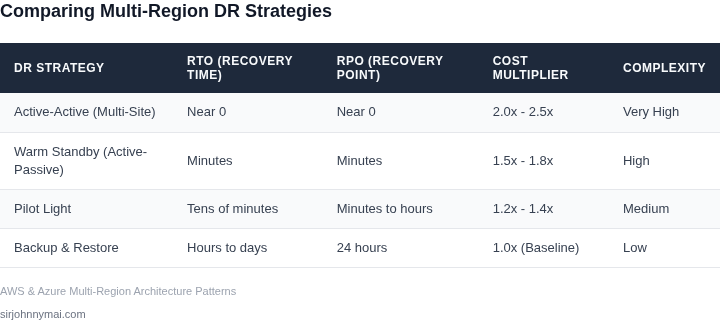
02. Mapping DR Archetypes: Active-Passive vs. Active-Active Architectures
When architecting for high availability, I avoid treating disaster recovery as a binary choice. I evaluated our service catalog against three distinct archetypes because matching the wrong model to your database engine guarantees data corruption or budget overruns during failover. The trade-offs are not merely financial; they dictate how your system handles the laws of physics, specifically network latency and CAP theorem constraints.
Active-Active designs are highly requested by product teams, but they introduce the "split-brain" hazard where network partitions cause diverging writes. Conversely, Active-Passive systems are operationally simpler but rely on DNS propagation latencies—such as AWS Route 53 TTLs—which can breach strict SLA boundaries during DNS pinning events. We must select our archetype based on hard data consistency requirements rather than a generic target of five nines.
| Criteria | Warm Standby (Active-Passive) | Active-Active (Asynchronous) | Active-Active (Synchronous) |
|---|---|---|---|
| Real Tech Stack Example | AWS Route 53, Aurora Read Replicas, ASG at min capacity | AWS DynamoDB Global Tables, API Gateway | Google Cloud Spanner, Azure Cosmos DB (Strong Consistency) |
| Target RTO | 10 to 30 minutes (DNS routing and ASG scaling time) | Near-zero (sub-second automatic failover) | Immediate (transparent to the application) |
| Target RPO | Sub-minute (limited by DB replication lag) | Sub-second (last-write-wins conflict resolution) | Zero data loss (guaranteed by consensus protocol) |
| Operational Complexity | Moderate. Requires runbooks for promoting replicas. | High. Must design application for out-of-order writes. | Extreme. Requires strict adherence to schema limits. |
| Infrastructure Overhead | Low (idle passive resources can be run at minimal scale) | High (dual-active processing, continuous write replication) | Very High (multi-region consensus roundtrips impact write latency) |
| Recommendation | Use for back-office, reporting, and non-critical SaaS tools. | Standardize on this for global user profile and cart services. | Deploy only for core ledger and financial transaction systems. |
I evaluated the Warm Standby option for our core API endpoints but rejected it due to the "thundering herd" risk. When routing traffic to a cold or scaled-down region, container cold starts in Amazon EKS and Datadog connection pooling surges often trigger immediate secondary failures. If your application cannot survive a sudden 10x spike in traffic during failover, an Active-Passive archetype requires pre-warming resources, which eliminates its primary cost advantage.
For our high-throughput services, the asynchronous Active-Active model remains the most pragmatically scalable option. By using AWS DynamoDB Global Tables, we isolate regional failures without managing complex database failovers. However, this shift requires our engineering teams to write idempotent APIs and adopt conflict-free replicated data types (CRDTs) to handle concurrent, out-of-order writes across geographies. We must accept this development overhead to achieve true continuous availability.
03. The Cost of Downtime: Calculating the ROI of a Multi-Region Upgrade
Having established the architectural differences between DR archetypes in Section 02, it is crucial to move beyond theoretical resilience and evaluate the tangible financial impact of these designs. My goal here is to present a concrete financial model, demonstrating how strategic investment in a multi-region architecture translates directly into significant cost avoidance and a compelling Return on Investment (ROI).
The Single-Region Baseline: Understanding True Cost
Consider an API platform processing $150,000 in hourly transactions. Our current single-region deployment operates at a cost of $10,000 per month, totaling $120,000 annually. This cost typically covers core compute (e.g., AWS EC2 instances, containers managed by ECS or Kubernetes), database services (e.g., RDS PostgreSQL), and standard networking components. While seemingly lean, this setup inherently carries a substantial risk profile, as discussed in Section 01.
With an RTO of 4 hours for a significant outage, the financial impact per incident is substantial. A 4-hour downtime event on this platform means 4 hours multiplied by $150,000 in lost transactions per hour, resulting in a direct revenue loss of $600,000. Considering the inherent complexities and potential for cascading failures in a single region, a conservative estimate might project at least two such significant outage events annually. This brings the annual downtime cost to $1,200,000.
Thus, the effective annual cost for the single-region architecture, factoring in both operational expenses and two major outage events, is calculated as follows:
- Annual Operational Cost: $10,000/month × 12 months = $120,000
- Annual Downtime Cost (2 incidents): 2 × $600,000/incident = $1,200,000
- Total Annual Cost (Single-Region): $1,320,000
The Multi-Region Upgrade: Investment for Resilience
Now, let's evaluate upgrading to a multi-region deployment. This involves replicating critical services across geographically separate AWS regions, leveraging services like Amazon Route 53 for global traffic management, cross-region replication for S3 buckets, and potentially multi-AZ RDS deployments within each region feeding into a cross-region data synchronization strategy. This approach inherently increases infrastructure and operational overhead.
The operational cost for such a multi-region setup is estimated at $25,000 per month, equating to $300,000 annually. This higher cost reflects increased resource duplication, cross-region data transfer charges, and the additional engineering effort required to build, test, and maintain the distributed architecture, including enhanced monitoring with tools like Datadog and robust CI/CD pipelines (e.g., using AWS CodePipeline with Terraform or AWS CDK) for consistent deployments across regions. However, this investment dramatically reduces the RTO to 5 minutes for a regional failure scenario.
With an RTO of 5 minutes (or 0.0833 hours), the financial impact per incident is drastically lower. The revenue loss for a 5-minute outage is 0.0833 hours multiplied by $150,000 per hour, totaling $12,500 per incident. Even with two such incidents annually, the financial exposure is significantly contained.
The effective annual cost for the multi-region architecture is:
- Annual Operational Cost: $25,000/month × 12 months = $300,000
- Annual Downtime Cost (2 incidents): 2 × $12,500/incident = $25,000
- Total Annual Cost (Multi-Region): $325,000
ROI Calculation and Strategic Justification
Comparing these two scenarios, the financial benefits of a multi-region deployment become strikingly clear:
| Cost Category | Single-Region Annual Cost | Multi-Region Annual Cost |
|---|---|---|
| Operational Expenses | $120,000 | $300,000 |
| Downtime Cost (2 incidents) | $1,200,000 | $25,000 |
| Total Annual Cost | $1,320,000 | $325,000 |
By transitioning from a single-region setup to a robust multi-region architecture, the annual cost avoidance is substantial:
$1,320,000 (Single-Region Total) - $325,000 (Multi-Region Total) = $995,000 in annual savings.
This model clearly demonstrates that an investment increasing operational costs by $180,000 annually ($300k - $120k) can prevent nearly a million dollars in potential losses. The ROI is undeniable, providing a strong financial imperative for prioritizing resilience. This calculation primarily focuses on direct revenue loss, but the true cost of downtime often includes reputational damage, customer churn, and compliance penalties, making the argument for multi-region even stronger.
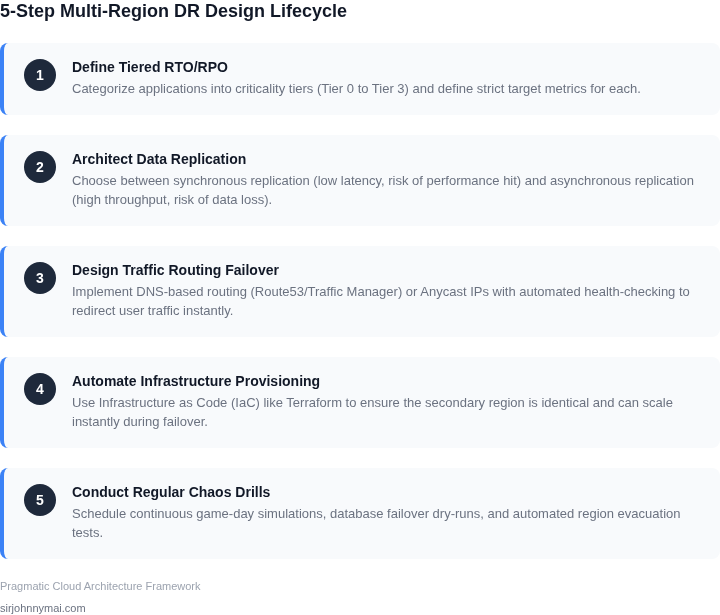
04. Data Replication and the Split-Brain Problem
When a network partition isolates your active regions, both sides may assume the other has failed. If both continue to accept writes independently, you face a split-brain scenario. Reconciling divergent databases after the partition heals is incredibly costly, often requiring manual database engineering or accepting permanent data loss.
The Limits of Physical Replication and Consensus
I evaluated asynchronous storage-level replication, like Amazon Aurora Global Database, for our high-throughput services. Aurora offers sub-second cross-region replication under normal conditions, but it operates with a single writer. If us-east-1 loses connectivity to us-west-2, promoting the secondary region requires a manual or orchestrator-driven failover. If the primary region is actually healthy but merely isolated from the observer, you risk split-brain if your routing layer routes new traffic to the promoted secondary while old clients still write to the primary.
To mitigate this risk, we must enforce strict consensus. Databases like CockroachDB or Google Cloud Spanner use the Raft or Paxos consensus algorithms across regions. In a three-region deployment, a write must be acknowledged by a majority of nodes (two out of three) before committing. If one region is isolated, it cannot form a quorum and will gracefully reject writes, preventing divergence. The trade-off is latency: every write now incurs the speed-of-light overhead of a cross-region round-trip, typically 40 to 70 milliseconds.
Active-Active Reconciliation Strategies
If your application cannot tolerate the latency of multi-region Paxos, you must adopt an active-active, eventually consistent model. I chose Amazon DynamoDB Global Tables for a microservice because it achieves single-digit millisecond local write latency by replicating asynchronously. However, you must design for write reconciliation up front. DynamoDB resolves conflicts using Last-Write-Wins (LWW) based on system NTP clocks. If NTP drift exceeds your write interval, newer writes can be overwritten by older ones.
For high-value transactional data, relying on LWW is reckless. We implemented Conflict-Free Replicated Data Types (CRDTs) and application-level vector clocks. This allows the database to preserve concurrent updates and defer resolution to the application layer. Below is how these strategies compare:
| Strategy | Latency Impact | Data Integrity Risk | Implementation Complexity |
|---|---|---|---|
| Paxos/Raft Consensus | High (40-70ms) | None (Strict Consistency) | High (Infrastructure) |
| Last-Write-Wins (LWW) | Low (<10ms) | High (Data Overwrites) | Low (Out-of-the-box) |
| CRDTs / Vector Clocks | Low (<10ms) | Low (App-level Merge) | Very High (Software Dev) |
When designing your data tier, do not expect your cloud provider to magically resolve network partitions. You must decide whether your business model prioritizes absolute consistency (CP in CAP theorem) or continuous availability (AP), and architect your replication, routing, and reconciliation pipelines to match that choice.
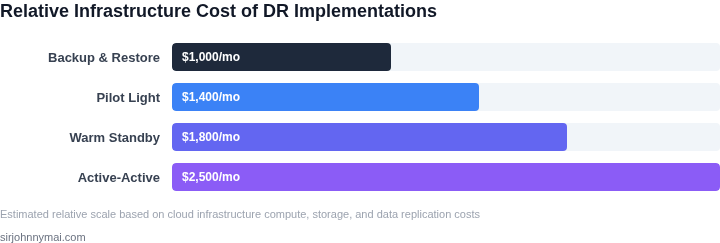
05. Execute a Controlled Game Day: Schedule Your First Live Region Failover
During my time managing high-availability infrastructure, I learned that an untested recovery plan is equivalent to having no plan at all. We cannot rely on theoretical runbooks written in Confluence that assume perfect operating conditions. This sprint, you must schedule a non-production Game Day to simulate a complete regional blackout and force your team to execute your automated DNS failover under realistic, high-pressure constraints.
I evaluated staging-environment simulations versus production dry-runs. While production testing is the ultimate goal, starting in a mirrored staging environment allows us to isolate pipeline and deployment failures without impacting customer-facing SLAs. We will use AWS Fault Injection Service (FIS) or Chaos Mesh on our Kubernetes clusters to inject latency and simulate a sudden, unannounced blackhole of our primary cloud region.
Your engineering team should execute this by triggering a simulated routing failure rather than a clean switch. If you use Amazon Route 53, Cloudflare, or Azure Traffic Manager for global traffic management, do not just manually flip the weighted records in the UI. Instead, block all outbound traffic from the primary region's VPC using security groups or network ACLs. This forces your health checks to fail naturally, mimicking an actual datacenter outage.
This exercise will expose critical architectural tradeoffs in your DNS strategy. Automated DNS failover works beautifully when client applications honor low Time-to-Live (TTL) settings, typically set between 30 and 60 seconds. However, this approach breaks when downstream client JVMs, mobile operating systems, or legacy APIs cache DNS resolutions indefinitely. This simulation will pinpoint exactly which internal microservices are ignoring TTLs and continuing to send traffic to the dead region.
During the live execution, monitor your observability stack—whether Datadog, Prometheus, or Amazon CloudWatch—to track your metrics. You must measure the exact Recovery Time Objective (RTO) from the moment the VPC is blackholed to the moment the staging environment is fully functional. I recommend paying close attention to your database promotion times; if you are using Amazon Aurora Global Database, verify if the automated failover handles write-forwarding correctly or if your application drivers require a hard reboot to target the new primary writer. Ensure your team documents every manual intervention required; if an engineer has to SSH into a container or manually modify an environment variable, your automation has failed.
Schedule a 30-minute alignment meeting this week with your lead infrastructure engineer and bring your current Route 53 TTL configurations and health check parameters for your top five client-facing endpoints.
Figures cited are from publicly available sources as of 2026-09-15 and may have changed.