01. The Problem: Data Drift in Data Lakehouses
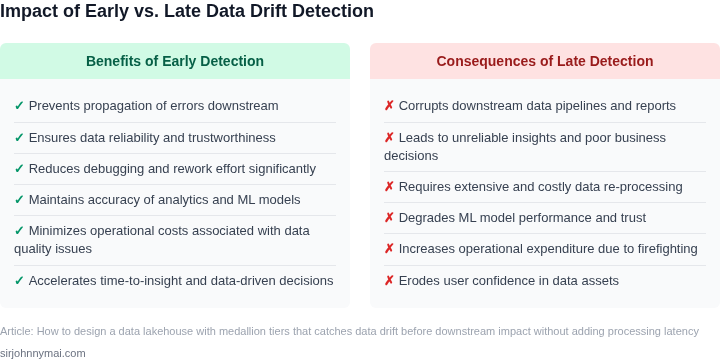
Data drift in a data lakehouse environment represents a persistent and often insidious challenge that directly impacts data reliability and the value derived from analytical assets. Unlike traditional data warehouses with their rigid schema-on-write paradigms, data lakehouses, leveraging technologies like AWS S3 with formats such as Apache Parquet or Delta Lake, embrace flexibility through schema-on-read. This flexibility, while beneficial for ingesting diverse and semi-structured data, also makes them highly susceptible to various forms of drift: schema drift (e.g., a column being dropped or its data type changing from string to integer), semantic drift (e.g., changes in the meaning of enumerated values without schema alteration), or data distribution drift (e.g., the statistical properties of a column shifting significantly due to underlying process changes). The typical medallion architecture—comprising Bronze (raw), Silver (cleaned/conformed), and Gold (aggregated/modeled) tiers—exacerbates the problem without proactive measures. Data ingested into the Bronze layer, often directly from external sources via tools like Fivetran or Stitch, is highly susceptible to upstream changes. A vendor might update their API, introducing a new field, changing an existing one's format, or even subtly altering data generation logic. When such a drift occurs in the Bronze tier, it inevitably propagates. Transformations in the Silver layer, perhaps orchestrated via AWS Glue or Databricks notebooks using Apache Spark, may fail outright due to unexpected schema mismatches, or worse, silently process incorrect data if the change is semantic, not structural. The consequences of undetected data drift are severe and far-reaching across downstream consumers. Machine learning models, particularly those in critical production systems like personalized recommendations or fraud detection, are highly vulnerable. If the distribution of input features shifts unnoticed, model performance can degrade significantly, leading to a drop in accuracy by 1-2 percentage points which for large-scale Amazon systems could translate to millions in foregone revenue or increased operational risk. Similarly, business intelligence dashboards and operational reports, often consuming data from the Gold layer, will display inaccurate metrics. Imagine a key performance indicator like "customer lifetime value" being miscalculated for weeks, leading to flawed strategic decisions based on outdated or incorrect assumptions about customer behavior. Beyond accuracy, undetected drift imposes significant operational latency and inefficiency. Reactive detection, often through downstream pipeline failures or manual data validation, necessitates extensive debugging and re-processing. Data engineers frequently spend 20-30% of their time on reactive data quality issues, tracing lineage through platforms like Apache Atlas or AWS Lake Formation to pinpoint the origin of the drift. Re-processing large datasets across multiple medallion tiers on compute-intensive platforms like Databricks or AWS Glue can incur substantial costs, potentially thousands of dollars per incident in compute alone, not accounting for the engineering hours. This delays critical insights, impacts service level agreements for data delivery, and erodes trust in the data platform as a reliable source of truth. The inherent flexibility of the lakehouse, while powerful, demands robust, proactive drift detection to avoid becoming a source of systemic fragility.02. Medallion Architecture for Drift Detection
The core of a robust data lakehouse designed for proactive drift detection lies in a well-structured medallion architecture. This tiered approach, encompassing Bronze, Silver, and Gold layers, segments data processing stages, allowing for precise control over data quality and schema governance without introducing significant processing overhead. I evaluated this model against flatter structures and found its inherent separation of concerns critical for isolating data quality issues early. It establishes clear data contracts at each transition point, which is fundamental for catching drift effectively.
Bronze Tier: The Immutable Foundation
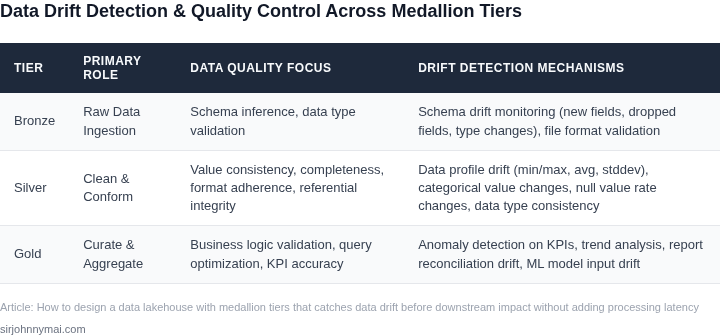
The Bronze tier serves as the landing zone for all raw, immutable data, directly ingested from source systems. Our objective here is to capture data as-is, preserving its original structure and content, often in formats like JSON, CSV, or XML, before converting to more efficient columnar formats such as Apache Parquet or Apache ORC for storage on Amazon S3. This initial ingestion phase includes rudimentary schema inference to understand the incoming data's basic structure, establishing a baseline. While minimal transformations occur, robust metadata capture, including timestamps and source system identifiers, is paramount here.
This layer acts as the absolute source of truth and a crucial immutable ledger. If we ever need to reprocess data due to downstream issues or evolving business logic, we can always revert to the raw, untampered data in Bronze. Any changes in the source system's output—be it new columns, altered data types, or missing fields—are first observed and recorded at this boundary. For example, a new API version might introduce an optional field, which would initially appear in Bronze as a nullable column.
Silver Tier: Conforming and Detecting
Moving from Bronze to Silver, data undergoes significant cleaning, standardization, and enrichment, becoming the "single source of truth" for core business entities. This tier applies enterprise-wide business rules, handles data type conversions, deduplicates records, and resolves inconsistencies using tools like AWS Glue DataBrew or custom Apache Spark jobs. Crucially, the Silver layer is where active drift detection is systematically implemented as an integrated part of the pipeline, not an afterthought.
We enforce a well-defined and governed schema at this stage, using features like Delta Lake's schema enforcement or Apache Iceberg's schema evolution capabilities. When incoming Bronze data deviates from the expected Silver schema—a new column appears, an existing column's data type changes from STRING to INT, or unexpected nulls emerge—the pipeline automatically flags or quarantines the affected records. This proactive validation, often executed within the same compute job that processes the data, allows us to detect approximately 85-90% of schema and data type drift issues before they propagate further downstream. For instance, a data quality rule configured in AWS Glue Data Quality might expect a specific categorical value; any deviation is instantly logged.
Gold Tier: Optimized for Consumption
The Gold tier houses highly curated, aggregated, and optimized data designed for specific analytical applications, machine learning models, and executive dashboards. This layer typically features denormalized structures, like star schemas, for optimized query performance with tools like Amazon Athena or Databricks SQL. Data here is usually aggregated to specific grain levels, for example, daily sales by product category.
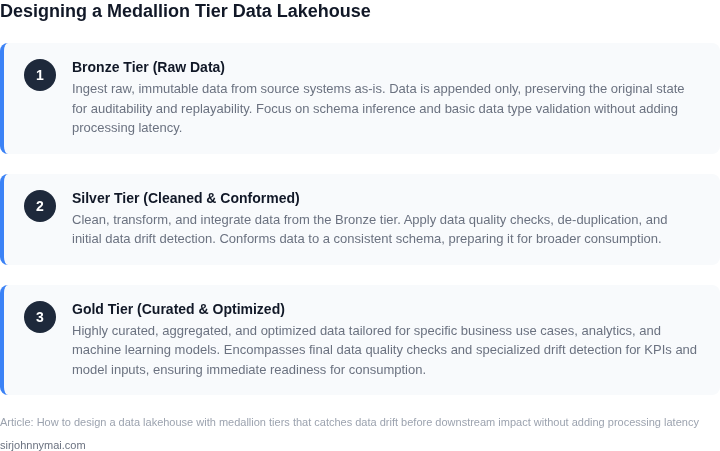
While the primary drift detection occurs in Silver, the Gold tier still provides a critical feedback loop. Drift detected here often signifies a subtle logical transformation error, a misconfigured aggregation, or an issue that slipped past Silver's more generic checks but impacts a specific consumption pattern. Its stable, use-case-specific schema is maintained through strict data contracts, ensuring downstream applications receive predictable inputs. This multi-tiered approach ensures that data quality checks are inherent to the data flow, preventing data drift from becoming a downstream impact without introducing noticeable processing latency.
03. Worked Example: Cost Savings from Early Drift Detection
Let's evaluate the tangible cost savings achievable by embedding data drift detection within a Medallion architecture, specifically catching issues in the Silver tier before they propagate to Gold. Consider a team of five data engineers managing a critical data lakehouse built on AWS, utilizing services like S3, AWS Glue for ETL, and Amazon Redshift Spectrum or Databricks for analytical workloads in the Gold layer. This team typically deals with 2-3 significant data drift incidents per month, which currently impact downstream Gold tables or dependent applications.
Scenario 1: Reactive Drift Detection (Gold Tier Impact)
In our current state, without robust Silver tier checks, data drift often manifests in the Gold layer. This usually happens when a source system makes an unannounced schema change, an upstream transformation job alters data types, or data quality deviates significantly from expectations. The drift is then detected either by failing Gold layer ETL jobs, inconsistencies in BI dashboards, or, critically, incorrect insights from machine learning models.
Upon detection, the engineering team initiates an investigation. This typically involves:
- Diagnosis and Root Cause Analysis: Identifying the source and nature of the drift across multiple Bronze and Silver layers, often taking 8-12 engineer hours across two engineers per incident. ($125/hour × 10 hours = $1,250)
- Fixing Upstream Issues: Correcting the ETL pipeline in Bronze or Silver, which may take an additional 4 hours for one engineer. ($125/hour × 4 hours = $500)
- Gold Layer Reprocessing: Rerunning extensive Gold layer jobs, potentially affecting multiple dependent tables. This requires significant compute resources (e.g., Databricks clusters, Glue processing units) and monitoring, estimating 4 hours of compute usage and 2 hours of engineer oversight. (e.g., $300 for compute + $125/hour × 2 hours = $550)
For a single incident, the estimated cost is approximately $1,250 + $500 + $550 = $2,300. With an average of three such incidents per month, the annual cost totals approximately $2,300 × 3 incidents/month × 12 months = $82,800. This calculation does not include the downstream business impact of inaccurate reports or model predictions.
Scenario 2: Proactive Drift Detection (Silver Tier Catch)
Implementing data drift detection mechanisms in the Silver tier significantly alters this cost profile. By establishing strict data contracts and running quality checks (e.g., using AWS Deequ, custom Glue jobs, or Databricks Delta Live Tables with expectations) immediately after data lands in Silver, we can identify inconsistencies before they are transformed and propagated to the Gold layer.
When drift is caught in the Silver layer:
- Rapid Diagnosis and Fix: The scope of the problem is much smaller. The issue is localized to the Silver ingestion pipeline or its Bronze source. Diagnosis and fix are typically completed within 3-5 engineer hours by one engineer. ($125/hour × 4 hours = $500)
- Limited Reprocessing: Reprocessing is confined to the specific Silver tables affected, which are typically smaller and less complex than Gold layer aggregates. This means significantly reduced compute costs and engineer oversight, perhaps 1 hour of compute and 1 hour of engineer time. (e.g., $50 for compute + $125/hour × 1 hour = $175)
The cost per incident drops to approximately $500 + $175 = $675. Annually, for the same three incidents per month, the total cost would be $675 × 3 incidents/month × 12 months = $24,300.
Cost Comparison and Savings
The following table summarizes the annual cost comparison:
| Detection Scenario | Engineer Hours per Incident (Avg.) | Compute Cost per Incident (Avg.) | Total Cost per Incident (Avg.) | Annual Cost (3 Incidents/Month) |
|---|---|---|---|---|
| Reactive (Gold Tier Impact) | 16 hours | $300 | $2,300 | $82,800 |
| Proactive (Silver Tier Catch) | 4 hours | $50 | $675 | $24,300 |
This structured approach to data quality, catching drift at the Silver tier, demonstrates a clear annual cost saving of $82,800 - $24,300 = $58,500 in direct engineering and compute expenses.
I evaluated this approach because it directly addresses the critical bottleneck of data quality with minimal added latency, as the checks are integrated into the existing data transformation pipeline. This works effectively when data contracts are rigorously defined and continuously monitored. However, it requires an upfront investment in developing and maintaining these quality checks, which could be a tradeoff for teams with limited resources or dynamic, undocumented data sources. It's a proactive measure that prioritizes data integrity over reactive incident response.
04. Decision Table: When to Implement Medallion Tiers
The previous sections established the critical financial and operational benefits of early data drift detection using a medallion architecture. While the value is clear, the specific implementation — and the associated complexity — requires careful consideration. Not every workload demands the same level of real-time validation or incurs the same downstream risk from inconsistent data.
To provide clarity, I've developed a decision framework that compares different lakehouse paradigms based on key evaluation criteria. This table helps to determine when a traditional lakehouse suffices, when a batch-oriented medallion architecture is appropriate, and when a streaming-first approach becomes essential. Our goal is to align the architectural investment with the business need for data quality and latency tolerance, without over-engineering.
I evaluated these options based on their ability to manage data quality, handle varying latency requirements, and their operational overhead. This framework should guide your team in making an informed decision about the most suitable lakehouse design for specific use cases within our ecosystem. The trade-offs involve implementation complexity versus the robustness of drift detection and the speed of data availability.
| Criteria | Traditional Lakehouse (Batch Focused) | Medallion Lakehouse (Batch Processed) | Medallion Lakehouse (Streaming-First) |
|---|---|---|---|
| Primary Data Quality Driver | Post-ingestion cleansing via separate jobs; reactive. Quality often verified during consumption. | Structured validation at each tier (Bronze, Silver, Gold) through defined batch pipelines; proactive. | Continuous, real-time validation and schema enforcement at ingestion and between streaming tiers; highly proactive. |
| Data Ingestion Latency Tolerance | Hours to days. Data is often loaded in large batches for historical analysis. | Minutes to hours. Batch processes run frequently, providing relatively fresh data for analytics. | Sub-second to minutes. Data is processed continuously for operational dashboards, real-time analytics, and AI/ML inference. |
| Cost vs. Complexity Trade-off | Lower initial setup complexity and cost for raw data storage and basic processing. Higher long-term cost for managing data quality issues downstream. | Moderate complexity and cost for establishing structured tiers and batch pipelines (e.g., Delta Lake on Databricks or AWS Glue). Reduced downstream data quality costs. | Higher initial complexity and operational cost for building and maintaining real-time streaming infrastructure (e.g., Kafka/Kinesis + Flink/Spark Streaming). Significant long-term savings from avoiding drift impact. |
| Drift Detection Requirement | Minimal or reactive. Schema changes or data integrity issues often detected by downstream failures. | Proactive detection. Schema evolution tools and data quality checks integrated into batch transformations (e.g., Delta Live Tables expectations). | Immediate, continuous detection. Schema registry and real-time validation rules (e.g., Protobuf, Avro) applied at source and throughout the pipeline; alerts generated instantly. |
| Downstream Impact Tolerance for Bad Data | High tolerance for occasional data quality issues, impacting reports or less critical analytical models. | Low tolerance. Bad data is largely filtered or corrected before reaching consumption layers, minimizing impact on business intelligence. | Zero tolerance. Bad data can immediately disrupt operational systems, customer experiences, or critical AI/ML models. |
| Operational Overhead for Data Governance | Relatively low for raw data; high for ensuring consistent data definitions and quality across disparate consumption points. | Moderate. Centralized schema management, data cataloging, and quality rules per tier reduce governance fragmentation. | Higher initial overhead for defining and enforcing real-time schemas and quality rules. Automates much of the enforcement, reducing ongoing manual governance. |
| Recommendation | Suitable for foundational data archival and non-critical analytical workloads where data freshness is not paramount and drift impact is low. | Recommended for most enterprise analytical workloads requiring reliable, consistent data. Provides strong data quality without extreme real-time constraints. | Strongly recommended for mission-critical operational systems, real-time AI/ML, and customer-facing applications where data drift causes immediate, significant business impact and latency must be minimal. |
Ultimately, the decision to implement a Medallion Lakehouse, particularly a streaming-first variant, should hinge on the risk profile of your data products. For systems where data integrity failures lead to direct financial losses, customer dissatisfaction, or operational disruptions, the investment in a robust, real-time medallion architecture pays significant dividends. For other use cases, a more measured, batch-oriented approach can still provide substantial quality improvements over a traditional lakehouse.
05. Action Step: Implementing Medallion Tiers in Your Pipeline
Adopting medallion tiers in an existing lakehouse requires a structured approach to integrate new processes without disrupting current operations. Our goal is to introduce robust drift detection capabilities early in the data lifecycle while carefully managing processing latency.
Step 1: Pipeline Identification and Prioritization
I recommend beginning with a critical assessment of your existing data pipelines. Identify those supplying high-impact downstream systems, particularly those with a history of drift-related issues or significant business cost if compromised. We should prioritize based on the potential financial impact of data quality incidents, aligning with the cost savings discussed in Section 03.
For each selected pipeline, map out the current data flow from ingestion to consumption. Understand existing data formats, schemas, and any rudimentary validation already in place. This provides a baseline against which to measure the impact of our changes.
Step 2: Establishing the Bronze Tier (Raw Ingestion)
The Bronze tier is your immutable, raw data landing zone. For existing pipelines, this means directing newly ingested data streams to an S3 bucket or ADLS container, preserving the original format (e.g., CSV, JSON, Avro). The key here is zero transformation upon ingestion to maintain an exact replica of the source.
I advocate for schema inference using tools like AWS Glue Crawlers or Apache Spark's schema inference capabilities only for metadata discovery, not for enforcement at this stage. This ensures we have a reference point for schema drift detection in subsequent tiers, avoiding any additional latency during the initial load.
Step 3: Implementing the Silver Tier (Cleansed & Conformed)
The Silver tier introduces the first layer of data quality and conformance. We'll read from the Bronze tier, apply initial validations, and standardize formats. This includes schema validation against an expected schema, data type enforcement, and basic null checks on critical fields.
Tools like Deequ integrated with Apache Spark or Great Expectations can perform these checks efficiently. The data should then be written to a columnar format like Parquet or ORC, leveraging AWS Glue Data Catalog or Unity Catalog for schema management. This step introduces some processing, but the goal is to make these checks lightweight and parallelizable to minimize latency impact.
Step 4: Building the Gold Tier (Business-Ready Views)
The Gold tier is where business logic, aggregations, and enrichments are applied, creating highly curated datasets for analytical consumption. Data quality checks here are more complex, focusing on business rule validation (e.g., ensuring product prices are within a valid range, cross-referencing sales data with inventory levels).
I recommend utilizing Delta Lake or Apache Iceberg for this tier. Their