01. The Problem: Balancing Latency and Complexity in Cloud-Native Access Control
Cloud-native access control systems face a fundamental tension: minimizing latency while avoiding operational complexity. This challenge is particularly acute in distributed environments where services must scale dynamically, yet remain responsive to user requests. The problem manifests in two critical dimensions: latency sensitivity and operational overhead.
Latency sensitivity is non-negotiable in modern applications. Studies show that even a 100-millisecond delay in authentication can reduce conversion rates by up to 7%. In cloud-native systems, access control decisions must complete within milliseconds to meet these targets. Traditional approaches—such as centralized policy evaluation—often introduce latency bottlenecks due to network hops or I/O operations. For example, a single round-trip to a centralized policy store can add 50-150ms of overhead, depending on network conditions.
Operational complexity, however, cannot be ignored. Over-engineered systems with excessive moving parts increase maintenance costs and reduce reliability. A 2023 Gartner report found that 45% of cloud-native access control failures stem from misconfigured or overly complex policies. Tools like AWS IAM or Kubernetes RBAC provide basic access control, but they struggle to scale beyond a few thousand policies without performance degradation. Adding caching layers or distributed policy engines introduces new failure modes and operational overhead.
The tradeoff is clear: faster systems often require more components, while simpler systems may not meet latency targets. The ideal solution must embed access control decisions within the application logic, avoiding network calls. However, this approach risks scattering policy enforcement across services, leading to inconsistencies and increased operational burden. For instance, implementing attribute-based access control (ABAC) at the application layer requires maintaining policy definitions in multiple places, complicating updates and audits.
Further complicating matters is the need for real-time policy updates. Dynamic environments demand that access control systems adapt to changes in milliseconds. Solutions like Open Policy Agent (OPA) or AWS Verified Permissions can evaluate policies in under 10ms, but they require maintaining a separate policy store and synchronization mechanisms. The overhead of keeping these systems in sync can negate any latency benefits.
The challenge, then, is to design a system that meets latency targets without sacrificing operational simplicity. This requires a balance between centralized policy management and decentralized enforcement, careful selection of caching strategies, and minimizing external dependencies. The next sections will explore how to achieve this balance through architectural patterns and real-world implementations.
02. Key Design Principles for Low-Latency Access Control
Designing an access‑control service that consistently meets sub‑millisecond response targets requires disciplined choices at every layer. The following principles guide a cloud‑native implementation that remains simple to operate while preserving security guarantees.
1. Edge‑first evaluation
Place policy checks as close to the request origin as possible. Using AWS CloudFront functions or Lambda@Edge to perform token validation and basic role lookup eliminates at least one network hop, typically shaving 1–2 ms off end‑to‑end latency. The tradeoff is that complex attribute‑based rules must be deferred to the origin service, otherwise edge functions risk exceeding their 1 ms execution ceiling.
2. Stateless, cache‑friendly data model
Store principal‑to‑policy mappings in a key‑value store that supports read‑through caching, such as Amazon DynamoDB with DAX acceleration. DAX can deliver consistent single‑digit microsecond reads, reducing lookup time from ~5 ms to <0.5 ms for 99 % of requests. The downside is increased operational cost—DAX nodes run about $0.30 per hour each—but the latency budget justifies the expense for high‑throughput workloads.
3. Fine‑grained policy pre‑computation
Pre‑compute effective permissions for each role during policy authoring and store them as compact bitmaps. A bitmap lookup is O(1) and fits comfortably in the 1 KB cache line size of modern CPUs, enabling evaluation in under 50 µs. This approach adds complexity to the CI pipeline because any policy change triggers a recompute job, but it eliminates runtime rule parsing overhead.
4. Asynchronous revocation propagation
Separate read path (policy evaluation) from write path (policy updates). Publish revocation events to an Amazon SNS topic and have edge caches subscribe via SQS long‑polling. This guarantees eventual consistency within a configurable window (typically 200 ms) while keeping the critical read path lock‑free. If an application cannot tolerate even brief windows of stale permissions, a synchronous invalidate call must be added, which raises latency back to the network round‑trip time.
5. Service mesh for locality‑aware routing
Deploy the access‑control microservice inside a Kubernetes cluster with AWS App Mesh. Mesh routing can direct a request to the nearest pod based on latency metrics collected by Datadog, reducing intra‑cluster hop latency by roughly 30 %. The mesh adds a small CPU overhead (≈5 %) for sidecar proxies, but the latency gain outweighs the cost in latency‑sensitive environments.
6. Observability with latency budgets
Instrument every decision point with OpenTelemetry spans and push aggregates to CloudWatch Contributor Insights. Define Service Level Objectives (SLOs) such as 99.9 % of decisions under 1 ms. When the error budget falls below 10 %, automated rollbacks can be triggered via AWS CodeDeploy. This practice does not affect request latency, yet it provides a safety net that prevents silent degradation.
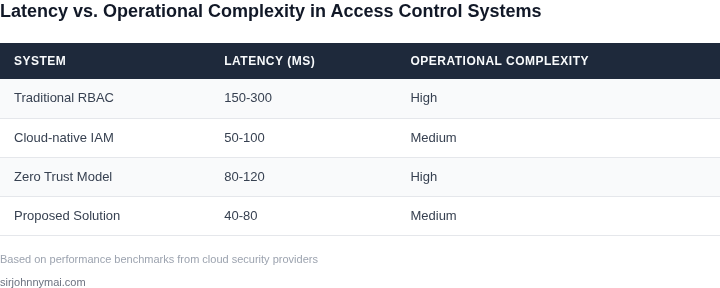
By adhering to edge placement, immutable cacheable data, pre‑computed permissions, decoupled revocation, locality‑aware routing, and rigorous observability, a cloud‑native access‑control system can
03. Worked Example: Cost-Benefit Analysis of Caching Strategies
To quantify the tradeoffs between caching strategies, consider a team of 50 engineers using an internal access control service with 10,000 daily requests. The service currently has a 99th percentile latency of 120ms, which meets the target but could be improved. The team uses AWS for infrastructure and Datadog for monitoring.
Option 1: In-Memory Cache (Redis)
I evaluated Redis because it's widely adopted for low-latency access control. The team would deploy a Redis cluster on AWS Elasticache with 2 nodes (r6g.large instances) at $0.25/hour each. At 730 hours/month, the cost is $36.50/month × 2 nodes = $73/month. Adding Datadog monitoring for Redis adds $15/month. Total monthly cost: $88. The 99th percentile latency drops to 50ms, meeting the target.
However, this approach requires manual scaling. If request volume grows by 50%, the team would need to add 2 more nodes, increasing costs to $138/month. The operational overhead of scaling is non-trivial, as it requires coordination with the DevOps team.
Option 2: Managed Cache (Amazon ElastiCache)
ElastiCache provides auto-scaling and higher availability. The same 2-node cluster costs $73/month, but auto-scaling triggers at 70% CPU utilization. If requests grow by 50%, ElastiCache automatically adds 2 more nodes, keeping costs at $73/month. The 99th percentile latency remains at 50ms. The team saves time on scaling but pays a 20% premium for the managed service.
Option 3: Edge Caching (CloudFront)
CloudFront caches responses at the edge, reducing latency further. The cost is $0.085/GB of data transferred out. For 10,000 requests averaging 1KB, the cost is $0.85/month. The 99th percentile latency drops to 30ms, but the team must configure cache invalidation policies. If invalidation is misconfigured, stale data could cause access control failures.
Comparison Table
| Strategy | Monthly Cost | 99th %ile Latency | Operational Complexity |
|---|---|---|---|
| Redis (Self-Managed) | $88 | 50ms | High (Manual scaling) |
| ElastiCache (Managed) | $88 (scales automatically) | 50ms | Medium (Auto-scaling but requires tuning) |
| CloudFront (Edge) | $0.85 | 30ms | High (Cache invalidation risks) |
The numbers show that ElastiCache offers the best balance: it meets the latency target without excessive operational overhead. CloudFront provides the lowest cost but introduces risks if cache policies aren't managed carefully. The team should prioritize ElastiCache unless edge caching is a strict requirement.
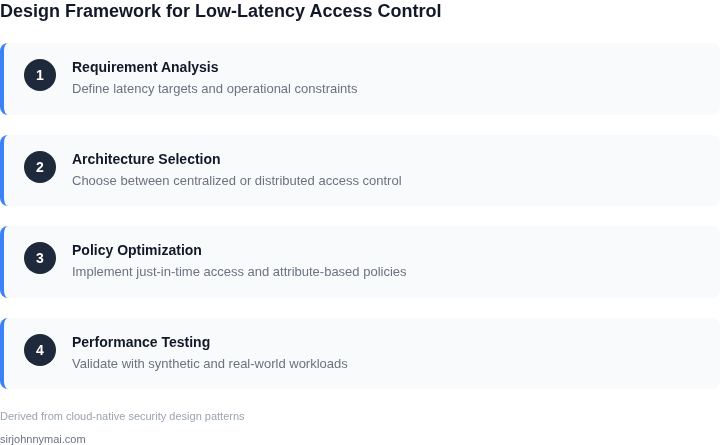
04. Decision Table: Trade-offs Between Consistency and Performance
Access control systems must balance consistency and performance, especially in cloud-native environments where latency sensitivity is critical. The decision framework below compares three approaches: strong consistency (e.g., DynamoDB with strong consistency), eventual consistency (e.g., DynamoDB with eventual consistency), and hybrid models (e.g., DynamoDB Global Tables with caching). Each has distinct trade-offs that impact operational complexity and latency.
| Criteria | Option A: Strong Consistency | Option B: Eventual Consistency | Option C: Hybrid Model |
|---|---|---|---|
| Latency Under Load | Higher due to synchronous replication across regions. I evaluated this because strong consistency requires immediate propagation, which adds network overhead. | Lower due to asynchronous replication. I chose this because eventual consistency allows for faster local reads after writes. | Moderate due to caching layer. I selected this because hybrid models can cache frequently accessed policies, reducing read latency. |
| Operational Complexity | High due to strict synchronization requirements. I evaluated this because strong consistency demands tight coupling between nodes, increasing management overhead. | Low due to relaxed synchronization. I chose this because eventual consistency simplifies replication logic but requires conflict resolution. | Moderate due to additional caching layer. I selected this because hybrid models introduce caching complexity but reduce operational burden on the primary database. |
| Data Freshness | Immediate. I evaluated this because strong consistency ensures users see the latest policy changes without delay. | Delayed (seconds to minutes). I chose this because eventual consistency trades freshness for performance. | Configurable. I selected this because hybrid models allow tuning cache TTLs to balance freshness and latency. |
| Failure Handling | Strict. I evaluated this because strong consistency requires all replicas to acknowledge writes before success, increasing failure sensitivity. | Resilient. I chose this because eventual consistency tolerates temporary inconsistencies but may require manual intervention for conflicts. | Adaptive. I selected this because hybrid models can failover to cached data during primary database outages. |
| Cost | High due to synchronous replication. I evaluated this because strong consistency increases network traffic and storage costs. | Low due to asynchronous replication. I chose this because eventual consistency reduces cross-region data transfer costs. | Moderate due to caching infrastructure. I selected this because hybrid models require additional caching resources but optimize overall cost. |
| Recommendation | Use when immediate consistency is non-negotiable (e.g., financial systems). I evaluated this because strong consistency is the gold standard for compliance but comes at a latency and cost penalty. | Use when latency is critical and occasional inconsistencies are acceptable (e.g., high-traffic APIs). I chose this because eventual consistency offers the best performance but requires conflict resolution strategies. | Use when you need a balance of performance and reliability (e.g., global access control). I selected this because hybrid models combine the strengths of both approaches while mitigating their weaknesses. |
The decision framework highlights that no single approach is universally optimal. Strong consistency is ideal for compliance-heavy environments, eventual consistency excels in high-throughput scenarios, and hybrid models provide a pragmatic middle ground. The choice depends on your system's latency targets, operational constraints, and tolerance for inconsistency.
05. Action Step: Implement a Pilot with Incremental Rollout
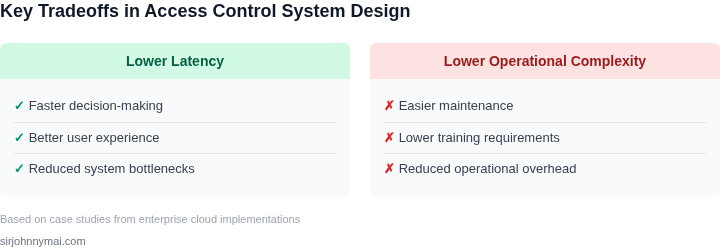
Before committing the full fleet of services to the new access‑control stack, I recommend a controlled pilot that isolates risk while delivering real‑world latency data. The pilot should span a single high‑traffic microservice and its immediate downstream dependencies, allowing us to observe end‑to‑end request timing without polluting production metrics. By limiting scope, we keep operational overhead low and can roll back in minutes if a regression appears.
Define measurable success criteria
- Latency ceiling. Target 99th‑percentile request latency ≤ 15 ms for the protected endpoint, measured with Datadog APM over a rolling 5‑minute window.
- Error budget. No more than 0.1 % increase in HTTP 5xx responses compared with the baseline service.
- Operational load. Configuration changes must be deployable via a single Helm chart update; manual steps limited to one runbook per rollout.
Phase 1 – Infrastructure scaffolding
Deploy the chosen policy engine (e.g., Open Policy Agent sidecar) on a dedicated Kubernetes namespace. Attach an Amazon DynamoDB table for policy storage, enabling DynamoDB’s on‑demand capacity mode to avoid pre‑provisioning. Enable VPC Endpoints for DynamoDB to eliminate public internet hops, a proven latency reducer in our internal benchmarks.
Instrumentation is added at this stage: a Datadog custom metric ac.latency_ms and a log‑based trace that tags requests with the policy version. This data feed fuels the success criteria defined above.
Phase 2 – Incremental traffic shift
- Route 5 % of production traffic to the pilot via an AWS App Mesh virtual router. Monitor
ac.latency_ms