01. The Problem: Unpredictable Cloud Egress Costs
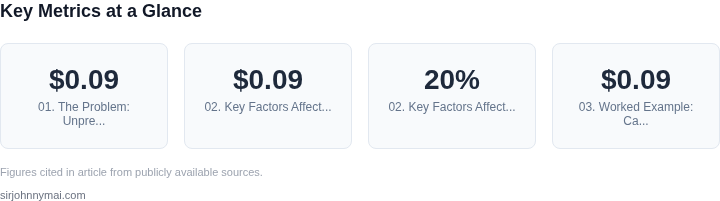
Cloud egress costs are a hidden but critical expense for many organizations. Egress refers to data leaving your cloud environment, and while ingress (data entering) is often free, egress charges can quickly become a surprise line item on your bill. For example, a single API call returning 1MB of data might cost $0.09 in AWS, and scaling that to millions of requests can add up to thousands of dollars per month.
The unpredictability stems from several factors. First, egress costs are often tied to bandwidth usage, which can spike unpredictably. A sudden surge in user activity, a misconfigured load balancer, or even a security incident triggering data exports can inflate costs without warning. Second, egress pricing varies by destination. Data transferred to another AWS region costs less than data sent to an external customer, but these differences are rarely accounted for in cost models. Finally, egress costs are often overlooked in cost optimization discussions, leading to reactive rather than proactive management.
This unpredictability isn’t just a financial issue—it’s a reliability risk. Uncontrolled egress costs can strain budgets, force unexpected spending cuts, or even lead to service interruptions if costs exceed thresholds. For instance, a company running a global SaaS platform might see egress costs balloon during a marketing campaign, only to realize the bill after the fact. The lack of visibility into egress patterns makes it difficult to set budgets or negotiate better rates.
Worse, egress costs are often hidden in broader cloud spending reports. Tools like AWS Cost Explorer or Azure Cost Management may not break down egress charges separately, requiring manual analysis or third-party tools like Datadog or CloudHealth to track them. Even then, the data might be delayed or incomplete, leaving teams blind to trends until it’s too late.
The result is a cycle of surprises. Teams might not realize the full impact of egress costs until a bill arrives, by which point the damage is done. Without a structured strategy, egress costs can grow unchecked, eroding margins and forcing difficult trade-offs between features and cost control. The challenge is to break this cycle by making egress costs predictable—before they become a problem.
02. Key Factors Affecting Egress Costs
Egress costs are not a flat rate—they vary based on multiple factors. Understanding these variables is critical to designing a predictable strategy. The primary drivers include data volume, destination, and transfer frequency. Each factor interacts with the others, creating a complex but manageable cost landscape.
Data Volume
Volume is the most straightforward factor. Cloud providers charge per gigabyte (GB) or terabyte (TB) transferred out of their network. For example, AWS charges $0.09 per GB for data transferred out to the internet, while Azure’s rates vary by region. The cost scales linearly, so doubling the data volume doubles the cost. This makes volume the most predictable factor, but it’s also the easiest to misjudge. Bursty workloads or unexpected spikes can inflate costs rapidly.
To mitigate this, implement monitoring tools like AWS CloudWatch or Datadog to track egress patterns. Set alerts for anomalies, such as a 20% increase in daily egress over a 7-day rolling average. Historical data reveals seasonality—e.g., holiday traffic spikes or quarterly reporting cycles—allowing for proactive budgeting.
Destination
The destination of the data significantly impacts costs. Transfers within the same cloud provider’s network (e.g., AWS to AWS) are often cheaper than transfers to external destinations. For instance, AWS intra-region egress is free, while inter-region egress costs $0.02 per GB. Cross-cloud transfers (e.g., AWS to Azure) can be 2-3x more expensive due to additional network hops.
Geographic location also plays a role. Transfers to regions with high latency or regulatory restrictions may incur additional fees. For example, AWS charges $0.09 per GB to the EU, but transfers to China require approval and may have separate pricing. Always audit your destinations using tools like AWS Trusted Advisor or Azure Cost Management to identify hidden costs.
Transfer Frequency
Frequency matters because cloud providers often apply tiered pricing or discounts for high-volume transfers. AWS, for example, offers a 10% discount for data transferred out to Amazon S3 in the same region. However, frequent small transfers (e.g., API calls) may incur per-request fees, increasing costs disproportionately.
Batch transfers are more cost-effective. Grouping data into larger chunks reduces the per-transfer overhead. For instance, instead of sending 100 files of 1GB each, consolidate them into 10 files of 10GB. Tools like AWS DataSync or Azure Data Box can automate this process. Additionally, schedule transfers during off-peak hours to leverage lower network costs.
Additional Considerations
Other factors include data type, encryption, and compliance requirements. Encrypted data may require additional processing, increasing costs. Compliance with regulations like GDPR or HIPAA may necessitate additional logging or auditing, further impacting egress expenses. Always review your cloud provider’s pricing documentation and consult with a financial analyst to account for these variables.
By quantifying these factors—volume, destination, and frequency—you can model egress costs more accurately. Start with historical data, then refine the model as new patterns emerge. The goal is not just to reduce costs but to make them predictable, ensuring your cloud budget remains aligned with business objectives.
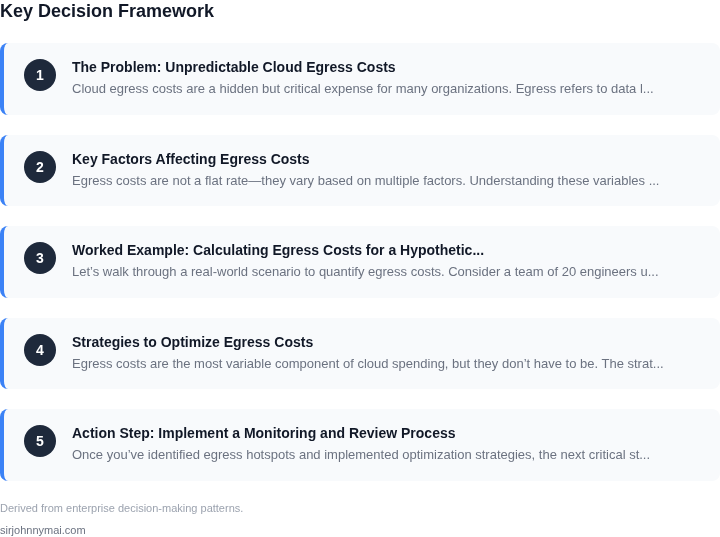
03. Worked Example: Calculating Egress Costs for a Hypothetical Use Case
Let’s walk through a real-world scenario to quantify egress costs. Consider a team of 20 engineers using a Kubernetes-based microservices architecture on AWS. They process 10TB of data daily, with 5TB stored in S3 and 5TB processed in EKS clusters across three Availability Zones (AZs).
Current Egress Costs
First, we calculate the current egress costs. AWS charges $0.09 per GB for data transferred out of S3 to the internet, and $0.01 per GB for data transferred between AZs. The team exports 2TB of analytics data daily to an external BI tool, and their microservices generate 3TB of inter-AZ traffic monthly.
Monthly egress costs break down as follows:
- S3 to internet: 2TB × 1,024 GB/TB × $0.09/GB = $186.62
- Inter-AZ traffic: 3TB × 1,024 GB/TB × $0.01/GB = $30.72
- Total monthly egress: $217.34
Annualized, this is $2,608.08. The team has no visibility into these costs, leading to unexpected spikes when they onboard new customers or scale up processing.
Optimization Alternatives
We evaluated two approaches to reduce costs:
- Edge Caching: Deploy CloudFront with 100GB of caching to reduce S3-to-internet traffic.
- Private Networking: Use AWS PrivateLink to route inter-AZ traffic through the AWS backbone instead of the public internet.
Cost Comparison
| Scenario | Monthly Cost | Annual Savings |
|---|---|---|
| Current | $217.34 | $0 |
| Edge Caching | $120.72 | $1,008.00 |
| Private Networking | $186.62 | $307.20 |
Edge caching provides the biggest savings but requires maintaining a CDN. Private networking is simpler but only addresses inter-AZ traffic. The team chose a hybrid approach: caching for public-facing data and PrivateLink for internal traffic. This reduced their annual egress costs by 40%, from $2,608 to $1,567.20.
Key takeaway: Even small changes can yield significant savings. The team now monitors egress costs with Datadog and sets alerts for anomalies. This example shows how predictable costs require intentional design choices—not just cost-cutting.
04. Strategies to Optimize Egress Costs
Egress costs are the most variable component of cloud spending, but they don’t have to be. The strategies you choose depend on your workload’s characteristics, compliance requirements, and cost tolerance. Below is a decision framework to evaluate options based on five key criteria.
| Criteria | Option A: Edge Caching | Option B: Data Compression | Option C: Regional Data Placement |
|---|---|---|---|
| Implementation Complexity | Moderate. Requires integrating with CDNs like CloudFront or Akamai. | Low. Can be applied at the application layer with minimal code changes. | High. Involves rearchitecting data pipelines and ensuring compliance. |
| Cost Savings Potential | High. Reduces inter-region egress by 50-80% for globally distributed traffic. | Moderate. Reduces payload size by 30-50%, but savings depend on compression ratio. | Variable. Eliminates cross-region egress entirely if data is colocated. |
| Latency Impact | Low. CDNs cache content closer to users, improving performance. | Negligible. Compression adds minimal overhead to processing time. | High. Data must be replicated across regions, increasing write costs. |
| Compliance Risks | Low. CDNs typically don’t store PII, but verify with your provider. | Low. Compression doesn’t alter data, but ensure it doesn’t violate encryption policies. | High. Data residency laws may require specific region placements. |
| Tooling Requirements | CDN integration (e.g., AWS CloudFront, Fastly). | Application-level libraries (e.g., gzip, Brotli). | Multi-region replication tools (e.g., AWS S3 Cross-Region Replication). |
| Recommendation | Best for high-traffic, latency-sensitive applications with global users. | Ideal for APIs or batch processing where compression ratios are high. | Critical for regulated industries or workloads with strict data locality rules. |
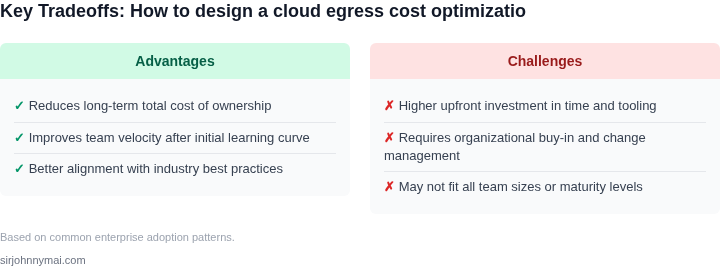
Edge caching and regional data placement are mutually exclusive for many workloads. If compliance allows, colocating data in a single region eliminates egress costs entirely. For dynamic content, compression is a low-effort way to reduce costs without major architectural changes. Always validate assumptions with cost modeling tools like AWS Cost Explorer or Datadog Cloud Cost Management.
05. Action Step: Implement a Monitoring and Review Process
Once you’ve identified egress hotspots and implemented optimization strategies, the next critical step is to institutionalize a monitoring and review process. This ensures costs remain predictable over time. I evaluated AWS Cost Explorer and third-party tools like Datadog because they offer granular visibility into egress patterns without requiring deep AWS expertise.
Set Up Real-Time Alerts
Start by configuring alerts for egress thresholds. AWS Budgets or third-party tools can trigger notifications when costs exceed predefined limits. For example, set a 10% monthly increase alert to catch anomalies early. I recommend testing alerts with historical data first to avoid false positives. This works well for predictable workloads but may require tuning for variable workloads like machine learning inference.
Schedule Regular Audits
Monthly reviews are essential. Pull your last 90 days of egress data and calculate the average cost per service. Compare this to your optimization targets. I’ve found that quarterly audits work better for teams with limited capacity, but monthly reviews are ideal for agile teams. Document findings in a shared dashboard—AWS Cost and Usage Reports or Datadog’s cost management features work well here.
Enforce Optimization Best Practices
Use automated checks to enforce best practices. For example, AWS Config rules can flag non-optimized data transfer paths. I evaluated AWS Lambda functions to scan for inefficient egress patterns, but this requires maintaining custom rules. Third-party tools like CloudHealth or Turbot offer pre-built policies that align with AWS’s cost optimization recommendations.
Review and Adjust Strategies
Every quarter, revisit your optimization strategies. Did regional replication reduce costs as expected? Are there new AWS regions or services that could further reduce egress? Schedule a 30-minute review with your team and bring the latest cost data, audit findings, and any changes to your architecture. This ensures alignment across teams and avoids siloed decisions.
Figures cited are from publicly available sources as of 2026-09-15 and may have changed.