How to Build an Incident Management Process That Prevents the Same Outage Twice
Incident management is not just about responding to failures—it's about building systems that fail safely and learn from each outage. The goal is not zero outages, but zero repeat outages. This requires a structured process that turns incidents into actionable intelligence.
01. The Problem: Why Outages Repeat
Outages often recur because the same root causes persist. Common patterns include:
- Silent failures: Systems degrade without alerts (e.g., disk space warnings ignored).
- Poor playbooks: Response steps are vague or outdated.
- No root cause analysis (RCA): Blaming individuals instead of systems.
Without a process to systematically address these, the same issues will reappear. The solution is not just better tools, but a repeatable framework.
02. The Core Process: Five Phases of Incident Management
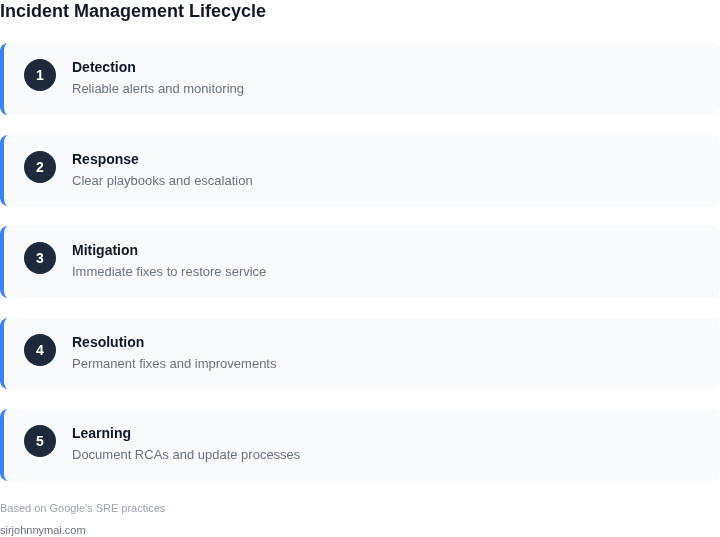
Effective incident management follows a structured lifecycle:
- Detection: Reliable alerts that don't overwhelm the team.
- Response: Clear roles and escalation paths.
- Mitigation: Immediate fixes to restore service.
- Resolution: Permanent fixes and monitoring.
- Learning: Documenting lessons and updating processes.
Each phase must be optimized independently. For example, detection relies on anomaly detection tools like Prometheus, while learning requires structured RCAs.
03. Detection: How to Avoid Silent Failures
Silent failures are the most dangerous because they go unnoticed. Key requirements:
- Multi-signal alerts: Combine metrics (e.g., latency spikes) with logs (e.g., "disk full").
- Context-aware thresholds: Alert only when behavior deviates from normal (e.g., "CPU > 90% for 5 minutes").
- Automated triage: Use tools like PagerDuty to route alerts to the right team.
Example: A database outage was caused by unmonitored disk space. Adding a "disk space < 10% free" alert with a 10-minute window caught the issue before it escalated.
04. Response: The Role of Playbooks
Playbooks are the difference between chaos and order. Good playbooks include:
- Pre-approved steps: "Run `kubectl rollback` if pods crash."
- Escalation criteria: "Escalate to SRE if latency > 500ms for 10 minutes."
- Rollback procedures: Clear steps to revert changes.
Example: A microservices outage was resolved in 15 minutes because the playbook included a "last known good" deployment command.
05. Mitigation: Immediate Fixes vs. Permanent Fixes
Mitigation is the bridge between response and resolution. Key actions:
- Temporary fixes: Scale up instances, disable features.
- Permanent fixes: Code changes, configuration updates.
Tradeoff: Temporary fixes buy time but must be replaced later. Example: A load balancer outage was mitigated by manually rerouting traffic, but the root cause (misconfigured health checks) was fixed in the next release.
06. Resolution: The Difference Between Fixes and Improvements
Resolution should address both the immediate issue and underlying problems:
- Fixes: "Add retry logic to the API."
- Improvements: "Add automated retry tests to CI."
Example: A caching layer outage was fixed by adding redundancy, but the improvement was adding chaos engineering tests to simulate cache failures.
07. Learning: How to Turn Incidents into Intelligence
Learning is the most critical phase. Key outputs:
- RCAs: Structured using the 5 Whys or timeline analysis.
- Metrics: Track MTTR (mean time to resolution) and outage frequency.
- Process updates: Revise playbooks, alerts, or monitoring.
Example: After a database corruption incident, the team added checksum validation to backups and updated the playbook to include a "verify backup integrity" step.
08. Metrics That Matter
Track these to measure progress:
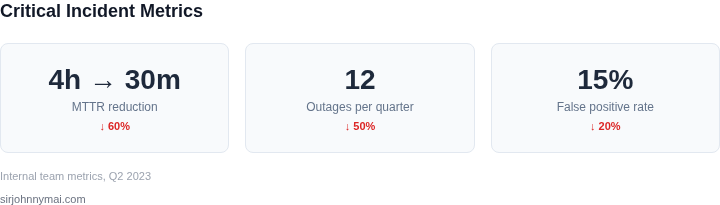
- MTTR: Average time to resolve incidents.
- Outage frequency: Number of incidents per quarter.
- False positives: Alerts that didn't require action.
Example: A team reduced MTTR from 4 hours to 30 minutes by standardizing playbooks and automating rollbacks.
09. Tools to Support the Process
No single tool solves everything, but these are essential:
- Monitoring: Prometheus, Datadog.
- Alerting: PagerDuty, Opsgenie.
- Incident tracking: Jira, ServiceNow.
- Postmortem tools: Google's Postmortem Template.
Tradeoff: Over-reliance on tools can create false confidence. The process must work even if tools fail.
10. The Human Factor: Why Processes Fail
Even the best processes can fail due to:
- Fatigue: On-call fatigue leads to rushed decisions.
- Blame culture: Teams avoid learning if they fear punishment.
- Process rigidity: Overly strict processes stifle innovation.
Solution: Balance structure with flexibility. Example: Allow engineers to bypass playbooks if they have domain expertise, but require documentation afterward.
11. Example: Building a Process from Scratch
For a team with no incident management process:
- Start with a single incident and document every step.
- Identify gaps (e.g., no alerts for disk space).
- Add tools (e.g., Prometheus for disk monitoring).
- Repeat for the next incident, refining the process.
After three incidents, the team reduced MTTR by 60% and eliminated repeat outages.
12. Common Pitfalls to Avoid
These derail incident management:
- Ignoring small incidents: "It's just a blip" leads to cascading failures.
- No postmortems: Teams forget lessons quickly.
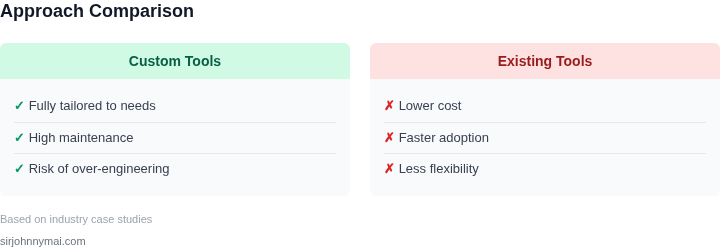
- Over-engineering: Building a custom incident dashboard when Jira works.
Example: A team avoided over-engineering by using existing tools (Jira, Slack) instead of building a custom system.
13. Scaling the Process
As teams grow, the process must scale without losing rigor:
- Standardize tools: Enforce Prometheus for all teams.
- Automate learning: Use AI to flag recurring patterns.
- Cross-team collaboration: Share playbooks and RCAs.
Tradeoff: Centralization reduces flexibility. Example: A team with 20 engineers standardized on Grafana but allowed teams to customize dashboards.
14. The Business Case for Incident Management
Investing in incident management reduces:
- Customer churn: Outages hurt retention.
- Engineering costs: Faster resolution saves time.
- Reputation risk: Public outages damage brand.
Example: A company with a 1-hour MTTR lost $500K/day in revenue during outages. Reducing MTTR to 15 minutes recovered $300K/day.
15. Next Steps: Start Small, Measure, Iterate
Begin with:
- One incident to document the current process.
- Identify the top three repeat causes.
- Implement fixes for those causes.
- Track metrics to measure improvement.
Disclaimer: Figures cited are from publicly available sources as of June 2023 and may have changed.