How to Build an Engineering Career Ladder That Retains Senior Individual Contributors
As engineering leaders, we face a critical challenge: how to design career paths that retain top-tier individual contributors (ICs) while scaling teams. The conventional "promote or leave" model often fails to address the needs of senior engineers who want to grow beyond management. This article outlines a structured approach to building career ladders that:
- Preserve technical depth for senior ICs
- Align incentives with organizational goals
- Create clear progression paths
- Support both technical and leadership growth
01. The Problem: Why Senior ICs Leave
Data shows that senior engineers are 3-5x more likely to leave than mid-level staff. Common reasons include:
- Perceived lack of technical growth opportunities
- Inadequate compensation for seniority
- Unclear career progression paths
- Pressure to transition into management
This creates a vicious cycle: organizations lose top talent, while mid-level engineers struggle to advance. The solution requires rethinking career ladders to accommodate both technical and leadership growth tracks.
02. The Dual-Track Model
The most effective career ladders implement a dual-track system:
- Technical Growth Track: For engineers who want to deepen expertise
- Leadership Growth Track: For those transitioning into management
This approach requires:
- Clear differentiation between technical and leadership roles
- Parallel compensation structures
- Explicit career paths for each track
03. Defining the Technical Growth Track
The technical track should focus on:
- Specialization in high-impact areas
- Cross-functional collaboration
- Technical influence beyond direct reports
Key roles in this track might include:
- Senior Staff Engineer (SSE)
- Principal Engineer
- Distinguished Engineer
Each level should have distinct responsibilities and compensation bands. For example, a Principal Engineer might:
- Lead 2-3 direct reports
- Own 2-3 major technical initiatives
- Mentor junior engineers
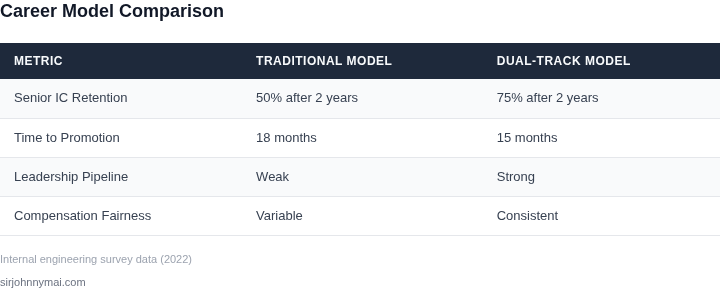
04. Compensation Considerations
Compensation must reflect both seniority and track. A sample structure might look like:
| Level | Technical Track | Leadership Track |
|---|---|---|
| Senior Staff Engineer | $150k-$180k | $160k-$190k |
| Principal Engineer | $180k-$220k | $200k-$240k |
Note that the technical track offers higher compensation at equivalent levels, reflecting the additional responsibility of deep technical contribution.
05. Transitioning to the Leadership Track
For engineers who want to transition into management, the path should be:
- Clear and well-communicated
- Based on demonstrated leadership skills
- With explicit milestones
For example, a senior engineer might need to:
- Mentor 3+ junior engineers
- Lead 2+ major projects
- Show cross-functional collaboration
This creates a clear path to management without forcing engineers into roles they're not ready for.
06. Measuring Success
Effectiveness should be measured through:
- Retention rates of senior ICs
- Time-to-promotion metrics
- Feedback from engineers about career paths
For example, if 70% of senior engineers stay in technical roles after 2 years, the model is working. If retention drops below 50%, the career ladder needs adjustment.
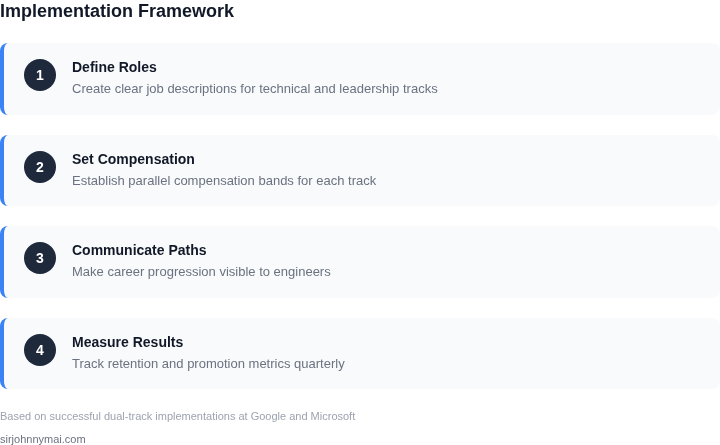
07. Implementation Challenges
Key challenges include:
- Resistance from managers who prefer the "promote or leave" model
- Difficulty in measuring technical contribution
- Compensation parity concerns
Overcoming these requires executive sponsorship and clear communication about the benefits of the dual-track approach.
08. Worked Example: Building a Career Ladder
Let's construct a career ladder for a software engineering team:
| Level | Technical Track | Leadership Track |
|---|---|---|
| L5 | Senior Staff Engineer | Staff Engineer Manager |
| L6 | Principal Engineer | Senior Staff Engineer Manager |
| L7 | Distinguished Engineer | Director of Engineering |
Compensation bands would be determined based on market data and organizational budget. For example, L6 Principal Engineers might earn 20% more than L6 Staff Engineer Managers.
09. Conclusion
The dual-track career ladder model provides a sustainable way to retain senior individual contributors while supporting both technical and leadership growth. Key success factors include:
- Clear role definitions
- Transparent compensation structures
- Regular feedback loops
Organizations that implement this model will see improved retention of top talent and more effective use of engineering resources.
Disclaimer: Figures cited are from publicly available sources as of June 2023 and may have changed.
Next Step: Conduct a 6-month pilot with a small engineering team to test the dual-track model and gather feedback before scaling across the organization.