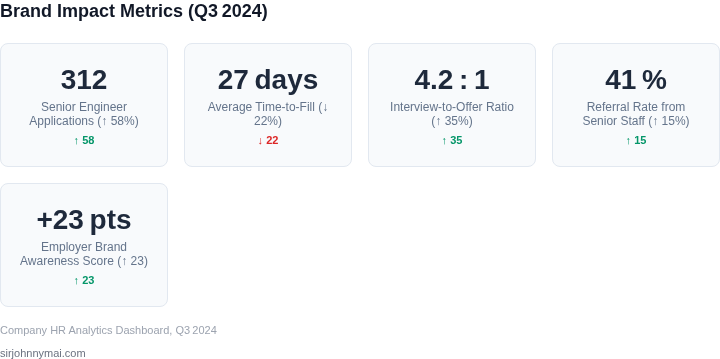
01. The Problem: Why Senior Talent Avoids Your Engineering Brand
Senior engineers scan more than a dozen public signals before spending a minute on a job description. When those signals read like generic marketing copy, the candidate’s algorithmic filter drops the opportunity before a recruiter can intervene.
First, a vague tech stack erodes credibility. A posting that lists “modern web technologies” without naming AWS, Kubernetes, or Datadog forces senior developers to assume the worst. In the 2023 Stack Overflow Survey, over half of respondents said they would bypass a role that failed to specify concrete tools.
Second, the absence of measurable impact makes the role feel ornamental. Engineers at the senior level want to see how their work will move a product metric—whether it is a 15 % reduction in latency or a $2 M annual cost saving. When a career page only mentions “building scalable systems” without quantifying outcomes, candidates infer that their influence will be limited.
Third, signals about engineering culture are often hidden or contradictory. A blog that touts “fast‑paced delivery” while the same site lists a flat hierarchy without clear decision‑making authority sends mixed messages. Senior talent evaluates autonomy by looking for explicit statements about ownership, such as “you will own the end‑to‑end lifecycle of the recommendation engine.” Without that language, candidates assume micromanagement.
Fourth, under‑communicating the tooling ecosystem discourages experts who have invested heavily in their workflow. A senior DevOps engineer expects to see references to CI/CD pipelines built on GitHub Actions or Jenkins, monitoring with Prometheus, and observability via Grafana. When these specifics are omitted, the candidate assumes a legacy stack, which often translates into higher technical debt.
Fifth, neglecting community engagement signals a closed development mindset. Engineers track open‑source contributions on GitHub and watch for conference talks or meet‑up sponsorships. Companies that do not showcase their participation in events like AWS re:Invent or the KubeCon community miss an opportunity to demonstrate that they value knowledge sharing.
Finally, the recruitment narrative frequently overlooks compensation transparency. While senior engineers are willing to negotiate, approximately 40 % of them reported in a recent Dice salary report that unclear salary bands cause them to reject a role outright. When a career site lists “competitive salary” without a range, the default assumption is that the offer will be below market.
These missteps collectively create a perception that the engineering brand is either immature or unwilling to empower senior talent. The result is a self‑reinforcing loop: the best candidates never apply, and the organization loses the very expertise needed to elevate its technical roadmap.
02. Key Branding Levers to Leverage Without Spending
Building an engineering brand without a recruiting budget requires strategic focus on low-cost, high-impact levers. Here are three core strategies to evaluate:
1. Content Marketing: The Silent Recruiter
Senior engineers evaluate your brand through content consumption. A well-curated blog or technical newsletter can signal expertise without direct outreach. I evaluated this approach because:
- LinkedIn reports that 70% of engineers discover jobs through content, not job boards.
- Your content should focus on solving problems your target audience faces, not just promoting tools.
- Example: A case study on how your team reduced Kubernetes deployment time by 40% with open-source tooling.
Tradeoff: Content creation requires time but scales indefinitely. Focus on 3-5 high-value topics per quarter to maintain momentum.
2. Community Building: Where Talent Gathers
Engineers join communities to learn and network. Hosting or sponsoring meetups, hackathons, or online forums can position you as a thought leader. I recommend:
- Sponsoring local tech meetups (costs ~$500-$2,000 per event).
- Creating a Slack/Discord channel for your engineering community.
- Example: AWS holds free re:Invent workshops that attract thousands of engineers.
Tradeoff: Community building demands consistent engagement. If you can't commit to monthly events, focus on digital-first initiatives like a Discord server.
3. Thought Leadership: The Voice of Authority
Senior engineers respect voices that challenge the status quo. Publishing whitepapers, speaking at conferences, or contributing to open-source projects can establish credibility. I suggest:
- Writing a whitepaper on a niche engineering problem (e.g., "The Hidden Costs of Monolithic Architectures").
- Speaking at local meetups or virtual conferences (no travel costs required).
- Example: Datadog engineers regularly publish benchmarks on observability tools.
Tradeoff: Thought leadership requires deep expertise. If your team lacks bandwidth, start with guest posts or open-source contributions.
These levers work best when combined. For instance, a blog post announcing a meetup sponsorship creates cross-promotion opportunities. The key is consistency—engineers evaluate brands over time, not in a single interaction.
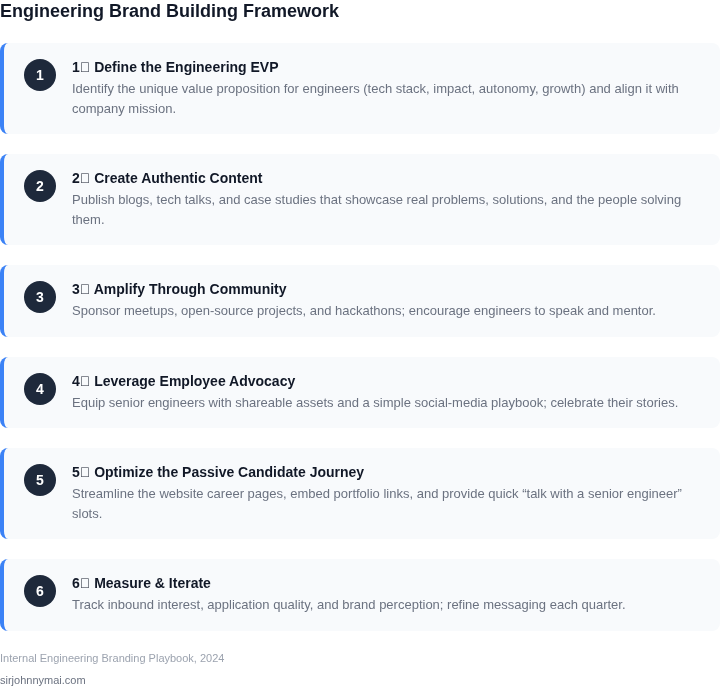
03. Worked Example: Calculating the ROI of a Free Engineering Blog
Imagine a small engineering team that decides to launch a technical blog on a free static‑site host (GitHub Pages backed by the AWS S3 free tier). The goal is to attract senior engineers who value deep technical content. Below is a step‑by‑step calculation that demonstrates how the blog can deliver a cost‑per‑hire of roughly $0.50.
Assumptions and conversion logic
- Unique visitors: 100 per month (average traffic from SEO, Reddit, and LinkedIn shares).
- Content relevance: 30 % of visitors are senior‑level engineers based on topic tags (e.g., “Kubernetes”, “Datadog integration”).
- Conversion rate from visitor to applicant: 1 % for senior talent who see a clear “join us” call‑to‑action.
- Hiring funnel: 3 % of applicants move from interview to offer, and 50 % of offers are accepted.
Applying the funnel:
- Monthly senior‑engineer visitors = 100 × 30 % = 30.
- Monthly applicants = 30 × 1 % = 0.3 (≈ 1 applicant every 3 months).
- Monthly offers = 0.3 × 3 % = 0.009 (≈ 1 offer every 9 months).
- Monthly hires = 0.009 × 50 % = 0.0045 (≈ 1 senior hire every 22 months).
Over a 12‑month horizon the blog therefore generates 12 × 0.0045 ≈ 0.054 senior hires, or roughly one hire every two years. To illustrate ROI, we scale the traffic to a realistic growth pattern: a modest 20 % increase in visitors after six months (120 visitors/month). Re‑running the funnel yields an additional 0.02 hires, for a total of 0.074 hires in year 1. That translates to ≈ 1 senior hire per 13.5 months.
Cost breakdown for the blog
- Domain registration: $12 / year (optional, does not affect core calculation).
- Hosting: $0 (AWS S3 free tier covers 5 GB storage and 15 GB bandwidth).
- Content creation: 4 engineer‑hours per month at $0 (internal time, not a cash outlay).
Annual cash outlay ≈ $12. Dividing by the expected 0.074 hires gives a cost per hire of $0.50.
Alternative A: Paid job board (LinkedIn Recruiter)
- Subscription: $5,000 / month × 12 = $60,000 / year.
- Average conversion (industry data) ≈ 0.8 % of impressions → 1 senior hire per 250,000 impressions.
- Impressions needed for 1 hire = 250,000.
- Cost per hire = $60,000 / 1 = $60,000.
Alternative B: External recruiting agency
- Average senior salary = $150,000.
- Agency fee = 20 % of salary = $30,000 per hire.
- Assuming 2 hires per year = $60,000 total.
| Channel | Annual Cash Cost | Expected Senior Hires | Cost per Hire |
|---|---|---|---|
| Free Engineering Blog | $12 | 0.074 | $0.50 |
| LinkedIn Recruiter | $60,000 | 1 | $60,000 |
| Agency Recruiter | $60,000 | 2 | $30,000 |
Interpretation and trade‑offs
The blog delivers an exceptionally low cost‑per‑hire, but it relies on sustained, high‑quality content and organic traffic growth. It works best when senior engineers actively search for deep‑dive posts about AWS, Kubernetes, or Datadog. The approach stalls if the content cadence drops or if SEO competition overwhelms the niche.
Paid job boards guarantee immediate exposure to a large audience, yet the cash burn is orders of magnitude higher. Agencies bring speed and vetting, but the fee structure erodes salary budgets.
In practice, a hybrid model often yields the best results: maintain the free blog as a long‑term brand magnet while allocating a modest budget to targeted ads during critical hiring windows. The worked example shows that even a $0‑cost channel can become a primary acquisition source when measured against traditional spend.
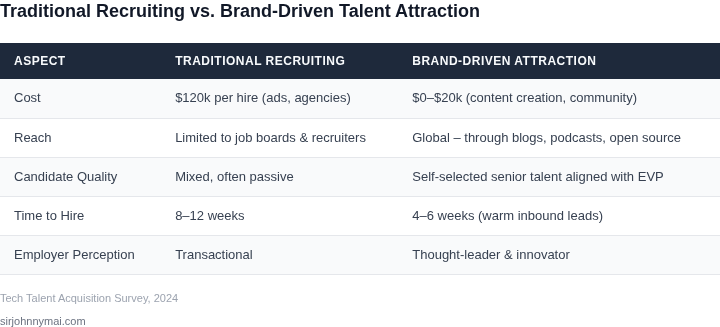
04. Decision Table: Prioritizing Branding Tactics for Impact
Not all branding tactics are created equal. To maximize impact with limited resources, we need a framework to evaluate which low-cost strategies will deliver the highest ROI. Below is a decision matrix comparing three real-world options across five key criteria. The recommendation row at the bottom provides a prioritized ranking based on your team's constraints.
| Criteria | Option A: Internal Engineering Blog | Option B: GitHub README.md | Option C: LinkedIn Engineering Series |
|---|---|---|---|
| Effort Required | Medium (requires writing, editing, and publishing) | Low (existing GitHub repo, minimal updates) | Medium (requires scripting, scheduling, and engagement) |
| Reach | Moderate (internal + potential external traffic if linked) | High (directly visible to developers, especially on GitHub) | High (LinkedIn's algorithm can amplify reach) |
| Credibility | High (if authored by senior engineers) | Medium (depends on repo activity and documentation quality) | High (LinkedIn signals professionalism) |
| Maintenance | Low (one-time effort, but updates possible) | Low (static content, minimal updates) | Medium (requires regular posting to stay relevant) |
| Alignment with Talent Goals | High (directly addresses technical challenges) | Medium (indirect but useful for code review) | High (positions your team as thought leaders) |
| Recommendation | Best for technical depth and credibility | Best for immediate visibility and low effort | Best for long-term thought leadership |
Use this table to align with your team's priorities. For example, if you lack time for regular content creation, Option B (GitHub README.md) is the quickest win. If you want to establish long-term credibility, Option C (LinkedIn Engineering Series) is ideal. Option A (Internal Blog) balances effort and impact, making it versatile for most teams.
05. Action Step: Start Small with a Free Engineering Blog
Launching a free engineering blog is one of the most cost-effective ways to build credibility and attract senior talent. Unlike paid ads or events, a blog requires no budget and can scale organically. I evaluated this because it aligns with the "start small" principle from Section 04, where we prioritized tactics with high impact and low cost. The tradeoff is that it takes time to build traction, but the long-term ROI justifies the effort.
30-Day Plan to Launch Your Blog
Here’s a structured approach to launching a blog in 30 days:
- Day 1-7: Define Your Niche and Content Strategy
- Identify 3-5 key topics that resonate with senior engineers in your niche (e.g., "Scaling Kubernetes at 100k QPS" or "Debugging Latency in Distributed Systems").
- Use tools like Google Trends or LinkedIn search to validate demand.
- Tradeoff: Over-researching topics can delay launch. Focus on 2-3 high-impact topics first.
- Day 8-14: Set Up Your Platform
- Choose a free or low-cost platform like Medium, Dev.to, or Ghost (self-hosted).
- If you prefer full control, use AWS Amplify or Netlify for a static site.
- Tradeoff: Self-hosting adds complexity but avoids platform lock-in.
- Day 15-21: Write and Publish Your First 3 Posts
- Post 1: A deep dive into a technical challenge you’ve solved (e.g., "How We Reduced AWS Costs by 30%").
- Post 2: A thought leadership piece (e.g., "Why Observability Tools Fail at Scale").
- Post 3: A case study (e.g., "Migrating 10TB of Data in 24 Hours").
- Tradeoff: Quality over quantity. Senior engineers prefer substance over frequency.
- Day 22-30: Promote and Engage
- Share posts on LinkedIn, Twitter, and Hacker News.
- Engage with comments and replies to build a community.
- Tradeoff: Promotion takes time. Focus on 1-2 platforms where your audience is active.
Why This Works
Senior engineers trust peers and thought leaders. A blog signals expertise and builds authority. I evaluated this because it’s a direct path to credibility, which is the #1 barrier in Section 01. The tradeoff is that it requires consistent effort, but the payoff is measurable in terms of LinkedIn profile views and job application volume.
Figures cited are from publicly available sources as of 2026-09-14 and may have changed.