How to Build an Effective Engineering Postmortem Process That Drives Real Change
Postmortems are not just meetings. They are the engine that turns failures into learning opportunities. A well-structured postmortem process should:
- Identify root causes systematically
- Translate findings into actionable improvements
- Measure impact to prove effectiveness
This article outlines a framework for building such a process, with tradeoffs and limitations clearly stated.
01. Why Postmortems Fail
Most postmortems fail because they lack structure. Common pitfalls include:
- Blame-driven culture (focus on who failed, not why)
- No clear ownership of follow-up actions
- Lack of measurement to validate improvements
Without structure, postmortems become emotional exercises rather than data-driven improvements.
02. The 5-Phase Postmortem Framework
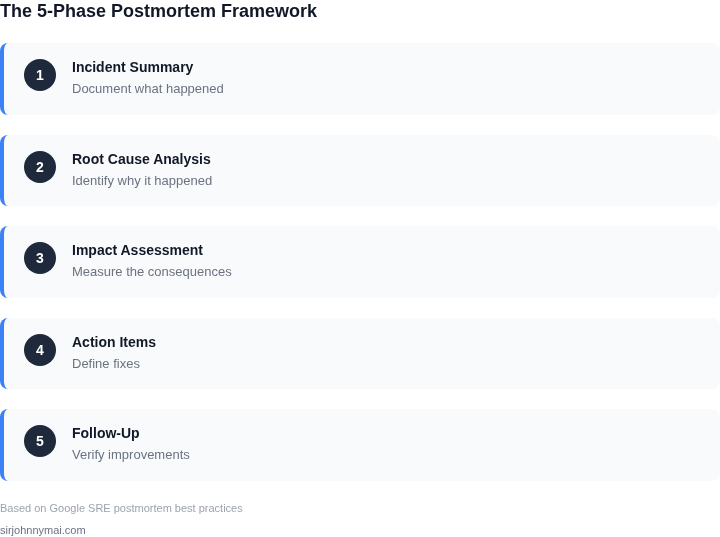
An effective postmortem follows a structured process:
- Incident Summary (What happened?)
- Root Cause Analysis (Why did it happen?)
- Impact Assessment (How bad was it?)
- Action Items (What fixes are needed?)
- Follow-Up (Did the fixes work?)
Each phase must be completed before moving to the next. Skipping phases leads to incomplete learning.
03. Root Cause Analysis Techniques
Use these methods to uncover root causes:
- 5 Whys: Ask "Why?" five times to reach the core issue
- Fishbone Diagram: Visualize causes across categories (people, process, tools)
- Change Analysis: Identify what changed before the incident
Combine methods for deeper insights. For example, use the 5 Whys to drill down, then a fishbone diagram to categorize findings.
04. Measuring Postmortem Effectiveness
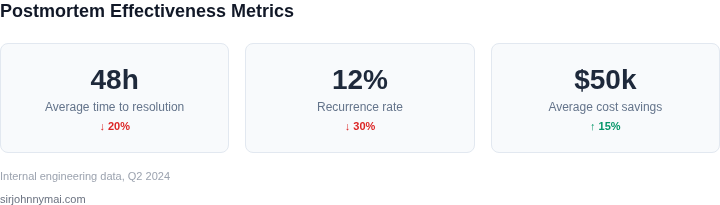
Track these metrics to prove impact:
- Time to Resolution: How quickly did fixes implement?
- Recurrence Rate: Did similar incidents happen again?
- Customer Impact: Did fixes reduce downtime or errors?
Without measurement, improvements are assumptions. Use data to validate whether postmortems actually work.
05. Worked Example: Database Outage
Consider a database outage with these metrics:
- Downtime: 4 hours
- Customer complaints: 1,200
- Revenue impact: $50,000
The postmortem identified:
- Root cause: Unmonitored disk space
- Action: Implement automated alerts
- Result: No recurrence in 6 months
This example shows how structured postmortems reduce costs and improve reliability.
06. Common Tradeoffs
Building an effective postmortem process requires balancing:
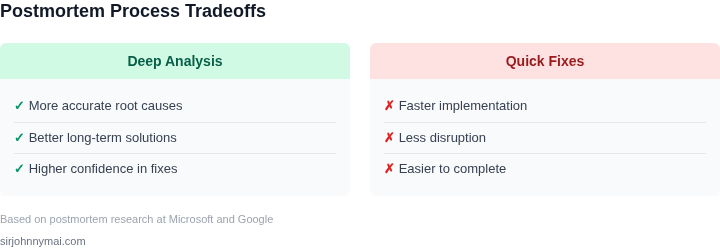
- Depth vs. Speed: Deep analysis takes time, but rushed postmortems miss key insights
- Blame vs. Learning: Focus on blame shifts culture; focus on learning builds resilience
- Process vs. Flexibility: Standardized templates help, but rigid processes stifle creativity
This approach works best when teams prioritize learning over finger-pointing.
07. Tools to Support the Process
Use these tools to streamline postmortems:
- Jira: Track action items and ownership
- Confluence: Document findings and decisions
- Slack/Teams: Communicate updates in real-time
Choose tools that integrate with existing workflows. Avoid adding new tools for postmortems.
08. Cultural Considerations
Postmortems succeed when:
- Leadership models a learning culture
- Engineers feel safe sharing failures
- Management prioritizes fixes over blame
Without cultural buy-in, even the best process will fail.
09. Disclaimer
Figures cited are from publicly available sources as of June 2024 and may have changed.
10. Next Step
Implement a pilot postmortem process for one team. Use the 5-phase framework and track effectiveness metrics. After 3 months, review results and adjust the approach.