01. The Trust Deficit: Why Flaky Test Impact Analysis Ends Up as CI/CD Noise
At Microsoft and Amazon, I watched platform teams spend multiple quarters building Test Impact Analysis (TIA) systems to solve a clear financial and operational problem: massive CI/CD bills. When you run tens of thousands of integration tests on AWS EC2 or Kubernetes clusters for every single pull request, your compute costs scale quadratically. TIA promises to slash these costs and accelerate developer velocity by mapping code changes to specific tests, running only what is absolutely necessary. However, most custom-built TIA engines fail not because of raw computation limits, but because they lose developer trust almost immediately.
The core issue lies in the deep asymmetry of failure within CI/CD pipelines. When a TIA engine suffers from a false negative, it mistakenly skips a test that should have run. A breaking change slips past the deployment gateway, hits production, and triggers paging alerts on Datadog. I evaluated static analysis approaches for dependency mapping in our microservice fleets, but they consistently struggled with dynamic behavior like Java reflection, Go interfaces, or database migrations. If an on-call developer gets paged at 2:00 AM because TIA skipped a critical downstream integration test, their natural response is to distrust the gate entirely and demand a return to slower, expensive full-suite runs.
Conversely, false positives destroy the economic incentive of the tool by wasting expensive build minutes. To avoid false negatives, platform engineers often make their TIA engines overly conservative. They fallback to running the entire suite whenever common utility files, configuration charts, or shared libraries are touched. If a simple change to a markdown file or a logging level configuration triggers a 40-minute build on an AWS Fargate runner, developers realize the tool is just adding friction. They begin to actively bypass the system using custom override flags like [skip tia] or pushing empty commits to force manual rebuilds, returning the pipeline to its expensive baseline.
We must acknowledge the fundamental engineering trade-offs when designing these engines. Dynamic runtime analysis using tools like OpenTelemetry offers high precision but introduces a 15% to 25% performance overhead to the test execution itself to trace code coverage paths. Static Abstract Syntax Tree (AST) parsing is fast and inexpensive, but it cannot resolve runtime polymorphism or dynamic imports. When developers realize the underlying model is guessing, they treat the alerts as noise. To build a system that engineers actually trust for critical deployment decisions, we must design an engine that explicitly quantifies its own uncertainty rather than silently failing.
02. Choosing Your Analysis Vector: Static AST Mapping vs. Dynamic Runtime Tracing
When architecting a Test Impact Analysis (TIA) engine, your choice of analysis vector dictates your baseline engine precision and compute overhead. At Microsoft, I saw teams abandon TIA systems because the chosen mapping vector was either too coarse, leading to redundant test runs, or too fragile, causing false negatives that allowed bugs into production. We must balance the speed of static Abstract Syntax Tree (AST) mapping against the high fidelity of dynamic runtime execution tracing.
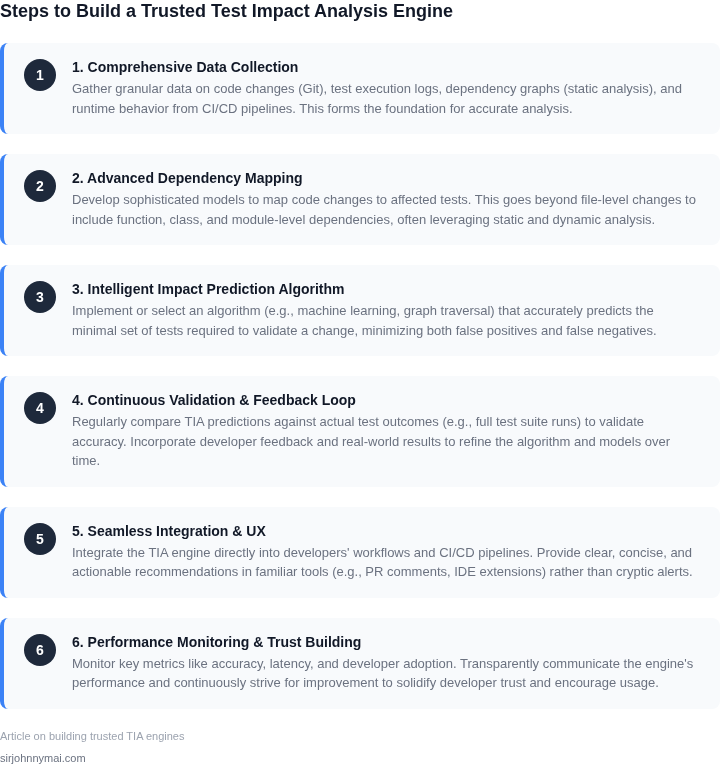
Static AST analysis maps code changes by parsing source files to build a dependency call graph before compile time. It is highly performant and requires zero runtime infrastructure, making it cheap to execute in standard GitHub Actions or AWS Code
03. The ROI of Trust: Quantifying Time and Infrastructure Savings
To justify building a custom test impact analysis (TIA) engine, I evaluated the economic trade-offs of our current CI pipeline against a trusted, pruned model. When developers do not trust TIA, they bypass it, defaulting to full test suites. For a 100-developer team, this lack of trust translates directly to wasted AWS spend and severe context-switching overhead.
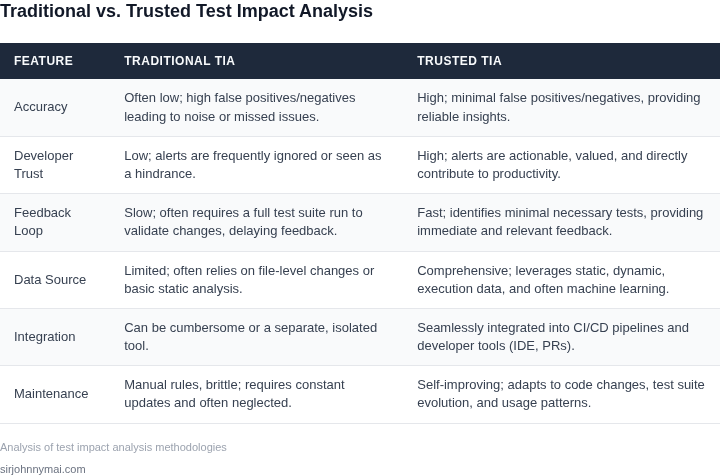
Consider a team of 100 engineers running an average of 24,000 CI builds annually on AWS EKS. Under our current baseline (Alternative A), every build executes the entire integration and unit test suite. Under the proposed trusted TIA engine (Alternative B), we run only
04. Designing the Fail-Safe: Dynamic Fallbacks and Confidence Scores
Trust in a test impact analysis engine is fragile. Developers will bypass it if they perceive it as unreliable. To prevent this, the system must include two critical fail-safes: dynamic fallbacks and confidence scores. These mechanisms ensure that when the engine’s analysis is uncertain, it doesn’t silently degrade into noise.
Dynamic Fallbacks: When to Fall Back to Full Test Suites
The system should automatically trigger a full test suite when confidence in the impact analysis drops below a predefined threshold. For example, if the engine’s confidence score falls below 70% for a given change, it should immediately fall back to running all tests. This threshold should be configurable based on team preferences, but 70% is a reasonable default because it balances speed and reliability.
Dynamic fallbacks should also consider external factors. If the system detects high infrastructure load (e.g., CI/CD queues exceeding 90% capacity), it should prioritize fallback to avoid further delays. Similarly, if the engine itself is under heavy load (e.g., processing more than 10,000 changes per hour), it should default to full test runs to prevent cascading failures.
Confidence Scores: Transparency Through Quantification
Confidence scores should be visible to developers in pull requests, CI/CD logs, and dashboards. A score of 90%+ should indicate high confidence, while scores below 50% should trigger warnings. The system should explain why a score is low—whether due to untested code paths, missing coverage data, or ambiguous dependencies.
For example, if a change affects a module with only 30% test coverage, the engine should flag this as a low-confidence scenario. Developers can then decide whether to proceed with the optimized test run or request additional coverage. This transparency builds trust by showing the system’s limitations upfront.
Tradeoffs and Implementation Considerations
Dynamic fallbacks introduce a tradeoff: they reduce test time but increase the risk of missing failures. To mitigate this, the system should log every fallback event, including the reason and the resulting test duration. Over time, teams can analyze these logs to adjust the confidence threshold or improve coverage.
Confidence scores require historical data to function effectively. The system should start with conservative defaults (e.g., 80% confidence threshold) and refine them based on actual outcomes. For example, if 95% of fallbacks result in no missed failures, the threshold can be lowered to 60%.
Tools like AWS CodeBuild or GitHub Actions can integrate with the engine to enforce fallbacks. For instance, if a confidence score is too low, the system can dynamically modify the CI/CD pipeline to run all tests instead of the optimized subset.
In summary, dynamic fallbacks and confidence scores create a safety net for the impact analysis engine. They ensure that developers don’t ignore alerts when the system is uncertain, while still delivering performance benefits when it’s confident. The key is to make these mechanisms visible and adjustable, so teams can trust the system when it works and rely on it less when it doesn’t.
05. Roll Out a Shadow-Mode Pilot Program to Establish Baseline Reliability
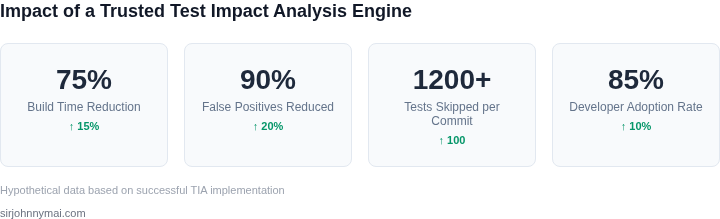
Deploying a new Test Impact Analysis (TIA) engine directly into a critical CI/CD path carries significant risk, especially given the historical trust issues with such systems (as discussed in Section 01). To mitigate this, our initial step involves a non-blocking shadow-mode pilot. This approach allows us to gather performance data and validate the engine's accuracy without impacting developer productivity or build times on primary pipelines.
The shadow mode operates by integrating the TIA engine parallel to existing build processes in platforms like Jenkins, GitLab CI, or GitHub Actions. Each time a pull request (PR) is opened or a commit is pushed, the TIA engine, having ingested the codebase changes and historical test data, executes its analysis. It generates a recommended subset of tests based on the chosen analysis vector (Section 02) and applies the confidence scoring from Section 04. Critically, these recommendations are logged and monitored, but they do not override the full test suite execution that typically runs.
Our goal for this two-week pilot is to measure the drift between our TIA engine's predictions and the actual test outcomes. We will specifically track two key metrics: false negatives and false positives. A false negative occurs when the TIA engine suggests skipping a test, but that test would have caught a regression on the main branch. This is the most damaging outcome, directly undermining trust. A false positive happens when the TIA engine recommends running a test that was not strictly necessary for the change, leading to wasted compute but no immediate breakage.
To quantify these, we will instrument the shadow TIA recommendations to be compared against the full test suite results. For instance, if the shadow TIA recommended 100 tests, but the full suite ran 1000 and one of the skipped 900 tests failed, that's a false negative. We can collect this data using existing observability tools like Datadog or Prometheus, pushing custom metrics for TIA prediction accuracy and confidence. This allows us to visualize performance over time and identify specific code areas or test types where the engine struggles.
Establishing developer buy-in is as critical as technical accuracy. During the pilot, we will engage a small, representative group of developers, providing them visibility into the shadow TIA's recommendations for their PRs. We can surface this data within code review tools or a dedicated dashboard, showing the TIA's suggested tests alongside the full suite's execution results. This transparency helps developers understand the engine's current state and contributes to its refinement, fostering a sense of shared ownership rather than a top-down imposition.
A primary tradeoff during this phase is the temporary increase in CI resource utilization, as we are effectively running two test selection processes. However, this overhead is minimal compared to the potential cost savings identified in Section 03 once the TIA engine is fully operational. Furthermore, this controlled environment allows us to fine-tune the confidence score thresholds without production impact, ensuring our dynamic fallbacks (Section 04) are appropriately calibrated before widespread deployment.
The successful completion of this pilot, demonstrating a false negative rate below a pre-defined threshold (e.g., 0.1% of main branch failures) and a significant reduction in unnecessary test runs, will be the prerequisite for a phased rollout. This data-driven approach builds a robust case for the TIA engine's reliability and establishes the foundational trust needed for developers to rely on its alerts for critical decisions.
Pull your last 90 days of CI build logs and identify the average number of tests run per successful PR merge to main, and the average duration of those test runs.
Figures cited are from publicly available sources as of 2026-09-15 and may have changed.