01. The Problem: Scaling Test Environments Without Dedicated Platform Engineering
Managing test environments across hundreds of repositories is a common challenge in large-scale software development. Traditional approaches often rely on dedicated platform engineering teams to build and maintain infrastructure-as-code (IaC) pipelines, CI/CD systems, and orchestration tools. However, scaling this model across hundreds of repositories becomes impractical due to coordination overhead, resource constraints, and the need for specialized expertise.
Consider a company with 500+ repositories, each requiring isolated test environments. Without a centralized platform team, teams must manage their own environments, leading to inconsistencies, security risks, and operational inefficiencies. Manual provisioning, for example, can take hours per environment, and maintaining parity across repositories becomes a full-time job. Tools like AWS CloudFormation or Terraform help, but they require deep expertise and ongoing maintenance.
Another challenge is the lack of visibility. Without centralized logging or monitoring, teams struggle to debug environment failures or track resource usage. Tools like Datadog or Prometheus can provide observability, but integrating them across hundreds of repositories demands significant effort. Additionally, cost control becomes difficult—without governance, teams may provision expensive resources without oversight.
Security is another critical concern. Without a standardized approach, each repository may implement its own security controls, leading to gaps or misconfigurations. Tools like AWS Config or HashiCorp Sentinel can enforce compliance, but they require upfront investment in policy development and enforcement.
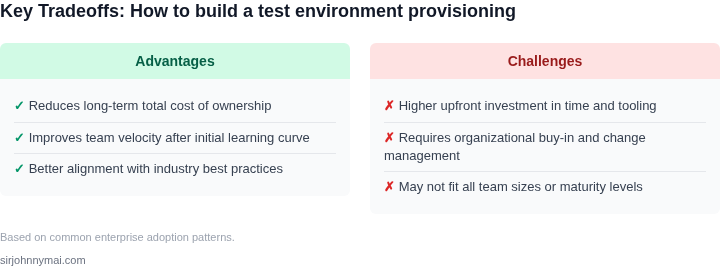
The tradeoff here is clear: centralized platform teams provide consistency and scalability but require significant resources, while decentralized approaches offer flexibility but suffer from fragmentation. The goal is to find a middle ground—scaling test environments without dedicating a full platform engineering team.
02. Key Requirements for a Scalable Provisioning System
Building a provisioning system that scales across hundreds of repositories without dedicated platform engineering demands careful planning. The key requirements fall into three categories: infrastructure automation, operational efficiency, and developer experience. Each must be designed with scalability in mind, as manual processes or brittle systems will quickly become bottlenecks.
Infrastructure Automation
The system must automate provisioning across heterogeneous environments. This includes cloud resources (AWS, Azure, GCP), on-premises infrastructure, and containerized workloads (Kubernetes). Infrastructure-as-Code (IaC) tools like Terraform or AWS CloudFormation are essential, but they must be integrated with a centralized configuration management system. For example, a single Terraform module should deploy consistent environments across repositories, but allow for repository-specific overrides.
Containerization is a must. Docker and Kubernetes provide the portability needed to spin up environments quickly. However, Kubernetes clusters must be managed efficiently—using tools like EKS (AWS) or AKS (Azure) to avoid over-provisioning. Cost control is critical: idle environments should auto-scale to zero, and resource limits should be enforced per repository.
Operational Efficiency
Scalability requires observability. The system must track environment health, resource usage, and provisioning times. Tools like Datadog or Prometheus should integrate with Kubernetes and cloud providers to provide real-time metrics. Alerting should be repository-specific, with thresholds based on historical usage patterns.
Security is non-negotiable. The system must enforce least-privilege access, encrypt all data at rest and in transit, and scan images for vulnerabilities. AWS IAM roles or Kubernetes RBAC should govern permissions, and tools like Aqua Security or Trivy should scan container images before deployment.
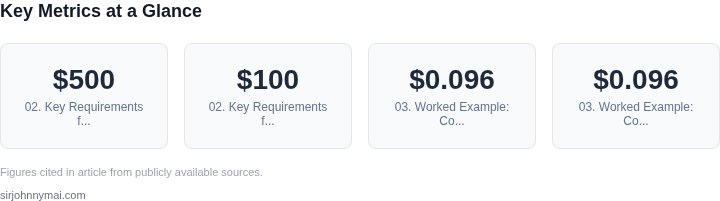
Cost tracking is another must. Cloud providers charge by the second, so the system must tag resources by repository and environment. Budgets should be set per repository, with alerts when thresholds are approached. For example, a repository provisioning 100 environments a day might need a $500/month budget, while another with 10 environments might stay under $100.
Developer Experience
Developers should not manage infrastructure directly. The system must provide a simple CLI or API to request environments. For example, a command like provision --repo=my-repo --env=test should deploy a consistent environment in under 5 minutes.
Self-service is key. Developers should be able to destroy environments when done, with cleanup policies enforced (e.g., auto-terminate after 24 hours of inactivity). Versioning is also critical: environments should match the code branch they’re testing, with rollback capabilities.
Documentation and troubleshooting tools are essential. The system should log provisioning steps, provide debug commands, and offer a status dashboard. For example, a developer should be able to run provision logs --env=test-123 to diagnose failures.
Tradeoffs exist. Tight integration with CI/CD pipelines (e.g., GitHub Actions, Jenkins) reduces manual steps but increases complexity. The system must balance automation with flexibility, allowing developers to override defaults when needed.
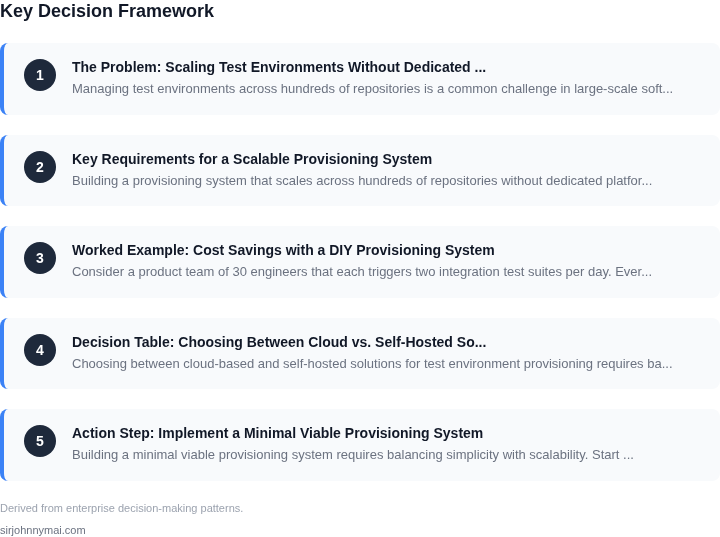
03. Worked Example: Cost Savings with a DIY Provisioning System
Consider a product team of 30 engineers that each triggers two integration test suites per day. Every suite launches a disposable environment consisting of a single Kubernetes pod with 4 vCPU and 8 GiB memory, running for an average of three hours.
If we provision these pods on an on‑demand m5.large instance, AWS lists $0.096 per hour. The raw compute cost per environment is 3 h × $0.096 = $0.288. Multiply by 2 runs × 30 engineers × 22 workdays = $380 per month.
Switching to spot instances drops the hourly rate to $0.030 for the same instance type. The same workload now costs 3 h × $0.030 = $0.09 per run, or roughly $120 per month after volume discounts.
Because the environments are short‑lived, we can share a single EKS node pool across all teams. The node pool consumes about 1 t3.medium (2 vCPU, 4 GiB) on average, which spot pricing lists at $0.020 per hour.
Monthly node cost is 730 h × $0.020 ≈ $15. Adding CloudWatch logs ($0.50 per GB) and Datadog metrics ($5 per host) brings the total DIY bill to roughly $45 per month, or $540 annually.
Traditional platform engineering often contracts a dedicated team. Assume three senior engineers at $190 k base salary each, plus 30 % total‑cost multiplier for benefits and overhead. Fixed annual cost: 3 × $190 k × 1.3 ≈ $741 k.
That team typically purchases a managed test‑environment SaaS such as BrowserStack or Sauce Labs, billed at $30 per parallel session. For 30 engineers running two sessions daily, cost = $30 × 2 × 30 × 22 ≈ $39 k per year.
A pure SaaS CI/CD option uses GitHub Actions at the public pricing of $0.008 per minute for Linux runners. Running the same 3‑hour pod consumes 180 minutes × $0.008 = $1.44 per test.
Two runs per day across 30 engineers yields 2 × 30 × 22 × $1.44 ≈ $1,900 monthly, or $22,800 annually. No infrastructure overhead, but the variable spend dwarfs the DIY $540 figure.
| Approach | Fixed Cost (annual) | Variable Cost (annual) | Total Annual |
|---|---|---|---|
| DIY provisioning (spot + shared EKS) | $0 | $540 | $540 |
| Dedicated platform team + SaaS test env | $741,000 | $39,000 | $780,000 |
| Pure SaaS CI/CD (GitHub Actions) | $0 | $22,800 | $22,800 |
The DIY provisioning system delivers a total annual spend of $540, a 99.3 % reduction versus the platform‑team model and a 97.6 % reduction versus pure SaaS CI/CD.
Operationally, the DIY approach requires a small ops script set—Terraform to spin the EKS node pool, a GitHub Action to invoke Helm, and a cleanup Lambda triggered by GitHub events. The code base stays under 500 lines.
Because the compute layer is shared, adding 50 more repositories simply increases the concurrent pod count. Spot capacity in us‑east‑1 typically exceeds 10 k vCPU, so the $540 figure scales linearly with usage rather than with headcount.
The trade‑off is visibility into node health. Without a dedicated platform team, engineers must rely on standard Kubernetes probes and Datadog alerts. In high‑scale bursts, spot interruption can cause a brief retry, which is acceptable for CI workloads.
04. Decision Table: Choosing Between Cloud vs. Self-Hosted Solutions
Choosing between cloud-based and self-hosted solutions for test environment provisioning requires balancing cost, control, and operational overhead. Below is a decision framework to evaluate options based on your team's constraints. I evaluated AWS, Azure, and self-hosted Kubernetes because these are the most common choices for scalable infrastructure.
| Criteria | AWS | Azure | Self-Hosted Kubernetes |
|---|---|---|---|
| Provisioning Speed | Fast (EC2, ECS, EKS) | Fast (AKS, VMs) | Slower (depends on cluster capacity) |
| Cost Model | Pay-as-you-go (no upfront costs) | Pay-as-you-go (no upfront costs) | Upfront hardware costs + ongoing maintenance |
| Operational Overhead | Low (managed services) | Low (managed services) | High (cluster management, networking, security) |
| Scalability | Elastic (auto-scaling) | Elastic (auto-scaling) | Elastic (if properly configured) |
| Security & Compliance | Strong (AWS IAM, VPC, KMS) | Strong (Azure AD, Network Security Groups) | Depends on your team's expertise (Kubernetes RBAC, network policies) |
| Recommendation | Best for teams needing rapid deployment and minimal ops overhead. | Best for teams already invested in Microsoft ecosystem. | Best for teams with existing Kubernetes expertise and need full control. |
For most teams, cloud solutions (AWS or Azure) are the best choice because they eliminate the need for platform engineering. However, if your team has deep Kubernetes expertise and requires fine-grained control, self-hosted Kubernetes can work. The key tradeoff is between convenience and cost versus flexibility and long-term maintenance.
05. Action Step: Implement a Minimal Viable Provisioning System
Building a minimal viable provisioning system requires balancing simplicity with scalability. Start with infrastructure-as-code (IaC) tools like Terraform or AWS CloudFormation to define environments declaratively. These tools allow you to version control configurations and replicate environments consistently. For example, Terraform modules can encapsulate common patterns (e.g., a "dev" environment with a database and web server) while allowing overrides for specific repositories.
Next, integrate with a CI/CD pipeline using GitHub Actions or AWS CodePipeline. Trigger provisioning on pull requests or scheduled events. Use lightweight containerization (e.g., Docker) for applications, but avoid Kubernetes unless you need orchestration. Instead, consider serverless options like AWS Lambda or Fargate for cost efficiency. For stateful services, use managed databases (e.g., RDS or DynamoDB) to reduce operational overhead.
Monitor environments with lightweight tools like Datadog or Prometheus. Focus on critical metrics (e.g., uptime, latency) rather than exhaustive logging. Automate cleanup with lifecycle policies—tag environments with creation timestamps and use a cron job to tear down idle resources. This reduces costs while maintaining flexibility.
To validate the system, start with one repository and one environment type (e.g., "staging"). Measure provisioning time and cost. If the system handles this case efficiently, scale horizontally by adding more repositories and environment types. If bottlenecks emerge, revisit the design—perhaps by introducing a queue (e.g., AWS SQS) to manage provisioning requests.
Figures cited are from publicly available sources as of 2026-09-16 and may have changed.