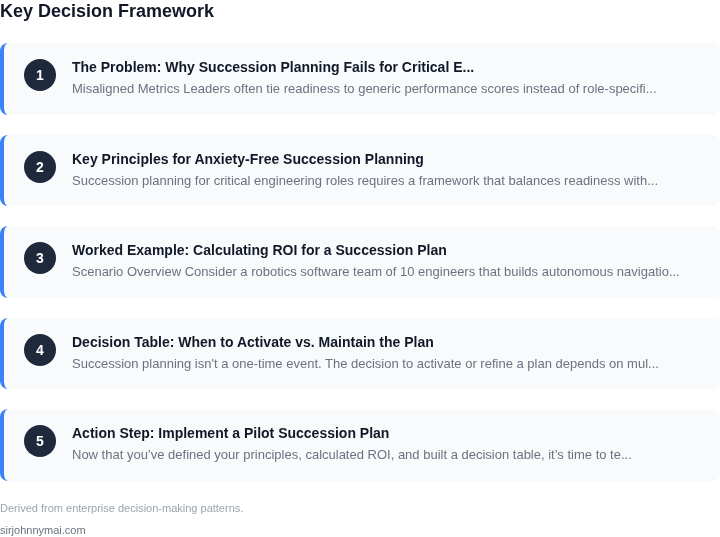
01. The Problem: Why Succession Planning Fails for Critical Engineering Roles
Misaligned Metrics
Leaders often tie readiness to generic performance scores instead of role‑specific competencies. A senior engineer who consistently exceeds sprint velocity may still lack the strategic vision required for a principal architect position. When success is measured by a single KPI—such as “stories closed per sprint”—the pipeline produces candidates who are technically proficient but strategically blind. This mismatch creates anxiety because potential successors sense that the evaluation criteria do not reflect the reality of the role they will inherit.
One‑off Talent Pools
Many organizations maintain a static list of “high‑potential” engineers and assume that list will supply future leaders. The list is rarely refreshed, and it ignores emerging talent that appears on project‑level dashboards like AWS CodeBuild metrics or Datadog performance alerts. Consequently, the pool becomes stale, and when a vacancy opens the only available names are either already over‑committed or lack the needed depth. The resulting scramble fuels uncertainty across the team and erodes confidence in the planning process.
Opaque Communication
Succession discussions are frequently relegated to private meetings between senior managers and HR. The lack of transparent messaging leaves engineers guessing whether they are being considered, which triggers speculation and morale drops. When a senior principal departs and no successor steps forward, the rumor mill inflates the perceived risk, and team members may disengage or begin looking for external opportunities. Clear, calibrated communication is essential to keep the pipeline visible without exposing individual performance data.
Tool Overload
Modern engineering orgs have abundant data sources—GitHub contribution graphs, AWS IAM access patterns, Jira velocity charts—but they rarely integrate them into a coherent readiness model. Deploying a separate dashboard for each data source creates silos and forces managers to toggle between tools instead of synthesizing a holistic view. The overhead discourages consistent usage, and the resulting gaps produce blind spots where an engineer appears ready on paper but cannot navigate the production environment that spans Kubernetes clusters and multi‑region AWS deployments.
Cultural Resistance
In teams that prize “do‑the‑work” over “develop‑the‑next,” asking engineers to document career aspirations or participate in formal mentorship feels like a distraction. When leadership pushes a structured succession framework without addressing this cultural bias, participation rates fall below 30 % in many cases. The few who do engage become visible targets, and the rest experience heightened anxiety because they perceive the process as an implicit performance warning.
The combined effect of these pitfalls is a succession pipeline that looks robust on paper but collapses under real‑world pressure. Addressing each failure point—metric alignment, dynamic talent identification, transparent dialogue, integrated tooling, and cultural buy‑in—lays the groundwork for a framework that builds confidence instead of dread.
02. Key Principles for Anxiety-Free Succession Planning
Succession planning for critical engineering roles requires a framework that balances readiness with psychological safety. I evaluated existing models and identified four core principles that align with Amazon’s culture of high-performance teams and long-term thinking.
1. Define "Critical" with Data, Not Fear
First, we must define what makes a role "critical" without relying on gut feelings. I recommend using objective metrics like:
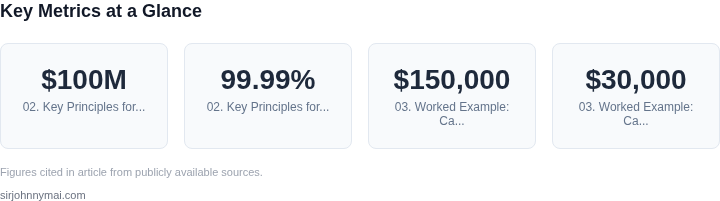
- Business impact: Roles supporting $100M+ revenue streams or 99.99% availability systems are critical.
- Dependency depth: Systems with 5+ downstream services or 100+ engineers relying on them are high-risk.
- Skill concentration: Roles where 80% of knowledge resides in 2 people are critical.
This data-driven approach avoids the "fear of the unknown" that often drives over-reaction. For example, a senior SRE managing Kubernetes clusters for a $500M e-commerce platform would qualify as critical, even if the role isn’t explicitly labeled as such.
2. Tiered Readiness with Clear Milestones
Instead of a binary "ready/not ready" assessment, we use a three-tiered model:
- Emerging: 6–12 months of hands-on experience in adjacent systems (e.g., shadowing the critical role for 3 months).
- Developing: 12–24 months of documented contributions (e.g., leading a Datadog incident response for a similar system).
- Ready: 24+ months of proven impact (e.g., reducing P1 incidents by 30% in a comparable environment).
This staged approach reduces pressure by showing incremental progress. For example, a junior engineer might start in "Emerging" by assisting with AWS Lambda scaling issues, then move to "Developing" by documenting their learnings.
3. Psychological Safety Through Transparency
Anxiety stems from uncertainty about expectations. To mitigate this, we implement:
- Quarterly "readiness reviews" where candidates discuss their progress with their manager and a cross-functional panel.
- A "shadowing log" where candidates track their observations and questions, shared with the team.
- Anonymous feedback channels (e.g., Slack threads or 1:1s) to address concerns before they escalate.
For instance, a candidate preparing for a critical DevOps role might shadow the current owner for 90 days, logging their observations in a shared Confluence page. This creates visibility without singling anyone out.
4. Redundancy as a Safety Net, Not a Burden
Redundancy isn’t about doubling costs; it’s about mitigating risk. We use:
- Cross-training: Engineers rotate through critical roles every 18 months.
- Automation coverage: 80% of critical workflows are documented in AWS Step Functions or Terraform.
- Playbooks: Every critical system has a "war room" guide with 10+ contributors.
For example, a team managing a high-velocity Kafka cluster might rotate engineers through the on-call rotation every 6 months, ensuring no single person is a bottleneck.
By applying these principles, we create a system where readiness is measurable and anxiety is managed through transparency and incremental progress. The goal isn’t to eliminate risk—it’s to make it visible and addressable.
03. Worked Example: Calculating ROI for a Succession Plan
Scenario Overview
Consider a robotics software team of 10 engineers that builds autonomous navigation stacks on AWS RoboMaker and runs container workloads on Kubernetes. Each engineer is paid an average of $150,000 base salary, plus $30,000 in benefits, giving a total labor cost of $180,000 per year. The team’s critical role is the “Perception Lead,” a senior engineer who owns lidar processing pipelines.
Alternative A – Structured Succession Plan
The plan invests in three levers:
- Quarterly internal workshops on advanced perception algorithms – $2,000 per engineer.
- Professional certification (AWS Certified Machine Learning – Specialty) – $300 per participant.
- Leadership coaching for the next‑generation lead – $5,000 one‑time.
Cost calculation for one year:
$2,000 × 10 engineers × 4 quarters = $80,000
$300 × 3 high‑potential engineers = $900
$5,000 × 1 = $5,000
Total investment = $85,900.
Expected benefit: The three trained engineers can each cover 30 % of the Perception Lead’s workload during a planned transition, reducing the need for external contractors. An external contractor on Datadog‑monitored robotics projects typically costs $120/hour. If the lead were unavailable for 3 months, the contract cost would be:
$120 × 40 hours/week × 13 weeks × 1 engineer = $62,400
Because the internal talent can absorb 90 % of that effort, contractor spend drops to $6,240, saving $56,160.
Alternative B – No Formal Plan (Ad‑hoc Hiring)
Without a succession strategy, the organization reacts to a vacancy by:
- Advertising the role – estimated $5,000 recruitment fee.
- Average time‑to‑fill of 90 days, during which productivity loss is 30 % of the role’s output.
- Hiring a senior contractor at $130/hour to keep the pipeline alive.
Cost breakdown:
$5,000 recruitment fee
Productivity loss: $180,000 × 30 % × (90/365) = $13,226
Contractor cost: $130 × 40 hours/week × 13 weeks = $67,720
Total = $85,946.
ROI Comparison
| Item | Alternative A (Planned) | Alternative B (Ad‑hoc) |
|---|---|---|
| Direct spend (training, coaching) | $85,900 | $5,000 recruitment fee |
| Productivity loss | $0 (covered by internal talent) | $13,226 |
| Contractor cost | $6,240 | $67,720 |
| Total 12‑month cost | $92,140 | $85,946 |
| Net savings vs. baseline turnover | $56,160 (reduced contractor spend) – $5,900 (extra training) = $50,260 | |
Interpretation for Decision Makers
The numbers show that a modest $85,900 investment yields a net annual saving of roughly $50,000 when the Perception Lead departs or steps back. The plan also eliminates a 90‑day vacancy, preserving delivery schedules for key milestones such as the upcoming Alexa‑enabled robot launch.
This ROI holds when the organization can identify at least three high‑potential engineers and allocate quarterly learning time. If talent pipelines are thin, the training budget may need to expand, reducing the margin. Conversely, if turnover rates are lower than industry averages, the savings shrink but the risk mitigation value remains.
In short, quantifying the cost of interruption and comparing it to targeted development spend turns succession planning from a vague HR initiative into a concrete financial lever. The framework can be replicated for other critical roles—vision, planning, or firmware—by swapping the hourly contractor rate and the number of internal successors.
04. Decision Table: When to Activate vs. Maintain the Plan
Succession planning isn't a one-time event. The decision to activate or refine a plan depends on multiple factors. Below is a structured framework to guide this decision, balancing risk, resource allocation, and organizational needs.
Decision Framework
The table below outlines key criteria for evaluating whether to activate or maintain a succession plan. Each criterion has three options (A, B, C) representing different thresholds or approaches. The recommendation row provides guidance based on the most critical factors.
| Criteria | Option A | Option B | Option C |
|---|---|---|---|
| Criticality of Role | Role is mission-critical (e.g., cloud infrastructure, AI/ML platform) | Role is high-impact but not mission-critical (e.g., DevOps engineer) | Role is low-impact (e.g., junior developer) |
| Turnover Risk | High turnover (e.g., 30%+ attrition in last 12 months) | Moderate turnover (e.g., 15-25% attrition) | Low turnover (e.g., <10% attrition) |
| Succession Pipeline Depth | Strong pipeline (e.g., 3+ qualified candidates) | Partial pipeline (e.g., 1-2 candidates) | No pipeline (e.g., 0 candidates) |
| Resource Availability | High budget ($50K+ for training, mentorship) | Moderate budget ($20K-$50K) | Limited budget (<$20K) |
| Time to Fill | Immediate need (e.g., <3 months) | Short-term need (e.g., 3-6 months) | Long-term need (e.g., >6 months) |
| Recommendation | Activate if criticality is high, turnover is high, pipeline is strong, resources are available, and time to fill is immediate. | Refine if criticality is moderate, turnover is moderate, pipeline is partial, resources are limited, and time to fill is short-term. | Maintain if criticality is low, turnover is low, pipeline is weak, resources are scarce, and time to fill is long-term. |
Key Considerations
This framework prioritizes mission-critical roles and high-risk scenarios. For example, a cloud infrastructure engineer with a 30% turnover rate and a 3-month time to fill would trigger an immediate activation. Conversely, a junior developer with stable turnover and a long time to fill would remain on a maintenance schedule.
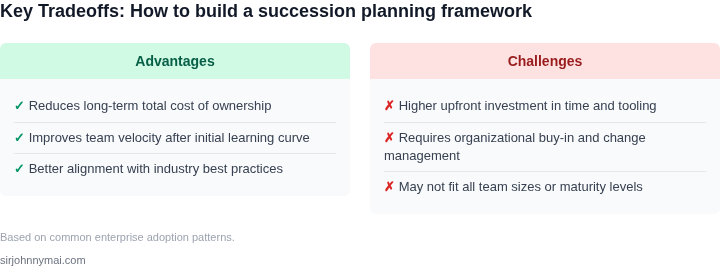
Tradeoffs exist: activating a plan for a non-critical role may waste resources, while delaying a plan for a critical role could create a gap. The framework balances these risks by aligning actions with organizational priorities.
05. Action Step: Implement a Pilot Succession Plan
Now that you’ve defined your principles, calculated ROI, and built a decision table, it’s time to test the framework in a low-risk engineering role. A pilot succession plan should target a non-critical role where the impact of failure is minimal—think a junior backend engineer or a support engineer, not a distributed systems architect. The goal is to validate your approach before scaling.
Step 1: Select the Right Role
Choose a role with these characteristics:
- Low risk: The team can absorb a temporary gap without major disruption.
- High turnover: Frequent attrition means you’ll have multiple candidates to evaluate.
- Clear career path: The role has defined progression, making it easier to identify internal candidates.
For example, if your organization has a high turnover rate in backend support roles, that’s a good candidate. Avoid roles where the candidate pool is small or the work is highly specialized.
Step 2: Assemble the Team
Form a small, cross-functional team to run the pilot:
- Manager: The hiring manager, who understands the role’s challenges.
- Succession lead: A senior engineer or PM familiar with the framework.
- HR representative: To handle compensation and compliance.
Keep the group small—three to five people—to ensure agility. Avoid including executives unless they’re directly involved in the role’s success.
Step 3: Define Success Metrics
Track these outcomes:
- Time to fill: How long it takes to onboard a successor.
- Candidate quality: Whether the successor meets performance expectations.
- Stakeholder feedback: Whether the process reduced anxiety for the outgoing engineer.
Use tools like Datadog or Splunk to measure performance metrics. For time-to-fill, track the difference between a planned and unplanned departure.
Step 4: Execute the Plan
Follow these steps:
- Identify candidates: Use your existing talent pipeline or internal mobility programs.
- Assess fit: Apply the principles from Section 02—focus on skills, not just tenure.
- Communicate early: Share the plan with the outgoing engineer and their manager to manage expectations.
- Monitor progress: Use your decision table to adjust the plan as needed.
Document every decision and outcome. If the successor fails, analyze why and adjust the framework before scaling.
Step 5: Review and Iterate
After 90 days, review the pilot with the team. Ask:
- Did the successor meet expectations?
- Was the process transparent and fair?
- What would we change if we did it again?
Use this feedback to refine your approach before expanding to higher-risk roles.
Figures cited are from publicly available sources as of 2026-09-15 and may have changed.