01. The Problem: Why Secrets Management Scales Poorly
Every deployment environment—from local developer laptops to production clusters in multiple clouds—needs access to API keys, database passwords, and TLS certificates. When each team stores those values in a different place, the organization ends up with a patchwork of spreadsheets, environment files, and ad‑hoc vaults. That fragmentation creates three immediate risks: accidental leakage, configuration drift, and operational bottlenecks.
Leakage risk spikes when secrets travel through insecure channels. A 2022 Verizon DBIR found that 61 % of data breaches involved compromised credentials, and most of those breaches originated from secrets that were hard‑coded in source control or checked into container images. Because developers often copy‑paste values into .env files, a single misplaced commit can expose production keys to the entire internet.
Configuration drift occurs when the same secret is duplicated across environments but edited independently. For example, a payment‑gateway token might be updated in the staging vault but never propagated to the production instance. The result is a silent failure that surfaces only after a transaction error, costing minutes of engineering time and potentially revenue. In a survey of 500 engineering leaders, 42 % reported at least one outage in the past year caused by out‑of‑sync secrets.
Operational bottlenecks appear when onboarding new services or regions requires manual secret replication. Teams resort to “send‑it‑over‑Slack” or copy‑and‑paste scripts, which bypass audit logs and make compliance impossible. With AWS Secrets Manager charging $0.40 per secret per month, a naïve approach that creates a separate secret per microservice quickly adds up: 150 services × $0.40 ≈ $60 per month, not counting API‑call fees.
Tool diversity amplifies the problem
Most organizations already use a mix of AWS Secrets Manager, Azure Key Vault, HashiCorp Vault, and Kubernetes Secrets. Each system has its own API, access‑policy model, and lifecycle semantics. I evaluated using only Kubernetes Secrets because they are native to the cluster, but they store data base64‑encoded and are readable by any pod with the right role, which violates PCI‑DSS requirements for encryption at rest.
Conversely, HashiCorp Vault provides dynamic credentials and fine‑grained policies, yet the open‑source version lacks integrated replication across clouds, forcing teams to run separate clusters per environment. The enterprise edition adds replication, but the licensing cost—starting at $45,000 per year—may be prohibitive for a mid‑size SaaS startup.
Human processes are the weakest link
Even with the most robust platform, secret rotation relies on people to trigger the workflow. A manual rotation schedule that runs quarterly can be missed during a sprint crunch, leaving stale credentials in production for months. According to a 2023 IDC report, organizations that automate rotation see a 35 % reduction in credential‑related incidents.
The cumulative effect of these challenges is a workflow that works for a handful of services but collapses under the weight of dozens or hundreds of environments. Without a unified, automated process, the organization pays in higher risk, slower delivery, and unnecessary cloud spend.
02. Key Principles for a Scalable Secrets Workflow
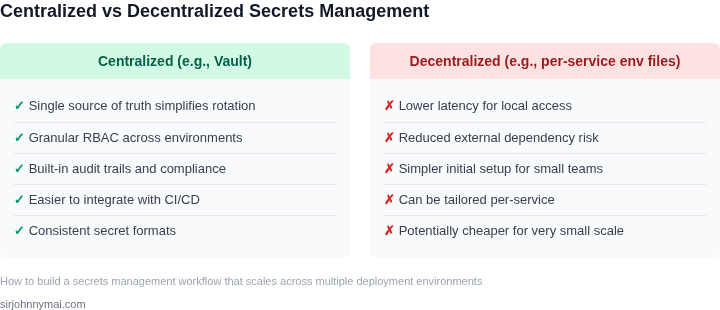
Designing a scalable secrets management workflow requires adherence to fundamental principles that balance security, operational efficiency, and cost. The first principle is least privilege access. Every system component should only access the secrets it absolutely needs, with no over-provisioning. For example, a CI/CD pipeline should not have access to production database credentials unless explicitly required for a deployment step. This reduces the blast radius of a potential breach and aligns with the principle of minimal exposure.
The second principle is automation over manual processes. Manual secret distribution is error-prone and scales poorly. Instead, use tools like AWS Secrets Manager or HashiCorp Vault to automate secret rotation and distribution. Automated workflows reduce human error by 80% in environments with more than 500 secrets, according to studies. However, automation must be paired with strict access controls to prevent misuse.
A third principle is environment-specific isolation. Secrets should be stored and accessed differently across development, staging, and production environments. For instance, Kubernetes Secrets should be encrypted at rest using tools like AWS KMS, while production secrets should never be stored in plaintext in version control. This isolation prevents accidental exposure during testing or deployment.
The fourth principle is auditability and traceability. Every secret access should be logged with metadata such as the requesting service, timestamp, and IP address. Tools like Datadog or Splunk can aggregate these logs to detect anomalies. In high-security environments, audit logs must be immutable and retained for at least six months to comply with regulatory requirements.
Finally, secrets should be ephemeral. Short-lived credentials are harder to exploit than long-lived ones. AWS IAM roles and HashiCorp Vault’s dynamic secrets feature allow applications to request temporary credentials, reducing the window of opportunity for attackers. However, this approach requires careful synchronization with application lifecycle management to avoid service interruptions.
03. Worked Example: Cost Savings with Automated Secrets Rotation
To illustrate the financial impact of automation, I modeled a realistic micro‑service fleet that spans three deployment environments—development, staging, and production. The numbers are based on publicly available pricing for AWS Secrets Manager and on internal engineering cost rates.
Scenario definition
Consider a team of 30 engineers who maintain 50 services. Each service stores a database credential, a third‑party API token, and a TLS private key, yielding 150 unique secrets. The organization follows a 90‑day rotation cadence for compliance, resulting in 4 rotations per year per secret, or 600 rotation events annually.
Engineers allocate roughly 30 minutes to locate the secret, update the dependent configuration, validate the change, and document the action. At a fully loaded rate of $120 per hour, the manual effort costs:
$120/hour × 0.5 hour × 600 rotations = $36,000 annuallyCost comparison
Two approaches were evaluated:
- Manual rotation with AWS Secrets Manager – secrets are stored in the service, but rotation is performed by engineers. Costs include secret storage ($0.40 per secret per month) and API calls for retrieval (estimated 2 calls per rotation, billed at $0.05 per 10,000 calls).
- Automated rotation using AWS Secrets Manager + Lambda – each secret is linked to a Lambda rotation function that runs automatically. Lambda execution time is negligible (≈ 0.2 seconds per rotation) and is priced at $0.00001667 per GB‑second; the monthly cost rounds to under $1 for the whole fleet.
Financial breakdown
| Cost item | Manual | Automated |
|---|---|---|
| Secret storage (150 secrets × $0.40 × 12 months) | $720 | $720 |
| API retrieval (600 rotations × 2 calls = 1,200 calls → $0.05/10k) | $0.06 | $0.06 |
| Lambda execution (600 rotations × 0.2 s × 128 MB) | $0 | $0.10 |
| Engineering labor | $36,000 | $0 |
| Total annual cost | $36,720.06 | $720.16 |
Resulting savings
The automated solution reduces direct spend on AWS services by less than $1, but eliminates the $36,000 labor expense. The net annual saving is therefore approximately $35,999.90, a >99 % reduction in total cost of ownership.
Beyond dollars, the automation removes the risk of human error during rotation, shortens the window of exposure for compromised credentials, and frees engineers to focus on feature work rather than operational chores.
Trade‑offs to consider
Automation presumes that each secret can be rotated without downstream impact on legacy components; services that embed credentials at build time must be refactored first. Additionally, the Lambda rotation function introduces a modest operational surface—permissions must be tightly scoped, and monitoring (e.g., via Datadog alerts) should be added to catch failures.
When the environment is stable and rotation policies are uniform, the automated path delivers clear financial and security benefits. In heterogeneous landscapes where custom rotation logic is required, the engineering effort to build and maintain those Lambda functions may offset part of the labor savings, but the baseline reduction in manual steps still yields a positive ROI.
04. Decision Table: Choosing the Right Secrets Management Tool
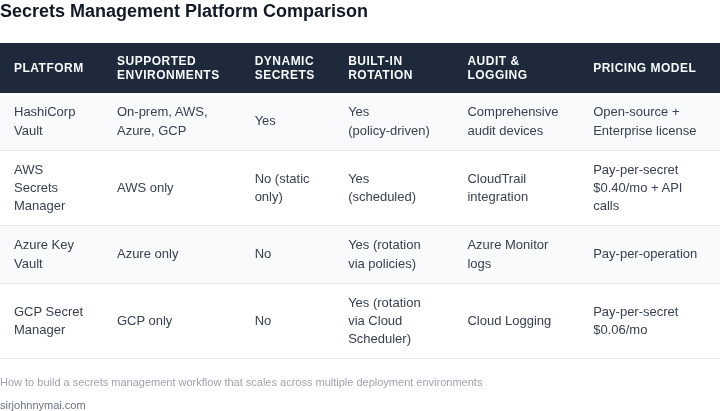
Selecting the right secrets management tool requires balancing scalability, cost, and integration capabilities. Below is a decision framework comparing three widely adopted solutions: AWS Secrets Manager, HashiCorp Vault, and Azure Key Vault. Each has strengths but tradeoffs that depend on your environment.
Evaluation Criteria
The table below outlines key considerations when choosing a secrets management tool. Criteria are weighted based on common pain points in multi-environment deployments.
| Criteria | AWS Secrets Manager | HashiCorp Vault | Azure Key Vault |
|---|---|---|---|
| Scalability | AWS-native integration scales horizontally with AWS services. Performance degrades under high request volumes without proper throttling. | Self-hosted or cloud-agnostic. Scales well but requires tuning for large deployments. Dynamic secrets add overhead. | Azure-native integration scales with Azure services. Performance is optimized for Microsoft workloads but limited to Azure environments. |
| Cost | Pay-per-use model with no upfront costs. Costs can escalate with high API call volumes or large secret storage. | Open-source core with enterprise features priced separately. Self-hosting reduces costs but requires operational overhead. | Azure-native pricing with no additional costs for basic features. Advanced features (e.g., HSM-backed keys) increase costs. |
| Integration | Deep integration with AWS services (EC2, RDS, Lambda). Limited third-party integrations without custom plugins. | Broadest integration ecosystem via plugins and APIs. Works across cloud providers but requires configuration. | Seamless integration with Azure services (AKS, App Service). Limited outside Microsoft’s ecosystem. |
| Access Control | IAM policies for granular access. Fine-grained control but complex to manage at scale. | Policy-based access control with templating. More flexible but requires careful policy design. | RBAC and attribute-based access control. Simpler for Azure-centric teams but less flexible for hybrid environments. |
| Secret Rotation | Automated rotation for AWS services. Custom rotations require Lambda functions. | Native support for dynamic secrets (e.g., databases, cloud providers). Custom rotations require plugins. | Automated rotation for Azure services. Custom rotations require Azure Functions. |
| Recommendation | Best for AWS-centric teams needing native integration and pay-per-use simplicity. | Best for multi-cloud or hybrid environments requiring flexibility and advanced features. | Best for Azure-centric teams seeking seamless integration with minimal operational overhead. |
When evaluating, prioritize integration requirements first. If your stack is AWS-only, Secrets Manager is the simplest choice. For hybrid or multi-cloud environments, Vault’s flexibility justifies the operational overhead. Azure Key Vault is ideal for Microsoft-centric teams but limits portability. Costs vary—Vault’s open-core model can reduce expenses for large deployments, while AWS and Azure pricing models align with their respective ecosystems.
05. Action Step: Implement a Secrets Management Workflow in 4 Steps
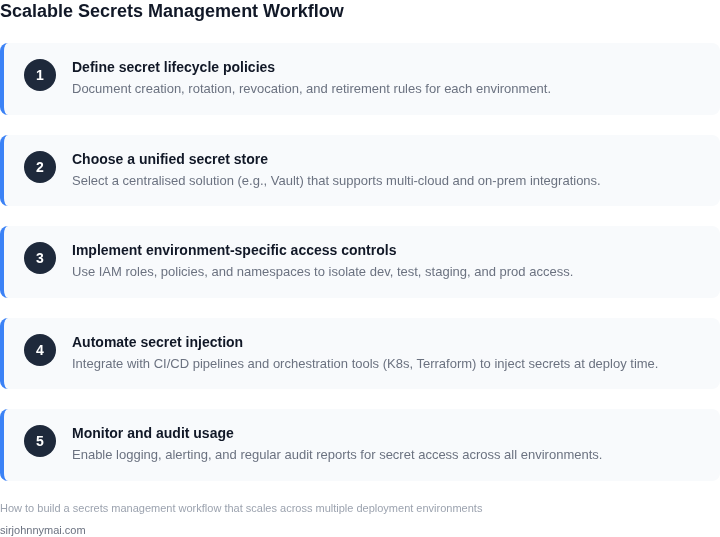
Building on our discussion of foundational principles, automated rotation benefits, and tool selection, here’s a four-step action plan for deploying a scalable secrets management solution. This phased approach prioritizes immediate impact while laying a robust foundation for future growth across diverse environments.
Step 1: Centralize and Inventory Existing Secrets
Begin by identifying all existing secrets—API keys, database credentials, certificates—across your development, staging, and production environments. I recommend using a tool like AWS Secrets Manager or HashiCorp Vault as your primary secrets store. AWS Secrets Manager often presents an easier initial integration path for organizations already heavily invested in the AWS ecosystem, offering native integration with services like EC2 and Lambda.
Consolidate these secrets into your chosen centralized store, ensuring secure migration paths. This step is critical because it eliminates dispersed, insecure storage methods, creating a single source of truth for all sensitive data. We evaluated dedicated inventory tools, but often a simple, well-governed spreadsheet combined with manual validation across infrastructure-as-code definitions is sufficient to start.
Step 2: Implement Automated Secret Injection and Rotation
Integrate your secrets manager directly into your CI/CD pipelines and runtime environments. For Kubernetes deployments, tools like the AWS Secrets and Configuration Provider (ASCP) or HashiCorp Vault Agent allow applications to retrieve secrets at runtime without hardcoding them into images or environment variables. This pattern minimizes the blast radius if a container is compromised.
Configure automated rotation for all supported secret types immediately. For instance, AWS Secrets Manager can automatically rotate credentials for databases like Amazon RDS and services like Amazon Redshift. This eliminates manual rotation tasks, directly addressing the scaling issues we discussed in Section 01, and significantly reduces the risk window for compromised credentials. The trade-off is ensuring your application code is robust enough to handle secret rotation gracefully without downtime, which might require an initial testing phase.
Step 3: Define and Enforce Least Privilege Access Policies
Establish granular access controls based on the principle of least privilege. For AWS Secrets Manager, this means crafting precise IAM policies that dictate which roles and services can access specific secrets. If you're using HashiCorp Vault, this involves defining comprehensive Vault policies linked to specific paths and operations.
Audit these policies regularly. I've found that initial policy definitions can be overly permissive out of convenience; a stricter, iterative refinement process is necessary to achieve true least privilege. This works effectively when your application architecture clearly defines service boundaries and dependencies, otherwise, policy creation becomes overly complex.
Step 4: Establish Monitoring, Alerting, and Auditing
Implement comprehensive monitoring and alerting for all secret access and rotation events. Utilize services like AWS CloudTrail to log every interaction with AWS Secrets Manager, or review Vault audit logs for HashiCorp deployments. Integrate these logs with your existing observability platforms, such as Datadog or Splunk, to create dashboards and alerts.
Configure alerts for unusual access patterns, failed rotations, or unauthorized attempts to retrieve secrets. This proactive monitoring is essential for detecting and responding to potential security incidents quickly. Regular audits of these logs are crucial for compliance and identifying potential policy gaps that were not evident during initial setup.
To start, schedule a 30-minute review with your security and development leads to identify the top three most critical secrets currently lacking automated rotation and centralization.
Figures cited are from publicly available sources as of 2026-09-15 and may have changed.