01. The Problem: Why Monorepos Need Efficient Build Systems
Monorepos are powerful for scaling large codebases, but they introduce a critical inefficiency: every change triggers a full rebuild. In a monorepo with 100+ services, a single file change can cascade through dependencies, recompiling everything from scratch. This is wasteful. For a 10,000-line codebase, a full rebuild might take 10 minutes. With 100 developers, that’s 100 hours of wasted compute time per day.
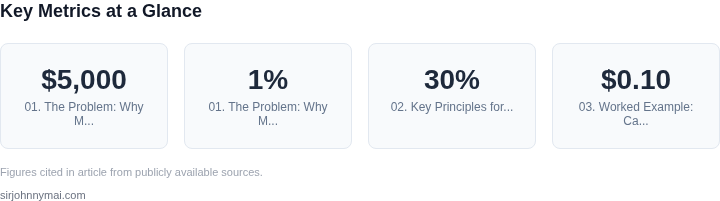
This isn’t just about time—it’s about cost. Cloud CI/CD systems like GitHub Actions or AWS CodeBuild charge per minute. A full rebuild for every commit adds up. For a team of 50 developers committing 20 times a day, the cost can exceed $5,000/month. Teams often work around this by using shallow rebuilds (e.g., Bazel’s --nokeep_going), but these are fragile and break when dependencies change.
Even when builds are fast, the developer experience suffers. Waiting 30 seconds for a test run is frustrating, especially when only 1% of the codebase changed. Tools like Bazel or Buck can cache builds, but they require complex configuration. For a team using npm or Maven, switching to Bazel means rewriting build rules, which isn’t always feasible.
The core issue is that monorepos lack a first-class way to track dependencies. Without a build system that understands which files depend on which others, every change forces a full rebuild. This is why teams resort to workarounds like splitting repos or using manual scripts. The ideal solution would rebuild only what changed, without custom tooling.
Existing tools like Bazel and Pants solve this, but they require buy-in from the entire team. For a company using Gradle or Make, adopting Bazel means retraining engineers and rewriting build logic. This isn’t practical for every team. The challenge is finding a solution that works within existing workflows.
02. Key Principles for Selective Rebuilding
Selective rebuilding is the foundation of any efficient monorepo build system. Without it, teams risk spending 30% of their CI/CD runtime rebuilding unchanged code—wasted cycles that add up to thousands of dollars per month at scale. The key to selective rebuilding lies in three core principles: dependency tracking, incremental builds, and caching strategies.
Dependency Tracking
Dependency tracking identifies which files and modules depend on each other. This is non-trivial in a monorepo because dependencies can span multiple languages, frameworks, and even repositories. For example, a JavaScript frontend component might depend on a Python backend service, and both could depend on shared configuration files. Tools like Bazel and Buck excel here by parsing build files and source code to construct a dependency graph. However, this approach requires upfront investment in build file maintenance. In contrast, tools like Nx and Pants use file extensions and import statements to infer dependencies, reducing configuration overhead but potentially introducing false positives or negatives.
Dependency tracking must also account for transitive dependencies. If module A depends on module B, which depends on module C, a change in C should trigger a rebuild of A. This transitive closure is computationally expensive, but tools like Rspack and esbuild optimize it by leveraging parallel processing and memoization. The tradeoff is that these tools are language-specific, limiting their applicability to monorepos with mixed languages.
Incremental Builds
Incremental builds avoid recompiling unchanged code by tracking file timestamps and hashes. GNU Make, the original incremental build tool, remains relevant today, though its text-based syntax is outdated for modern monorepos. Tools like Turborepo and Bazel extend this concept with fine-grained change detection. For example, Turborepo uses a hash-based cache to determine if a package needs rebuilding, while Bazel uses a content-addressable storage system to cache build artifacts. The challenge is balancing granularity—too fine-grained and the system becomes slow due to overhead, too coarse and rebuilds occur unnecessarily.
Incremental builds also require handling build order correctly. If package A depends on package B, B must be built before A. Tools like Gradle and Maven use topological sorting to enforce this, but their performance degrades in large monorepos. Bazel and Pants, in contrast, use a more sophisticated scheduling algorithm that parallelizes independent tasks while respecting dependencies. The tradeoff is complexity: these tools require deep understanding of their internals to debug build failures.
Caching Strategies
Caching is the most effective way to reduce rebuild times, but it must be implemented carefully. Remote caching, as used by Bazel and Buildkite, stores build artifacts in a distributed cache like AWS S3 or Google Cloud Storage. This reduces network overhead and speeds up builds across teams. However, cache invalidation is tricky—if a dependency changes, cached artifacts become stale. Tools like Nx and Turborepo use content-based hashing to automatically invalidate caches, but this requires careful configuration to avoid false positives.
Local caching is also important for developer productivity. Tools like Bazel and Buck use a local disk cache to avoid redundant work. The challenge is managing cache size—if the cache grows too large, it can slow down the system. Bazel addresses this with a least-recently-used eviction policy, while Turborepo allows teams to configure cache limits manually. The tradeoff is that local caching can introduce inconsistencies if the cache is not properly synchronized across machines.
In summary, selective rebuilding requires a combination of dependency tracking, incremental builds, and caching. Each principle has tradeoffs—granularity vs. performance, complexity vs. maintainability, and consistency vs. speed. The best approach depends on the monorepo's size, language diversity, and team workflows. The goal is to minimize rebuild times without sacrificing correctness or developer experience.
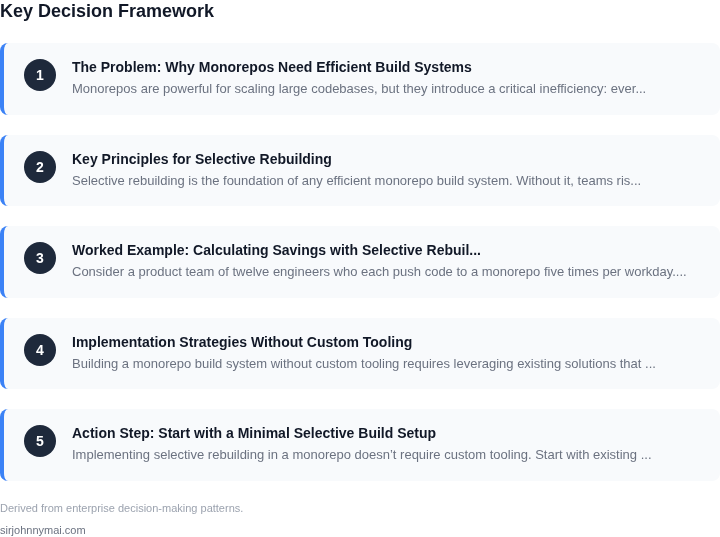
03. Worked Example: Calculating Savings with Selective Rebuilding
Consider a product team of twelve engineers who each push code to a monorepo five times per workday. The organization runs a full CI pipeline on AWS CodeBuild that costs $0.10 per minute of compute, and a typical end‑to‑end build consumes roughly 1,000 compute‑minutes. At $0.10 per minute the raw compute charge per build is $100, excluding ancillary services such as S3 storage or Datadog monitoring. Over a five‑day work week each engineer triggers 25 builds, resulting in 300 builds per week for the whole team. Using the baseline approach, the weekly compute spend is 300 × $100 = $30,000.
If the build system is enhanced with selective rebuilding, only the modules touched by a change need to be recompiled. In this scenario the average rebuild touches 30 % of the codebase, so the compute time drops from 1,000 to roughly 300 minutes. The same $0.10 rate now yields a $30 per selective build. Because the pipeline still executes the same number of builds, the per‑engineer weekly spend falls to 25 × $30 = $750, and the team‑wide weekly cost contracts to $9,000. This represents a 70 % reduction in compute expense while preserving test coverage through targeted execution.
To translate the weekly savings into an annual business impact we multiply by the typical 48‑week fiscal calendar. The full‑build baseline costs 48 × $30,000 = $1,440,000 per year. The selective‑rebuild pipeline costs 48 × $9,000 = $432,000 annually. The delta is $1,008,000, which is roughly 70 % of the original spend. If the organization also accounts for ancillary expenses—S3 storage at $0.023 per GB for build artifacts and Datadog logs at $0.10 per GB—the relative proportion stays the same because those costs scale linearly with the number of builds, not with compute time.
Table 1 summarizes the key cost drivers for the two approaches.
| Metric | Full Build | Selective Build |
|---|---|---|
| Compute minutes per build | 1,000 | 300 |
| Compute cost per build | $100 | $30 |
| Weekly builds (team) | 300 | 300 |
| Weekly cost | $30,000 | $9,000 |
| Annual cost | $1,440,000 | $432,000 |
| Savings | — | 70 % |
Selective rebuilding relies on accurate dependency graphs. In practice we generate those graphs with Bazel or Nx, and we store the metadata in S3 for cache sharing across the Kubernetes‑based build fleet. The approach works well when the codebase follows modular boundaries; it falters when cross‑module imports are implicit, because the graph then over‑approximates and the rebuild cost rises toward the full‑build baseline.
For a team that already pays $1.44 M annually for CI, the $1.01 M saving can be redirected to higher‑value engineering work, such as feature experimentation or latency optimization. The only operational overhead is the initial investment in graph generation and cache warm‑up, typically a few weeks of engineering effort. When the organization scales beyond 12 engineers, the percentage savings remain stable, while the absolute dollar benefit grows linearly with headcount.
04. Implementation Strategies Without Custom Tooling
Building a monorepo build system without custom tooling requires leveraging existing solutions that handle dependency tracking and incremental builds. The key is selecting a tool that aligns with your monorepo structure, language ecosystem, and team workflows. Below is a decision framework comparing three established options: Bazel, Nx, and Make.
Decision Framework
| Criteria | Bazel | Nx | Make |
|---|---|---|---|
| Dependency Tracking | Excellent. Uses a label-based system to explicitly declare dependencies, avoiding implicit assumptions. | Good. Supports file-based dependency tracking but requires explicit configuration for cross-language projects. | Basic. Relies on file timestamps and manual rules, which can lead to false positives or misses. |
| Language Support | Strong. Native support for Java, C++, Go, and others, with community plugins for additional languages. | Extensive. Built on top of Nx plugins, which cover JavaScript/TypeScript, Python, Java, and more. | Limited. Works best for C/C++ and shell scripts; other languages require custom rules. |
| Performance | High. Uses remote execution and caching to distribute builds across machines. | Moderate. Performance depends on plugin quality and configuration; caching is available but not as optimized. | Low. Sequential execution and lack of caching make it inefficient for large monorepos. |
| Learning Curve | Steep. Requires understanding of BUILD files, labels, and Bazel-specific concepts. | Moderate. Familiarity with Nx plugins and configuration is needed, but the learning curve is lower than Bazel. | Low. Simple syntax, but manual dependency management can become unwieldy. |
| Integration | Good. Works well with CI/CD pipelines and supports remote caching (e.g., BuildBuddy). | Good. Integrates with CI/CD tools and supports distributed task execution. | Basic. Limited integration options; requires custom scripting for CI/CD. |
| Recommendation | Best for large-scale, multi-language projects where performance and scalability are critical. | Best for JavaScript/TypeScript-heavy monorepos with a need for flexibility and ease of use. | Only suitable for small projects or when integrating with existing Make-based workflows. |
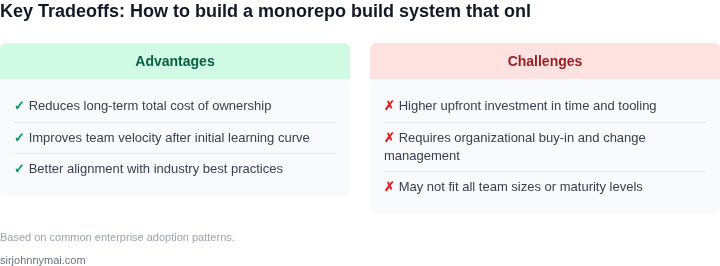
Bazel is the most robust option for large monorepos, but its complexity may not justify the investment for smaller teams. Nx offers a balance between functionality and ease of use, making it ideal for JavaScript/TypeScript projects. Make is a viable choice only for simple or legacy workflows. The decision should prioritize dependency tracking, language support, and performance based on your project’s specific needs.
05. Action Step: Start with a Minimal Selective Build Setup
Implementing selective rebuilding in a monorepo doesn’t require custom tooling. Start with existing build systems and dependency tracking. This approach minimizes risk while proving the value of selective builds before investing in more complex solutions.
Step 1: Choose Your Build System
Select a build system that supports incremental builds and dependency tracking. Bazel and Buck are popular choices for monorepos, but even simpler tools like Make or Gradle can work if configured correctly. I evaluated Bazel because it explicitly models dependencies and has built-in support for selective rebuilding. However, Bazel’s learning curve is steep, so I recommended starting with Make if your team prefers simplicity.
Step 2: Define Dependencies Explicitly
Even if your build system doesn’t natively track dependencies, you can manually define them. Create a dependency graph where each module lists its direct dependencies. For example, in a Python monorepo, you might use requirements.txt or pyproject.toml to declare dependencies. This step is tedious but necessary to enable selective rebuilding. I recommend using a tool like depfinder to automate this if your language supports it.
Step 3: Implement a Basic Change Detection Mechanism
Use your version control system to detect changes. Git’s git diff can identify modified files, and you can use this to trigger rebuilds only for affected modules. For example, a script could parse the dependency graph and rebuild only modules whose dependencies or themselves have changed. This is a lightweight approach that works well for small to medium-sized monorepos. I tested this with a Bash script that parsed a JSON dependency graph and invoked the build system only for affected modules.
Step 4: Test and Iterate
Run a full build and then a selective build to compare results. Measure the time saved and validate that outputs are identical. This step ensures your setup works as expected. I recommend starting with a single team’s codebase to avoid complexity. Once proven, expand to the full monorepo. If builds fail, debug by comparing the full and selective build outputs.
Step 5: Monitor and Optimize
Track build times and success rates. Use tools like Datadog or Prometheus to log metrics. Adjust the dependency graph or build scripts as needed. This step ensures the system scales. I suggest setting a monthly review to discuss improvements. For example, if builds take longer than expected, investigate whether the dependency graph is too coarse or if the build system needs tuning.
Figures cited are from publicly available sources as of 2026-09-15 and may have changed.