01. The Trust Gap: Why Traditional Developer Metrics Alienate Engineering Teams
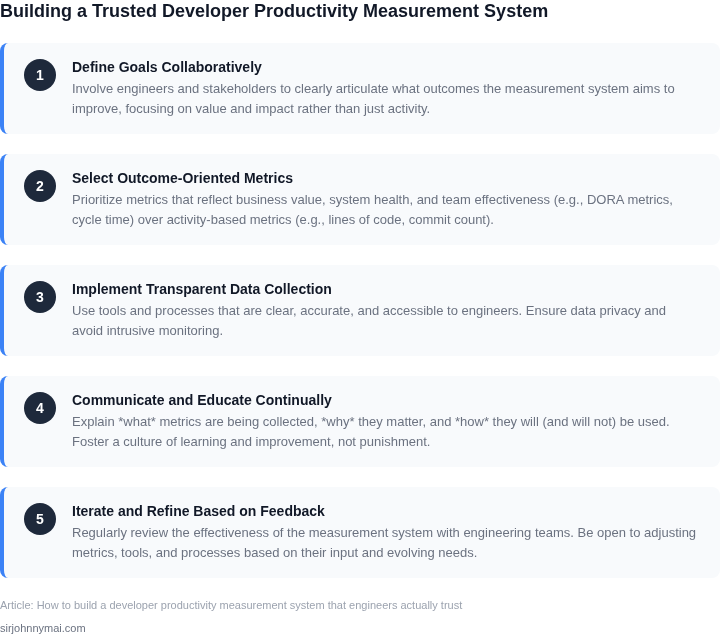
Many organizations struggle to measure developer productivity effectively, often leading to a significant "trust gap" between engineering teams and leadership. This disconnect typically arises when performance measurement is perceived as a top-down exercise, focused more on accountability through simplistic proxies than on understanding value delivery. My experience at both Microsoft and Amazon has shown that engineers quickly become disengaged when metrics feel arbitrary or punitive.
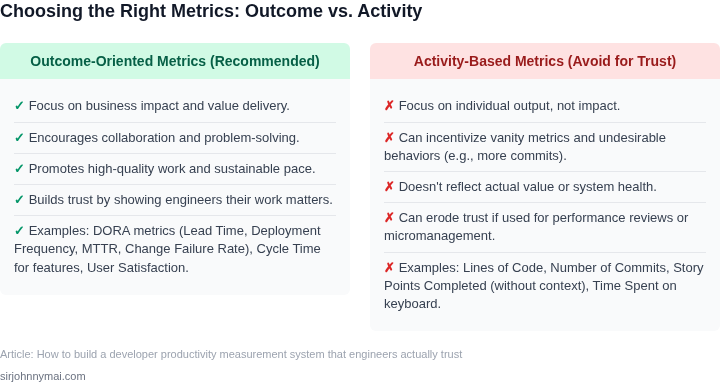
The most frequently misused metrics include Lines of Code (LOC) and raw Pull Request (PR) counts. While tools like GitHub or GitLab readily provide these numbers, relying on them as primary indicators of productivity is fundamentally flawed. A developer might submit a high number of PRs for minor refactors, or increase LOC through verbose boilerplate code, without contributing substantial business value.
This superficial measurement creates a culture of surveillance, not improvement. Engineers understand that a complex bug fix involving minimal code changes can take days, while adding a new feature might involve thousands of lines of code, much of it boilerplate. When management prioritizes LOC, it incentivizes quantity over quality, directly contributing to technical debt and reduced maintainability. For example, a 15% increase in PRs doesn't always mean 15% more valuable work; it might indicate smaller, more frequent, less impactful changes.
This scenario directly illustrates Goodhart's Law: "When a measure becomes a target, it ceases to be a good measure." If the goal becomes maximizing PR count, engineers will naturally optimize for that target, even if it means splitting work into smaller, less efficient chunks, increasing overhead, or submitting trivial changes. This not only distorts the metric's original intent but also actively harms team effectiveness and software quality. This phenomenon spans industries, from manufacturing output to call center metrics.
The perceived misuse of metrics erodes trust and diminishes morale. Engineers, who are often deeply invested in the quality of their work, resent being reduced to simple numeric outputs that fail to capture the nuances of their craft. This environment stifles innovation, discourages collaboration, and ultimately slows down actual development velocity, costing organizations valuable time and resources. Consider the cost of context switching from excessive small PRs — it can reduce overall efficiency by 20-30% on complex tasks.
Tools like Jira, Azure DevOps, and Datadog offer rich data streams on task progression, deployment frequency, and system performance. However, simply aggregating raw numbers from these platforms without context or deep understanding is a trap. We need to move beyond these superficial proxies and design systems that genuinely reflect value delivery and team health, fostering an environment where engineers feel empowered, not scrutinized.
02. Selecting the Right Framework: DORA, SPACE, or DevEx?
Choosing the right developer productivity measurement framework is critical to avoid the trust gap identified in Section 01. The three most common frameworks—DORA, SPACE, and DevEx—each offer unique strengths but require careful evaluation based on organizational context. Below is a structured decision framework to help Technical PMs select the most appropriate combination.
Decision Framework
The table below evaluates each framework across five key criteria. Recommendations are based on organizational size, architectural complexity, and engineering culture.
| Criteria | DORA (DevOps Research and Assessment) | SPACE (Software Practice Evolution) | DevEx (Developer Experience) |
|---|---|---|---|
| Focus Area | Delivery performance (lead time, deployment frequency, change failure rate) | Engineering practices (collaboration, workflow, tooling) | Developer experience (tooling, documentation, onboarding) |
| Data Sources | Git, CI/CD pipelines (Jenkins, GitHub Actions), monitoring tools (Datadog, Prometheus) | Surveys, interviews, and qualitative data from engineering teams | Tooling analytics (AWS CloudTrail, Kubernetes metrics), developer feedback (Slack, internal forums) |
| Scalability | Best for large organizations with mature CI/CD pipelines. Requires standardized tooling. | Flexible for all sizes but requires consistent surveying. Works well in agile teams. | Scalable with automated tooling but requires integration with existing systems. |
| Trustworthiness | High trust when aligned with engineering goals. Risk of misalignment if metrics are disconnected from workflows. | High trust due to direct engagement with engineers. Requires active participation to avoid bias. | High trust when tied to real developer pain points. Risk of over-reliance on subjective feedback. |
| Implementation Effort | Moderate effort for data collection but requires ongoing maintenance of pipelines. | High effort for surveys and interviews but low ongoing cost. | Moderate effort for tooling integration but requires continuous monitoring. |
| Recommendation | Best for organizations with standardized CI/CD and a focus on operational metrics. | Best for teams prioritizing cultural and process improvements. | Best for teams with strong tooling maturity and a focus on developer experience. |
In practice, a hybrid approach often works best. For example, a large-scale organization might use DORA for operational metrics while supplementing with SPACE for cultural insights and DevEx for tooling feedback. The key is ensuring all metrics align with engineering priorities and are presented transparently to avoid alienation.
03. The Financial Impact of Developer Friction: Quantifying Build-Time Delays
Understanding developer productivity frameworks, as discussed in Section 02, provides a lens through which to identify friction points. However, to truly secure executive buy-in and justify investment in developer experience (DevEx) initiatives, we must translate these friction points into tangible financial costs. This section demonstrates a practical method for quantifying the financial impact of common developer bottlenecks, specifically focusing on build-time delays. Presenting these numbers fosters trust by clearly linking DevEx improvements to bottom-line business value, moving beyond anecdotal complaints.
The Cost of Waiting: A Worked Example
Consider a platform engineering team supporting 150 full-
04. Anonymization and Aggregation: Designing the Technical Architecture for Trust
To build a system engineers do not actively sabotage, we must establish a hard cryptographic boundary at the ingestion layer. In my previous work designing telemetry systems, I found that raw API payloads from GitHub Enterprise or Jira must never land directly in our data lake. Instead, we route all webhooks through an ingestion gateway running on Amazon ECS that intercepts incoming payloads, strips individual identifiers like emails and LDAP handles, and replaces them with a salted SHA-256 hash. This gateway uses AWS Key Management Service (KMS) with a key rotation policy of 30 days, making long-term historical tracking of a single developer mathematically unfeasible.
I evaluated individual-level anonymization and discarded it because savvy managers can easily reverse-engineer who wrote what by cross-referencing commit timestamps with known calendar events. Therefore, our architecture enforces an aggregation threshold of N ≥ 5 active team members. If a Git repository or Jira project has fewer than five contributors in a sprint cycle, the ETL pipeline running on Apache Spark automatically rolls their data up to the parent department level. This prevents the "team of one" deanonymization exploit, though it admittedly breaks granular debugging for smaller, highly specialized platform teams.
We implement this pipeline via an OpenTelemetry Collector running on Amazon EKS. The collector uses processor pipelines to filter span attributes before sending telemetry downstream to our storage engine, Datadog. For instance, the collector's redact processor strips out git commit messages entirely, as they frequently contain sensitive local system paths or individual names, leaving only metadata like change size in bytes and build duration seconds.
Trust requires developer agency, which is why we built automated opt-out controls directly into the developer workflow. Teams can commit a declarative productivity.yaml file to the root of their repository containing opt_out: true. When our parser detects this flag, a GitHub Action automatically updates our DynamoDB configuration state table, halting all telemetry processing for that repository. This self-service opt-out prevents the system from feeling like a top-down surveillance mandate, though it does introduce statistical selection bias if high-friction teams selectively opt out.
| System Stage | Tech Stack | Trust Mechanism | Architectural Tradeoff |
|---|---|---|---|
| Ingestion | AWS ECS Gateway + AWS KMS | Salted SHA-256 Hashing | Prunes raw committer identity; prevents individual micro-management. |
| Aggregation | Apache Spark on Amazon EMR | K-Anonymity (N ≥ 5 contributors) | Protects small teams; loses hyper-local debugging metrics. |
| Consent | GitHub Actions + DynamoDB | Declarative YAML-based opt-outs | Ensures developer agency; introduces organizational selection bias. |
By implementing this multi-layered architecture, we shift the conversation from individual surveillance to systemic bottleneck analysis. We are no longer measuring who is slow, but rather which build pipelines are congested. This distinction is critical: when engineers know the system physically cannot track their individual keystrokes or speed, they stop gaming the metrics and start using the data to advocate for better development tools.
05. Launch a Collaborative 'Developer Experience' Pilot in 3 Weeks
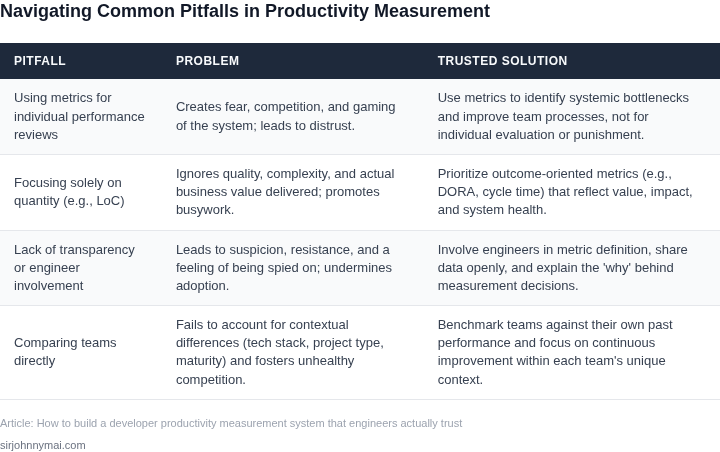
Scaling a metrics platform globally without testing the cultural friction is a recipe for silent non-compliance. I evaluated several roll-out strategies and chose a localized, single-team pilot because it allows us to isolate systemic pipeline issues from team-specific work patterns. We will target a single cross-functional squad of 8 to 12 engineers running on AWS and Kubernetes, as this size provides sufficient pull request and deployment data density without overwhelming our feedback collection channels.
To establish trust, we must co-design the instrumentation process with the pilot team rather than imposing it top-down. The schedule below details the weekly objectives to launch our 30-day feedback loop:
- Week 1: Collaborative Scope & Guardrails. Run a 45-minute kickoff with the pilot team to select two specific friction points to measure, such as Kubernetes deployment lead time or PR review latency. I chose this collaborative approach because engineers support metrics they help define, whereas top-down mandates breed skepticism. We also establish a firm "no-executive-visibility" rule for raw pilot data to ensure psychological safety.
- Week 2: Zero-Friction Telemetry Integration. Deploy the anonymized collection pipelines built in Section 04. Connect the system directly to GitHub Actions and Datadog to gather baseline cycle times passively. Do not introduce manual logging, timesheets, or daily standup tracking; if the measurement process requires developer manual effort, the data quality degrades rapidly.
- Week 3: Qualitative Calibration. Launch a weekly, two-question Slack poll asking: "How much did tool latency block you this week?" and "How easy was it to deploy?" We pair this qualitative sentiment directly with the telemetry. This hybrid approach works well when isolating flaky tests in CI, but it breaks if the team experiences survey fatigue.
Evaluating Pilot Tradeoffs
Using a highly technical pilot team—like a platform engineering team—allows for rapid API debugging of our measurement system. However, this creates a distinct tradeoff: platform teams have different workflows than product-focused application teams. The metrics that matter to them (like Helm chart rendering speed) will not map perfectly to product teams (who care more about Figma-to-code cycle times). We accept this bias initially because validating pipeline security and data anonymization accuracy takes precedence over metric universality in the first 30 days.
Next Step
Identify one engineering team of 8 to 12 developers using your core CI/CD pipeline, and schedule a 30-minute meeting to agree on the two specific workflow bottlenecks they want measured and solved during this pilot.
Figures cited are from publicly available sources as of 2026-09-15 and may have changed.