01. The Strategic Cost of Delayed Engineering Onboarding
Every week a new software engineer spends waiting for database credentials, troubleshooting local library versions, or navigating undocumented microservice architectures is direct capital waste. For an organization scaling its engineering headcount, this friction accumulates into a silent tax on productivity. When onboarding is unstructured, the typical time-to-productivity spans between 60 and 90 days. During this ramp-up period, the organization realizes negative utility from the new hire while simultaneously consuming the cycles of senior engineers who must act as ad-hoc guides.
At scale, we must treat developer onboarding as a deterministic software delivery pipeline. Just as we optimize a continuous integration pipeline to reduce build and deployment latency, we must optimize the human pipeline to reduce the latency between day one and the first production-ready contribution. The target metric for a high-performing engineering organization is clear: a new engineer must deliver a fully tested, peer-reviewed change to production within 14 calendar days of their start date.
This objective is not about rushing code or compromising quality. Instead, it is about engineering the organizational environment to remove structural bottlenecks. When an engineer takes weeks to ship their first line of code, the delay is rarely due to their technical capability. It is almost always a failure of environment provisioning, scattered documentation, and poor task scoping. To solve this, we must build a system where the default path leads directly to production readiness.
02. The 14-Day Onboarding Framework
Getting an engineer productive in two weeks requires a highly prescriptive, day-by-day roadmap that eliminates decision paralysis. We divide the 14-day cycle into three distinct operational phases: environment readiness, the engineered first contribution, and independent execution.
During the first phase (Days 1 to 3), the focus is entirely on system access and verification. The goal of Day 1 is not to read architectural wikis; it is to verify that the developer machine can authenticate, pull code, run local tests, and push a trivial change to a staging environment. If an engineer cannot run a green build on Day 1, the provisioning process has failed. Days 2 and 3 are reserved for basic architecture orientation, security compliance training, and repository structure mapping.
The second phase (Days 4 to 7) transitions the engineer from environment validation to code contribution. This phase relies on a curated queue of "Good First Issues." These are not low-value backlog items; they are small, isolated bugs or minor feature additions that touch key parts of the system's architecture without introducing critical risk. Resolving these issues forces the engineer to execute the entire development lifecycle: pulling the branch, reproducing the bug, writing a unit test, modifying the codebase, and opening a pull request.
The final phase (Days 8 to 14) steps up the complexity to standard product delivery. The new hire works on a structured feature ticket alongside a designated onboarding buddy. By Day 14, the engineer should have completed a code review, addressed feedback, observed the automated deployment pipeline, verified their changes in staging, and safely merged to production under a feature flag.
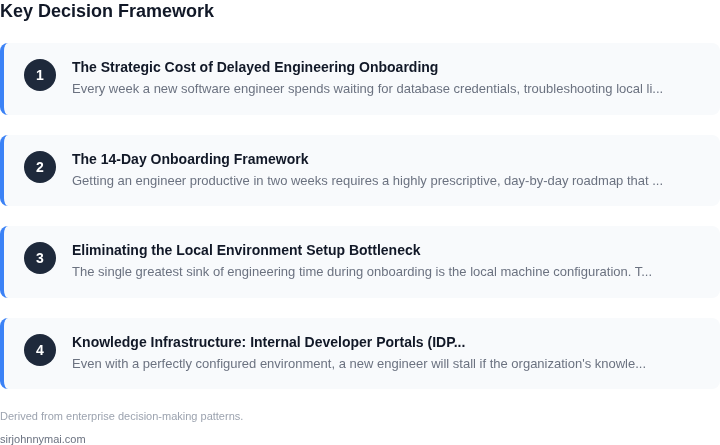
03. Eliminating the Local Environment Setup Bottleneck
The single greatest sink of engineering time during onboarding is the local machine configuration. The traditional approach of maintaining a long markdown file detailing how to install homebrew packages, configure local PostgreSQL instances, and set up specific Python or Node versions is fundamentally broken. Documentation of this type suffers from rapid decay. Software versions update, dependencies conflict with pre-installed tools, and individual machine states vary wildly.
To achieve a two-week onboarding target, engineering organizations must decouple development from the physical host machine. This is achieved through Cloud Development Environments (CDEs) or standardized containerized local environments. By utilizing tools like GitHub Codespaces, Gitpod, or locally managed Docker containers with the VS Code Dev Containers extension, the entire development workspace is defined as code.
In a containerized environment, the workspace configuration is checked into the version control repository alongside the source code. A configuration file (such as a .devcontainer.json or a docker-compose.yml) specifies the exact OS distribution, runtime engines, database engines, extensions, and environment variables required for development. When the new engineer opens the repository, the virtualized environment spins up in seconds with all dependencies pre-configured and the local servers already running.
This approach eliminates the "works on my machine" class of blockers. It shifts the environment setup time from days of manual troubleshooting to minutes of automated container compilation. Consequently, new hires can focus their energy on learning the codebase and domain logic, rather than debugging system path errors or dependency conflicts.
A Concrete Economic Calculation: Manual vs. Cloud Dev Environments
To justify the engineering effort required to transition to automated development environments, we can model the financial impact. Let us compare the total onboarding cost of manual environment setup against containerized or cloud-hosted setups for an organization hiring 50 engineers per year.
We assume a blended, fully loaded software engineer cost of $100 per hour (including benefits, equity, and overhead). We also assume a senior engineer (acting as an ad-hoc support guide) earns a blended rate of $130 per hour.
Scenario A: Traditional Manual Setup
Historically, manual machine configuration takes an average of 24 working hours (3 business days) of active developer time. During this time, the new engineer relies on a senior buddy for troubleshooting, consuming approximately 6 hours of the senior engineer's time over those 3 days.
Let us calculate the onboarding cost per engineer under Scenario A:
New Hire Waste Cost: 24 hours * $100/hr = $2,400
Senior Engineer Support Cost: 6 hours * $130/hr = $780
Total Setup Cost per Engineer (Scenario A) = $3,180
For 50 engineers annually, the organizational cost of manual environment setup is:
Annual Cost (Scenario A) = 50 * $3,180 = $159,000
Scenario B: Automated Containerized / Cloud Dev Environments (CDE)
With a standardized configuration (such as GitHub Codespaces or a pre-configured Docker stack), the environment is fully operational within 15 minutes (0.25 hours). Senior engineer intervention drops to zero for configuration issues. Let us factor in the hosting costs for running cloud environments, which average approximately $15 per developer per month ($180 per developer annually).
Let us calculate the onboarding setup cost per engineer under Scenario B:
New Hire Configuration Cost: 0.25 hours * $100/hr = $25
Senior Engineer Support Cost: 0 hours * $130/hr = $0
CDE Infrastructure Surcharge (Annualized per seat): $180
Total Setup Cost per Engineer (Scenario B) = $205
For 50 engineers annually, the total cost is:
Annual Cost (Scenario B) = 50 * $205 = $10,250
Net Financial and Temporal Impact:
By automating the environment setup, the organization achieves an annual cost reduction of $148,750. More importantly, the organization reclaims 1,187.5 hours of productive engineering time (1,187.5 hours that would have been spent on environmental troubleshooting) and redirects it toward feature delivery and system design.
04. Knowledge Infrastructure: Internal Developer Portals (IDPs) and Docs-as-Code
Even with a perfectly configured environment, a new engineer will stall if the organization's knowledge base is fragmented across Slack threads, Google Docs, and outdated Confluence wikis. A key component of rapid onboarding is an Internal Developer Portal (IDP) built on open-source frameworks like Spotify Backstage, or a tightly managed Docs-as-Code repository.
The IDP serves as a centralized software catalog. It indexes every service within the organization, detailing who owns it, where its documentation lives, its deployment status, and its API contracts. Instead of asking around to find the correct team or repository, a new engineer can query the IDP. This structural self-service reduces dependency on tribal knowledge and encourages autonomous discovery.