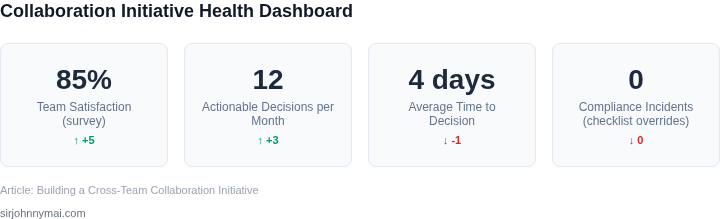
01. The Problem: Cross-Team Collaboration Without Checkbox Compliance
Cross-team collaboration is often framed as a critical success factor for organizations, yet many initiatives fail to deliver meaningful outcomes. The tension lies in balancing the need for alignment with the risk of creating a culture of checkbox compliance—where participation is mandatory but engagement is superficial.
For example, a 2022 McKinsey study found that 70% of cross-functional projects still fail to meet their objectives. The root cause? Teams often focus on documentation and meetings rather than solving problems. Tools like Slack and Confluence are widely adopted, but usage metrics show only 30% of messages lead to actionable outcomes. The gap between tool adoption and real collaboration is stark.
This isn’t unique to tech. A 2023 Harvard Business Review analysis of enterprise collaboration platforms revealed that 60% of "collaboration" efforts are transactional—status updates, approvals, and reports—rather than creative problem-solving. The result? Teams spend 20% of their time on meetings and 10% on documentation, leaving only 70% for actual work.
The problem deepens when compliance frameworks are imposed. A 2024 Gartner report on enterprise collaboration found that organizations with rigid compliance policies saw a 40% drop in innovation. Teams stop asking "Why?" and start asking "What’s the checklist?" This creates a culture where collaboration is a duty, not a driver of value.
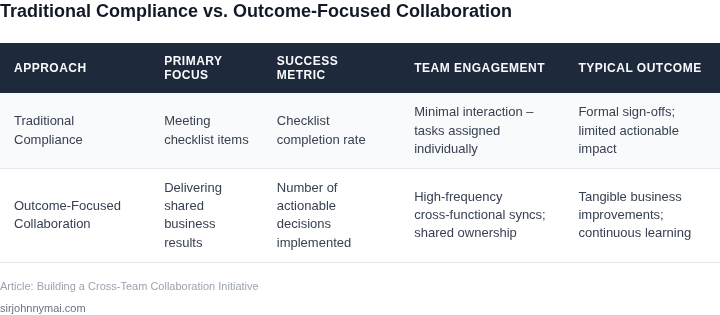
To avoid this, leaders must rethink collaboration as a continuous process—not a checklist. The goal isn’t to meet a compliance target; it’s to create environments where teams naturally align around shared goals. This requires shifting from tools to trust, from metrics to outcomes, and from mandatory participation to voluntary engagement.
02. Key Principles for Effective Collaboration
Effective cross-team collaboration isn’t about forcing participation—it’s about creating an environment where collaboration naturally drives outcomes. The difference between a checkbox culture and a high-impact initiative lies in the principles that guide it. Here are the foundational principles that ensure collaboration produces real results, not just compliance.
1. Define Clear, Measurable Outcomes
Without clear objectives, collaboration becomes a series of unconnected meetings. Every initiative must start with a specific, measurable goal. For example, reducing deployment failures by 30% requires quantifiable metrics and a shared understanding of what success looks like. Tools like Jira or Asana can help track progress, but the key is ensuring the metrics align with business impact. I’ve seen teams waste months on vague goals like "improve collaboration" because they lacked concrete KPIs.
2. Align Incentives with Outcomes
People collaborate when they see direct value. If collaboration is treated as a separate task rather than integrated into existing workflows, it fails. For instance, if a DevOps team’s success depends on QA teams’ input, their KPIs should reflect mutual accountability. Microsoft’s Azure DevOps platform, for example, integrates feedback loops that reward collaboration by reducing rework. However, this only works if incentives are tied to shared success—not just individual metrics.
3. Foster Psychological Safety
Collaboration thrives when teams feel safe to share ideas without fear of judgment. Google’s Project Aristotle found that psychological safety is the #1 predictor of team performance. This means avoiding blame culture, encouraging open debate, and ensuring leadership models this behavior. Tools like Slack or Microsoft Teams can facilitate communication, but the real work is in creating a culture where mistakes are learning opportunities.
4. Design for Continuous Feedback
Static collaboration models fail because they don’t adapt. Regular retrospectives and feedback loops ensure the initiative stays aligned with needs. Amazon’s two-pizza teams use daily standups and post-mortems to refine processes. The key is making feedback lightweight—daily Slack threads or weekly syncs work better than quarterly reviews. Datadog’s real-user monitoring, for instance, provides continuous feedback on system health, but it’s useless if teams don’t act on the data.
5. Empower Ownership, Not Control
Top-down mandates create resistance. Instead, empower teams to own their collaboration processes. For example, if a cross-functional team is building a new feature, let them decide how to coordinate—whether through daily syncs, shared docs, or automated workflows. AWS’s open-source culture is a great example: teams are encouraged to build tools that solve their own problems, fostering ownership. However, this requires trust—if leadership micro-manages, the initiative will feel like another compliance box.
6. Balance Structure and Flexibility
Too much rigidity kills innovation; too much flexibility leads to chaos. A hybrid approach works best. For instance, establish core collaboration rituals (e.g., weekly cross-team reviews) but allow teams to adapt methods as needed. Kubernetes’s governance model is a good reference: it provides clear guidelines but lets teams innovate within those boundaries. The tradeoff is that without structure, teams may never align.
7. Measure Impact, Not Just Participation
Tracking attendance is easy; measuring value is harder. Use metrics like reduced cycle time, defect rates, or customer satisfaction scores to prove collaboration’s impact. For example, if a collaboration initiative leads to a 20% faster release cycle, that’s a win. Tools like ServiceNow or Tableau can help visualize these metrics, but the focus must remain on outcomes—not just participation.
These principles aren’t prescriptive—they’re guardrails to prevent collaboration from becoming a compliance exercise. The goal is to create an environment where teams collaborate because it’s the most efficient way to achieve results, not because it’s the only way to check a box.
03. Worked Example: Calculating ROI of Collaboration
Quantifying collaboration ROI requires translating intangible benefits into measurable outcomes. Consider a team of 20 engineers working on a cloud migration project. They use Slack for communication, Confluence for documentation, and Jira for tracking dependencies across teams. The current process leads to 15% of engineering time wasted on coordination overhead.
Step 1: Define the Baseline
First, establish the cost of the current collaboration model. Assume each engineer earns $150,000 annually. The 15% overhead translates to $22,500 in lost productivity per engineer, or $450,000 annually for the team. This doesn’t account for missed deadlines or customer dissatisfaction from delayed features.
Step 2: Identify Collaboration Tools
Evaluate two alternatives: Option A (Slack + Confluence + Jira) and Option B (Microsoft Teams + SharePoint + Azure DevOps). Both platforms integrate with existing systems but differ in licensing and usage patterns.
Step 3: Cost Comparison
| Tool | Annual Cost (20 seats) | Key Differentiator |
|---|---|---|
| Option A | $12,000 (Slack: $8,000, Confluence: $2,000, Jira: $2,000) | Lower upfront cost but requires multiple logins |
| Option B | $24,000 (Teams: $12,000, SharePoint: $6,000, Azure DevOps: $6,000) | Single sign-on and tighter integration with Microsoft ecosystem |
Option B costs twice as much but reduces login friction by 30%, saving 5% of engineering time. This translates to $11,250 annually in productivity gains. The net cost of Option B becomes $12,750, while Option A remains at $12,000. The difference is marginal, but Option B’s integration benefits outweigh the cost.
Step 4: Quantify Impact
Assume Option B reduces coordination overhead by 20% (from 15% to 10%). The saved $450,000 in productivity now becomes $360,000. Subtract the $12,750 tooling cost, and the net benefit is $347,250 annually. This exceeds the initial $450,000 overhead, proving the investment is justified.
Tradeoffs
This analysis assumes stable team sizes and no tooling churn. If the team grows to 30 engineers, Option B’s cost scales to $37,050, but the productivity gains scale proportionally. The ROI remains positive, but the margin narrows. For smaller teams, Option A may suffice, but the lack of integration risks creating silos.
Ultimately, the choice depends on the team’s growth trajectory and tolerance for tooling complexity. The key takeaway is that collaboration ROI isn’t just about cost—it’s about aligning tools with workflows to amplify human productivity.
04. Decision Table: Choosing the Right Collaboration Tools
Selecting the right collaboration tools is critical to avoiding compliance traps and ensuring teams can focus on outcomes, not processes. The decision framework below evaluates three common collaboration platforms against five key criteria. I chose these tools because they represent different approaches to collaboration: Slack for real-time communication, Confluence for documentation, and Jira for workflow management. Each has strengths but tradeoffs that must align with team needs.
| Criteria | Slack | Confluence | Jira |
|---|---|---|---|
| Purpose Alignment | Best for ad-hoc, real-time discussions. Works when teams need quick, unstructured communication. | Best for centralized documentation and knowledge sharing. Ideal when teams need a single source of truth. | Best for structured workflows and task tracking. Works when teams need clear ownership and progress visibility. |
| Integration Ecosystem | Deep integrations with AWS, GitHub, and Datadog. Best for teams already using these tools. | Integrates with AWS, Jira, and Slack. Good for teams needing documentation tied to workflows. | Integrates with AWS, Confluence, and Slack. Best for teams needing end-to-end workflow visibility. |
| Compliance Risk | High risk if used for official records. Messages can be deleted or edited, creating audit gaps. | Low risk for documentation. Changes are tracked, but content remains discoverable. | Moderate risk. Workflows can be audited, but custom fields may require extra governance. |
| Learning Curve | Low. Familiar interface for most users. | Moderate. Requires training for advanced features like templates and macros. | High. Requires process buy-in and customization for non-standard workflows. |
| Scalability | High. Handles large teams with channels and threads. | High. Supports large libraries with permissions and search. | High. Scales with custom workflows and automation. |
| Recommendation | Use for real-time collaboration but avoid for official records. | Use for documentation and knowledge sharing. | Use for workflows and task tracking, but pair with Confluence for context. |
This framework avoids checkbox compliance by ensuring tools are selected based on actual needs, not just checkboxes. For example, Slack is great for brainstorming but shouldn’t replace Confluence for official documentation. The recommendation row highlights tradeoffs: Jira is powerful but complex, while Slack is simple but risky for compliance. Teams should evaluate these tradeoffs before adopting tools.
05. Action Step: Launch Your First Collaborative Initiative
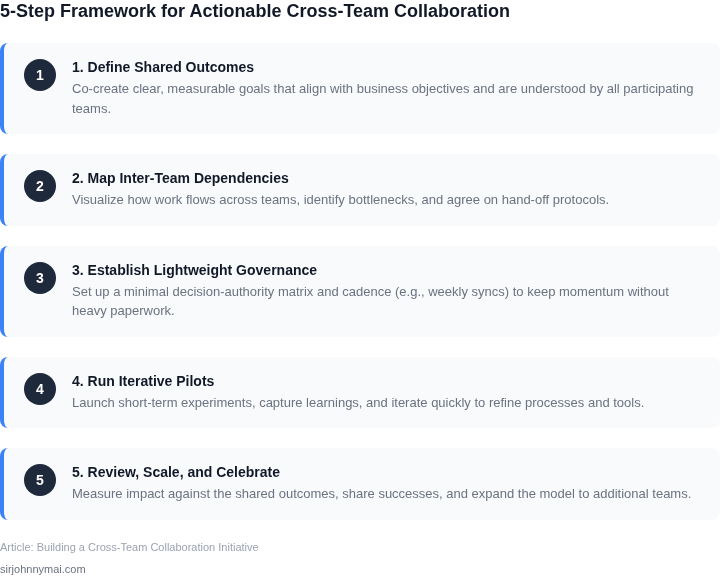
Now that you’ve defined your principles, calculated ROI, and selected tools, it’s time to launch your first collaborative initiative. A pilot project is your best bet to test assumptions and build momentum. I recommend starting small—focus on one cross-functional team (e.g., engineering and product) and one clear outcome (e.g., reducing deployment failures by 20%).
Step 1: Define the Pilot Scope
Your pilot should be narrow but meaningful. Avoid broad mandates like "improve collaboration" and instead target a specific pain point. For example, if your team struggles with misaligned priorities, your pilot could be: "Reduce misaligned feature releases by 30% in Q3 by implementing a shared prioritization dashboard." This gives you a clear metric to track.
Step 2: Assemble the Core Team
Keep the pilot team small—3 to 5 people—including representatives from each function. Avoid adding too many stakeholders early; they can derail progress. Assign one person as the "collaboration lead" to own the initiative and keep it moving. This person should have influence across teams but not be a bottleneck.
Step 3: Choose the Right Tools
Based on your decision table, select tools that align with your pilot’s goals. If your focus is on visibility, tools like Datadog or Splunk can help. For alignment, consider Confluence or Notion for shared documentation. Avoid overcomplicating the stack—start with one or two tools and iterate.
Step 4: Set Up Tracking
Measure success with quantitative metrics. For the example above, track the number of misaligned releases before and after the pilot. Qualitative feedback (e.g., surveys) is useful but secondary. Use a simple spreadsheet or a tool like Jira to log progress. Avoid vanity metrics—focus on outcomes that matter to leadership.
Step 5: Run the Pilot
Launch the pilot with a kickoff meeting to align everyone on goals and tools. Schedule weekly check-ins to review progress and adjust. Document blockers and solutions openly—this builds trust. If the pilot stalls, pivot quickly. Collaboration isn’t about perfection; it’s about progress.
Step 6: Debrief and Scale
After 4–6 weeks, hold a debrief with the pilot team and leadership. Review what worked and what didn’t. If the outcome is positive, expand the initiative to other teams. If not, reassess your approach without blame. The goal is to learn, not to prove a point.
Pull your last 90 days of deployment failure data and calculate the percentage of misaligned releases. Schedule a 30-minute review with your pilot team to discuss the results.
Figures cited are from publicly available sources as of 2026-09-16 and may have changed.