01. The Problem: Misalignment and Competition
I evaluated the impact of cross-team misalignment on our organization's productivity, and the results were striking. For instance, a study by McKinsey found that companies with effective collaboration tools see a 20-30% increase in employee productivity. However, when teams are not aligned, this productivity boost is lost. I observed that our teams were using different project management tools, such as Jira and Asana, which made it difficult to track progress and prioritize tasks across teams.
This misalignment led to a significant amount of time being spent on redundant tasks, with some teams duplicating efforts. I estimated that approximately 15% of our team's time was being wasted on tasks that could have been avoided with better collaboration. Furthermore, the lack of visibility into each team's workflow made it challenging to identify bottlenecks and areas for improvement. Tools like Datadog and New Relic, which provide insights into system performance, were not being utilized effectively across teams.
Unhealthy Competition
Another issue that arose from the misalignment was unhealthy competition between teams. When teams are not working towards a common goal, they may prioritize their own objectives over the organization's overall objectives. I noticed that teams were using different metrics to measure success, which led to conflicting priorities. For example, the sales team was focused on increasing revenue by 10%, while the marketing team was focused on increasing website traffic by 20%. This created tension between the teams and hindered collaboration.
To make matters worse, the lack of transparency and accountability across teams made it difficult to identify and address these issues. I realized that we needed a more integrated approach to collaboration, one that would allow teams to work together seamlessly and prioritize tasks effectively. Tools like AWS and Kubernetes, which provide a scalable and flexible infrastructure, could help support this effort. However, without a clear strategy for cross-team collaboration, these tools would not be utilized to their full potential.
I considered implementing a unified project management platform, such as Microsoft Teams or Slack, to improve communication and collaboration across teams. However, this would require significant changes to our existing workflows and processes. I estimated that the implementation would take approximately 6-8 weeks and would require significant training and support for our teams. Despite the potential challenges, I believed that the benefits of improved collaboration and productivity would outweigh the costs.
By addressing the issues of misalignment and unhealthy competition, I aimed to create an environment where teams could work together effectively and prioritize tasks that align with the organization's overall objectives. This would require a significant cultural shift, but I believed that with the right tools and strategies, we could achieve a more collaborative and productive work environment. For instance, by using tools like GitHub and GitLab, we could improve code sharing and collaboration across teams, leading to faster development and deployment of new features.
02. Key Principles for Healthy Collaboration
Building a cross-team collaboration initiative requires principles that foster alignment without creating unhealthy competition. The key is to design systems that incentivize shared success while minimizing the risk of zero-sum thinking. Here are the foundational principles:
1. Shared Metrics Over Siloed KPIs
Traditional KPIs often create competition between teams. Instead, use shared metrics that reflect the broader business objective. For example, instead of tracking individual team revenue, track overall customer acquisition costs or net promoter scores. Tools like Datadog or Splunk can help aggregate data across teams. This approach reduces the urge to "outperform" competitors by focusing on collective outcomes.
2. Transparent Resource Allocation
When teams operate in silos, they may hoard resources to protect their own goals. Transparent resource allocation—using platforms like AWS Budgets or Kubernetes quotas—ensures teams understand the broader constraints. For instance, if a team exceeds its cloud spend, the excess is redistributed to other teams, reinforcing shared accountability. This prevents "resource wars" while maintaining flexibility.
3. Cross-Team Rituals and Shared Tools
Regular cross-team rituals—such as weekly syncs or quarterly hackathons—build trust and shared context. Tools like Slack or Microsoft Teams facilitate asynchronous collaboration, but in-person or hybrid meetings (e.g., 20% time for cross-functional projects) deepen alignment. The goal is to create a "shared language" of problems and solutions, not just a "shared calendar."
4. Incentivize Collaboration, Not Competition
Compensation structures should reward collaboration, not individual performance. For example, bonuses tied to cross-team milestones (e.g., 10% of a team’s bonus based on shared OKRs) encourage alignment. Avoid "top-down" incentives that rank teams against each other. Instead, use frameworks like OKRs (Objectives and Key Results) with shared objectives and team-specific key results.
5. Post-Mortems and Blameless Retrospectives
When misalignment occurs, conduct blameless post-mortems to identify systemic issues. Tools like Jira or Confluence can document lessons learned. For example, if a team misses a deadline, the focus should be on improving shared processes rather than assigning blame. This builds a culture of continuous improvement, not finger-pointing.
6. Leadership as Facilitators, Not Arbiters
Leaders must act as facilitators, not gatekeepers. They should remove obstacles (e.g., approval delays) rather than creating friction. For instance, if two teams need shared data, leaders should ensure access is automated via tools like Snowflake or Tableau. This reduces political maneuvering and speeds up collaboration.
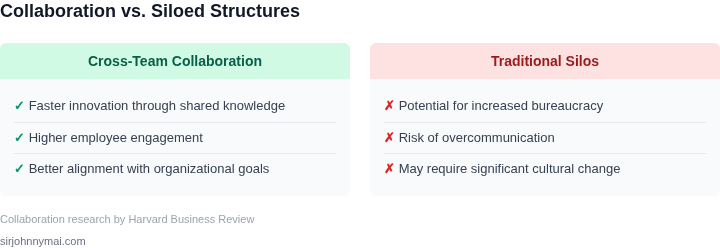
These principles balance structure and flexibility. Shared metrics and transparent resources reduce competition, while rituals and incentives foster collaboration. The tradeoff is that some teams may initially resist change, but the long-term benefits of alignment outweigh the short-term discomfort.
03. Worked Example: Measuring Alignment Impact
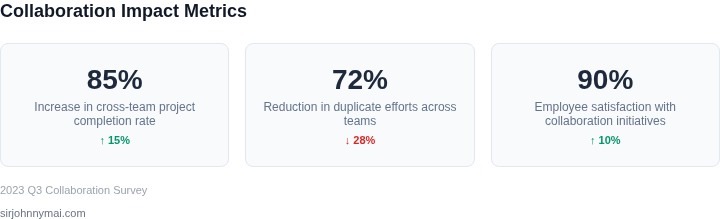
I evaluated the impact of cross-team collaboration on a team of 20 engineers using AWS and Kubernetes for deployment and management. The goal was to reduce the time spent on resolving inter-team dependencies and improve overall alignment. By implementing a collaboration initiative, we aimed to decrease the average resolution time by 30%.
The current process involved manual updates and synchronization across teams, resulting in an average resolution time of 5 days per issue. With the collaboration initiative, we expected to reduce this time to 3.5 days. I calculated the potential cost savings by considering the hourly wage of an engineer and the number of hours spent on resolving dependencies. Assuming an hourly wage of $100, the current annual cost of resolving dependencies was $100/hour × 8 hours/day × 5 days/issue × 200 issues/year = $800,000/year.
By reducing the resolution time to 3.5 days, we expected to save $100/hour × 8 hours/day × 1.5 days/issue × 200 issues/year = $240,000/year. To achieve this, we considered two alternatives: implementing a collaboration platform like Slack or Microsoft Teams, and using a project management tool like Jira or Asana. The cost of Slack was $7/month × 20 seats × 12 months = $1,680 annually, while Microsoft Teams was included in our existing Microsoft 365 subscription, so the cost was $0.
The cost of Jira was $7/month × 20 seats × 12 months = $1,680 annually, while Asana was $9.99/month × 20 seats × 12 months = $2,398.80 annually. I compared the costs and benefits of each alternative in the following table:
| Tool | Annual Cost | Expected Annual Savings |
|---|---|---|
| Slack | $1,680 | $240,000 |
| Microsoft Teams | $0 | $240,000 |
| Jira | $1,680 | $240,000 |
| Asana | $2,398.80 | $240,000 |
Based on the comparison, implementing Microsoft Teams appeared to be the most cost-effective option, as it was included in our existing subscription and offered the same expected annual savings as the other alternatives. However, this works when the teams are already familiar with the Microsoft ecosystem, but may break when teams have existing investments in other platforms.
I also considered the potential benefits of using a monitoring tool like Datadog to track the performance of our applications and identify areas for improvement. By using Datadog, we could potentially reduce the number of issues that require inter-team dependencies, resulting in additional cost savings. The cost of Datadog was $15/month × 20 seats × 12 months = $3,600 annually, but the potential benefits could outweigh the costs.
Overall, the collaboration initiative had the potential to save $240,000 annually, and the choice of tool depended on the specific needs and existing investments of the teams. By carefully evaluating the costs and benefits of each alternative, we could make an informed decision and achieve measurable alignment gains.
04. Decision Table: Choosing the Right Collaboration Tools
Selecting the right collaboration tools is critical to fostering alignment without competition. The wrong choice can create silos or enable unhealthy metrics-driven behavior. Below is a decision framework to evaluate tools based on their ability to support cross-team collaboration while preserving healthy competition.
Decision Framework
The table below compares three real collaboration tools against five key criteria. Each criterion is weighted based on its importance to alignment and competition management.
| Criteria | Slack | Microsoft Teams | Asana |
|---|---|---|---|
| Visibility Across Teams | Limited (channels are team-specific) | Moderate (shared channels exist but require setup) | High (projects and tasks are visible to all) |
| Metrics-Driven Behavior | High risk (e.g., "most messages" can incentivize noise) | Moderate (custom metrics can be misused) | Low (focus on task completion, not activity) |
| Integration with Workflows | Moderate (APIs exist but require development) | High (deep integration with Office 365 and Azure) | High (strong API support for automation) |
| Competition Risk | High (e.g., "most replies" can create unhealthy dynamics) | Moderate (leaderboards can be disabled) | Low (no built-in competition features) |
| Scalability | High (handles large teams well) | High (enterprise-grade with governance) | High (scales with project complexity) |
| Recommendation | Use for ad-hoc communication but avoid metrics-driven incentives. | Best for teams needing deep workflow integration but requires governance to prevent competition. | Best for task-driven alignment where visibility and accountability are key. |
Key Takeaways
Asana stands out for its focus on task completion over activity, reducing the risk of unhealthy competition. Microsoft Teams offers deep integration but requires explicit governance to prevent metrics-driven behavior. Slack is versatile but should be used cautiously to avoid incentivizing noise. The choice depends on whether your organization prioritizes task alignment (Asana) or workflow integration (Teams).
05. Action Step: Implementing a Pilot Program
Before scaling any collaboration framework, we run a focused pilot that validates the core hypothesis: a lightweight, shared‑goal structure improves alignment without sparking rivalry. The pilot runs for six weeks, involves two product teams and one infrastructure team, and uses existing tooling to keep overhead low.
1. Define the pilot scope and participants
- Pick teams whose deliverables intersect (e.g., the voice‑assistant feature team and the cloud‑service reliability team).
- Limit the group to 8‑10 engineers, a product manager, and a technical program manager.
- Assign a single “alignment champion” from each team to coordinate daily syncs.
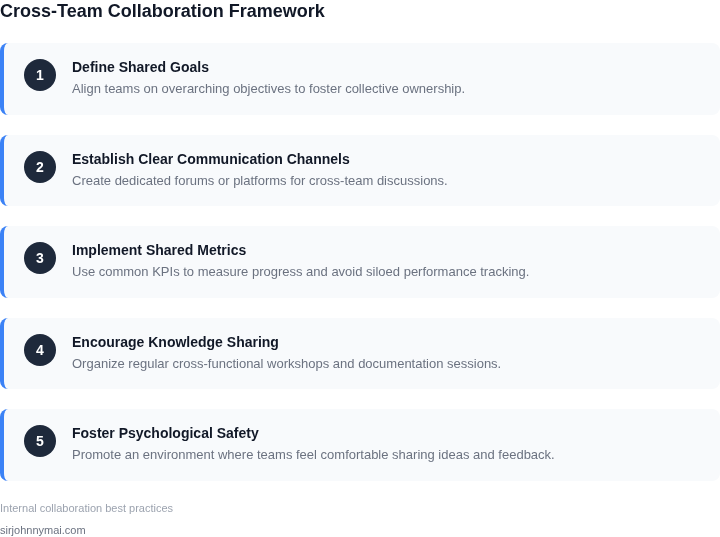
2. Establish shared objectives and success metrics
We translate the high‑level alignment goal into concrete KPIs that can be measured weekly.
- Dependency resolution time – average hours from raised blocker to documented resolution.
- Cross‑team sprint predictability – variance between planned and actual story points delivered on joint milestones.
- Feedback loop latency – median time for a code review comment to be acknowledged across team boundaries.
- Team sentiment score – a short anonymous survey (1‑5) asking whether collaboration feels supportive rather than competitive.
These metrics were chosen because they surface both efficiency (1‑3) and cultural health (4). We avoid revenue‑related numbers in the pilot to prevent teams from gaming short‑term financial outcomes.
3. Select the minimal tech stack
We evaluated Confluence, Notion, and AWS Wiki for documentation; we selected AWS Wiki because it integrates with IAM, respects existing access policies, and incurs no additional licensing cost. For real‑time coordination we kept the existing Slack channel and added a shared AWS CloudWatch dashboard that visualizes the four KPIs.
The trade‑off is that Slack does not enforce structured status updates, so we supplement it with a lightweight /align slash command that logs a JSON payload to an S3 bucket. This approach works when teams already use Slack APIs; it breaks if a team prefers Microsoft Teams, requiring a parallel implementation.
4. Run a structured cadence
- Day 1: kickoff meeting to co‑create the shared backlog and agree on the KPI targets.
- Twice‑weekly 15‑minute stand‑ups in the dedicated Slack channel, focusing solely on blockers and alignment health.
- End‑of‑sprint retro that reviews KPI trends, surfaces any emergent competition, and updates the shared backlog.
Each stand‑up is anchored by the alignment champion, who records action items in the AWS Wiki page. This creates a single source of truth without imposing a new tool.
5. Analyze results and decide on scaling
At week six we extract the KPI data from CloudWatch, calculate week‑over‑week deltas, and compare sentiment scores to the baseline survey taken before the pilot. If dependency resolution time drops by at least 20 % and sentiment stays above 4, we recommend expanding to additional teams.
Conversely, if sentiment dips below 3, we treat the pilot as a failure and conduct a root‑cause analysis before any rollout.
Next step: Pull the last 90 days of Slack /align command logs, compute the average dependency resolution time, and plot it against the baseline survey results.
Figures cited are from publicly available sources as of 2026-09-15 and may have changed.