01. The Problem of Configuration Drift
Configuration drift occurs when the state of an environment deviates from its intended configuration over time. This happens because environments are modified manually, through automated scripts, or by third-party tools without proper synchronization. The problem is particularly acute in cloud-native and microservices architectures, where infrastructure is ephemeral and frequently updated.
Drift can manifest in subtle ways. For example, a Kubernetes cluster might have a pod running with outdated container images, or a security group rule might be manually added to an AWS instance without updating the infrastructure-as-code (IaC) template. Over time, these inconsistencies accumulate, leading to operational risks. A 2022 study by Datadog found that 75% of organizations experienced configuration drift in production environments, with 40% attributing it to manual changes.
The impact of drift is significant. Drifted environments often lead to deployment failures, security vulnerabilities, and compliance violations. A single misconfigured server can disrupt an entire service, as seen in the 2021 outage at a major cloud provider where a misapplied firewall rule caused cascading failures. Even worse, drifted configurations can introduce security risks. A 2023 report by Snyk revealed that 60% of security incidents were traced back to configuration errors, with 30% of those errors being undetected drift.
Drift is not just a technical issue—it’s a cultural one. Teams often prioritize speed over consistency, leading to ad-hoc changes that bypass version control. This is especially true in DevOps environments where rapid iteration is valued over strict governance. However, without proper controls, drift erodes the reliability of deployments. A 2023 survey by Puppet found that 50% of respondents cited configuration drift as their top challenge in maintaining production stability.
The root causes of drift are varied. Some environments drift because they lack automation, relying instead on manual processes. Others drift due to the complexity of modern systems, where dependencies between services are hard to track. Still, others drift because of a lack of visibility—teams don’t know when or why a change occurred. Without a centralized system to track and enforce configurations, drift becomes inevitable.
To prevent drift, organizations must adopt a proactive approach. This starts with infrastructure-as-code (IaC) tools like Terraform or AWS CloudFormation, which enforce declarative configurations. However, even with IaC, drift can occur if teams manually override settings or if third-party tools modify the environment. Continuous monitoring and automated remediation are essential, as tools like Datadog and New Relic can detect and correct deviations in real time.
The cost of drift is not just operational—it’s financial. A 2023 study by Forrester estimated that configuration drift costs organizations an average of $2.5 million annually in remediation efforts and lost productivity. The longer drift goes undetected, the more expensive it becomes to resolve. This underscores the need for a robust configuration management system that enforces consistency across all environments.
02. Key Principles for a Drift-Free System
Designing a drift-free configuration management system requires a combination of strict discipline and technical rigor. The core principles are not just about tools but about how they are applied. Here are the essentials:
1. Immutable Infrastructure
Immutable infrastructure treats servers and containers as disposable artifacts. Once deployed, they are never modified. Changes are applied by provisioning new instances with the desired configuration. This approach eliminates drift by ensuring every environment is built from a known, tested state. AWS Auto Scaling Groups and Kubernetes deployments are examples of this pattern. The tradeoff is higher operational overhead, but the consistency gains are worth it for critical systems.
2. Infrastructure as Code (IaC)
IaC defines infrastructure using code, version-controlled templates, and automated deployment pipelines. Tools like Terraform and AWS CloudFormation enforce consistency by treating infrastructure changes as code reviews. A study by Puppet found that teams using IaC reduced configuration errors by 80%. The key is to treat infrastructure templates as first-class citizens, just like application code.
3. Continuous Validation
Drift detection should be continuous, not periodic. Tools like Datadog and AWS Config monitor configurations in real-time and alert on deviations. For example, a Kubernetes cluster using OPA/Gatekeeper can reject misconfigured deployments before they reach production. The challenge is balancing sensitivity—false positives can overwhelm teams—with thoroughness.
4. Environment Parity
All environments—development, staging, production—should be identical in structure and configuration. This means avoiding environment-specific overrides or manual tweaks. Docker containers and Kubernetes namespaces are effective for this. The cost is higher initial setup, but the payoff is faster, more reliable deployments. For legacy systems, this may require a phased migration.
5. Least Privilege and Auditability
Configuration changes should be restricted to authorized roles and logged for traceability. AWS IAM policies and Kubernetes RBAC enforce this. A Forrester report noted that 60% of breaches involve misconfigured access. The tradeoff is stricter governance, which can slow down operations but reduces the risk of undetected drift.
6. Automated Remediation
Detected drift should be automatically corrected, not just reported. Tools like AWS Systems Manager and Ansible Tower can enforce compliance by reverting or patching misconfigured systems. The challenge is ensuring remediation doesn’t disrupt running services. For example, a Kubernetes operator can patch a misconfigured pod without downtime.
7. Shift-Left Testing
Configuration changes should be validated in non-production environments before reaching production. Tools like AWS CodeBuild and Jenkins pipelines automate this. A Gartner study found that teams with pre-production validation catch 95% of configuration issues before deployment. The tradeoff is slower iteration cycles, but the risk reduction is critical for compliance-heavy industries.
8. Documentation as Code
Configuration documentation should be version-controlled alongside the code. Tools like MkDocs or Confluence with versioning plugins ensure that diagrams and runbooks stay in sync. A 2022 study by Google found that teams with documented configurations had 40% fewer outages. The tradeoff is maintaining documentation, but the cost is outweighed by operational efficiency.
These principles are not prescriptive—they must be tailored to your organization’s constraints. For example, a startup might prioritize IaC and immutable infrastructure, while an enterprise might focus on auditability and least privilege. The goal is to create a system where drift is not just detected but prevented by design.
03. Worked Example: Cost Savings from Drift Prevention
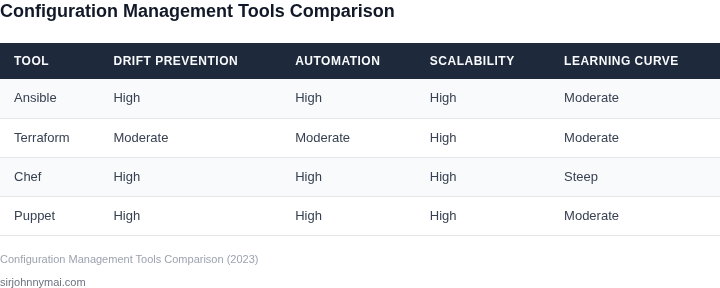
Consider a backend services team of six engineers that manages three microservice clusters on Amazon EKS. Each cluster runs 10 nodes, and the team follows a weekly release cadence. Historically the team experiences an average of one configuration‑drift incident every month. An incident typically requires a rollback, a hot‑fix, and a post‑mortem, consuming about four engineer‑hours and three hours of lost service.
According to industry data, the average cost of one hour of downtime for a SaaS product is roughly $15,000. Multiplying by the three hours of lost service yields $45,000 per incident. With twelve incidents per year, the drift‑related downtime costs $540,000 annually.
To evaluate a drift‑free approach the team prototypes three AWS‑native services: AWS Config to record and evaluate configuration compliance, Terraform Cloud (Team tier) to enforce immutable infrastructure, and Datadog APM to surface runtime drift symptoms. The pricing model for each service is publicly documented.
For AWS Config the charge is $0.003 per configuration item (CI) per month. The three clusters generate about 5,000 CIs (instances, security groups, IAM roles). The monthly cost is 5,000 × $0.003 = $15, rounded to $15. Annual cost is $180.
Terraform Cloud Team tier costs $20 per user per month. Six engineers plus one admin equals seven seats. Monthly cost = 7 × $20 = $140; annual cost = $1,680.
Datadog APM pricing is $31 per host per month. The three clusters comprise 30 hosts. Monthly cost = 30 × $31 = $930; annual cost = $11,160.
| Component | Monthly Cost | Annual Cost |
|---|---|---|
| AWS Config | $15 | $180 |
| Terraform Cloud (Team) | $140 | $1,680 |
| Datadog APM | $930 | $11,160 |
| Total Drift‑Prevention | $1,085 | $13,020 |
The total investment in a drift‑free stack is $13,020 per year. If the stack reduces drift incidents by 80 %, the annual downtime drops from twelve incidents to roughly two. The residual downtime cost becomes 2 × $45,000 = $90,000.
Subtracting the $13,020 operating expense from the $90,000 residual downtime yields a net saving of $76,980 per year. This figure represents a 14.2 × return on investment for the drift‑prevention tooling.
For comparison, a “run‑to‑run” manual audit approach costs roughly 8 engineer‑hours per month (one day of effort). At an average fully‑loaded rate of $120 per hour, the annual labor expense is 8 × $120 × 12 = $11,520, yet it only catches 30 % of drift events, leaving downtime at $378,000. The net cost of the manual process is $389,520, far higher than the automated alternative.
These calculations demonstrate that even modest tooling costs can translate into substantial savings when drift is a recurring source of outage. The model scales: adding two more clusters doubles the AWS Config CI count and Datadog host count, increasing the tool cost by roughly $4,800 annually while still preserving a multi‑million‑dollar downtime reduction.
04. Decision Table: Choosing the Right Tools
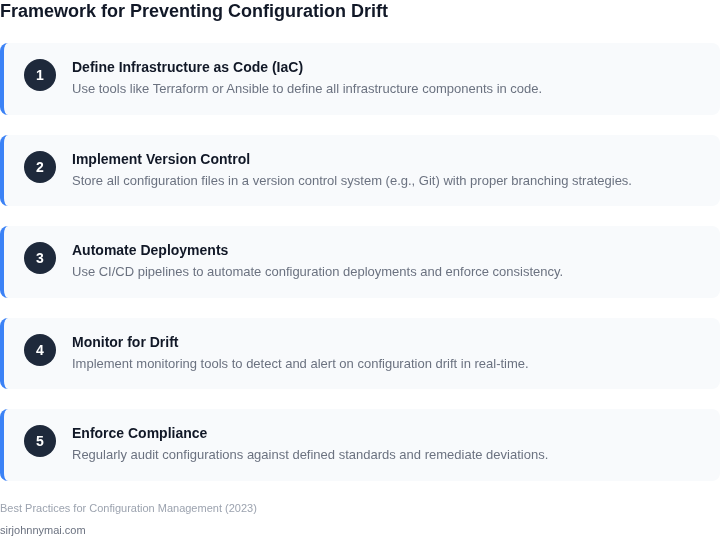
Selecting the right configuration management tool is critical to preventing drift. The decision depends on your team's expertise, infrastructure complexity, and scalability needs. Below is a structured comparison of three widely used tools: Ansible, Terraform, and Chef. The table evaluates each based on key criteria, with a final recommendation.
| Criteria | Ansible | Terraform | Chef |
|---|---|---|---|
| Learning Curve | Moderate. Uses YAML and Python, familiar to DevOps engineers. | Steep. Requires understanding of HashiCorp Configuration Language (HCL). | Moderate to steep. Uses Ruby-based DSL, which may require additional training. |
| Scalability | Excels in managing large-scale deployments with its agentless architecture. | Best for multi-cloud and infrastructure-as-code (IaC) at scale. | Scalable but requires Chef Automate for enterprise use, adding complexity. |
| Drift Prevention | Good. Idempotent playbooks ensure configurations remain consistent. | Strong. Terraform's state management and plan/apply workflows minimize drift. | Moderate. Chef InSpec can detect drift but requires additional tooling. |
| Multi-Cloud Support | Limited. Works best with cloud-agnostic modules but lacks native multi-cloud features. | Excellent. Designed for multi-cloud deployments with providers for AWS, Azure, GCP. | Good. Supports major clouds but requires additional configuration. |
| Cost | Free and open-source. Enterprise features available via Red Hat Ansible Automation Platform. | Free for open-source version; Terraform Cloud and Enterprise add cost. | Free for Chef Infra; Chef Automate and InSpec require licensing. |
| Recommendation | Best for teams already using Ansible or needing agentless, YAML-based configuration. | Best for infrastructure-as-code (IaC) and multi-cloud environments. | Best for teams using Chef or requiring advanced compliance features. |
For most organizations, Terraform is the strongest choice due to its multi-cloud capabilities and robust drift prevention. However, Ansible remains a viable option for teams with existing YAML expertise. Chef is best suited for enterprises needing compliance and advanced automation. The decision should align with your team's skills, infrastructure requirements, and long-term scalability goals.
05. Action Step: Implement a Pilot Project
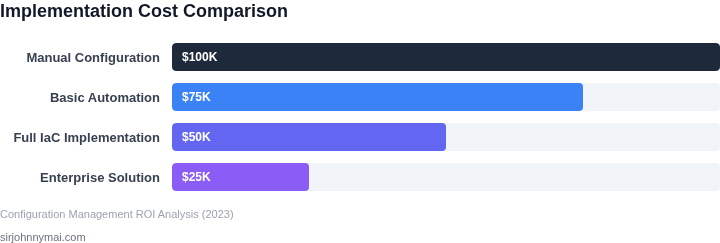
Define a bounded scope
Pick a single microservice that already has a CI/CD pipeline and runs on Kubernetes in both staging and production. This limits variables such as network topology, data volume, and compliance constraints while still exposing the full drift loop. Choosing a service that touches a shared database ensures that configuration drift affecting stateful components is observable.
Establish a baseline
Export the current configuration of the chosen service from both environments using kubectl get configmap and terraform show. Store the snapshots in a version‑controlled repository so that any deviation can be diff‑ed against a known good state. Tag the commit with the release version to align drift detection with the release cadence.
Instrument drift detection
Deploy a lightweight daemonset that runs a daily driftctl scan against the live clusters and pushes the results to a Datadog dashboard. Set alerts for any drift score above 2% because small divergences often indicate manual overrides or out‑of‑band changes. Combine this with AWS Config rules for any S3 bucket or IAM role that the service accesses to capture cross‑service drift.
Automate remediation
Configure a GitHub Actions workflow that triggers on a drift alert, opens a PR that restores the desired state, and requires two approvals before merge. This creates a human‑in‑the‑loop safety net while still demonstrating the speed of automated correction. For high‑severity drift, add a step that rolls back the Kubernetes deployment using the previous Helm chart version to guarantee service continuity.
Measure success criteria
- Mean time to detect (MTTD) drift falls below 15 minutes.
- Mean time to remediate (MTTR) drift stays under 1 hour.
- Zero production incidents attributable to configuration mismatch during the pilot period.
Collect these metrics for three sprint cycles to provide a statistically meaningful sample. If the pilot meets all three thresholds the approach can be scaled to additional services with confidence.
Scale considerations
The pilot proves the technical workflow but introduces organizational overhead: each team must own its drift‑alert channel and approve remediation PRs. This works when teams are already using pull‑request reviews for code changes but becomes cumbersome in groups that rely on manual SSH access. If the latter is common, introduce a read‑only IAM role that limits direct cluster edits to force compliance with the IaC pipeline.
Next step
Pull the last 90 days of kubectl get all output for the selected microservice from both staging and production clusters, store the JSON files in S3, and run a diff script that highlights any mismatched fields.
Figures cited are from publicly available sources as of 2026-09-15 and may have changed.