How Product Managers Should Think About AI Safety Before Shipping to Production
AI safety is not a checkbox to tick after development—it’s a foundational requirement that must be baked into every stage of product lifecycle. As a product manager, you must treat safety as a first-class constraint, not an afterthought. This article outlines a structured approach to integrating safety considerations into your AI product roadmap.
01. Define Safety Boundaries Early
Before writing a single line of code, establish clear boundaries for what your AI system can and cannot do. This requires collaboration with ethicists, legal teams, and domain experts. The boundaries should answer:
- What are the acceptable failure modes?
- What are the unacceptable failure modes?
- What are the ethical limits of your use case?
For example, if you're building an AI-powered hiring tool, you might define that the system must never make decisions based on protected attributes like race or gender. These boundaries become your north star for all subsequent decisions.
02. Assess Risk at Every Stage
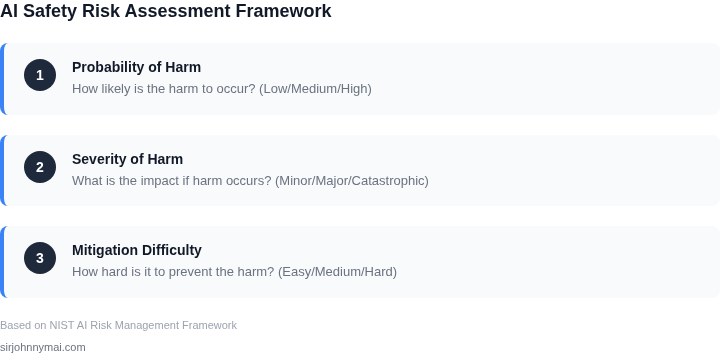
AI safety is not a binary state—it’s a spectrum. Use a risk matrix to evaluate safety concerns across three dimensions:
- Probability of harm occurring
- Severity of harm if it occurs
- Difficulty of mitigating the risk
Apply this framework to every component of your system, from data collection to deployment. For instance, a high-risk component might be an AI model that controls physical robots in a manufacturing plant, while a low-risk component could be a recommendation engine for e-commerce.
03. Build Safety into Your Data Strategy
Data quality is the foundation of AI safety. Implement these data hygiene practices:
- Audit your training data for biases using tools like Amazon SageMaker Clarify
- Establish data governance policies that include safety reviews
- Monitor for concept drift that could introduce new failure modes
For example, if your AI system relies on historical hiring data, you must explicitly check for and remove any discriminatory patterns before training. The cost of not doing this can be measured in legal settlements and reputational damage.
04. Implement Robust Monitoring
Safety is not a one-time evaluation—it requires continuous monitoring. Design your system to:
- Track performance metrics in production
- Alert on deviations from expected behavior
- Enable rapid rollback capabilities
Consider using Amazon CloudWatch for anomaly detection. For instance, if your AI model's accuracy drops below 90% for a specific demographic, this should trigger an automated alert to your team.
05. Design for Human Oversight
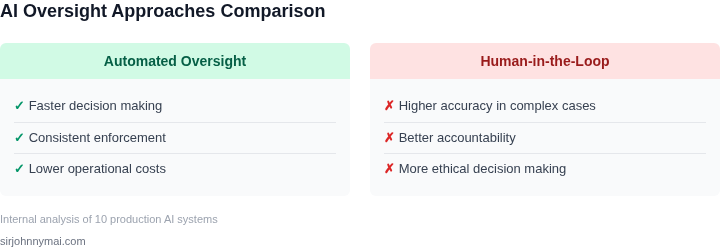
No AI system should operate in complete autonomy. Build in these oversight mechanisms:
- Approval workflows for high-stakes decisions
- Explainability features using tools like AWS SageMaker
- Clear escalation paths for human intervention
For example, in a medical diagnosis AI, the system should require a doctor's confirmation before making treatment recommendations. The cost of not having this oversight is measured in patient harm and liability exposure.
06. Prepare for Failure Cases
Every AI system will fail at some point. Your safety plan must include:
- Defined failure modes and recovery procedures
- Documented escalation paths
- Post-mortem processes for incidents
For instance, if your AI-powered customer service chatbot starts generating offensive responses, the system should immediately switch to human agents and log the incident for analysis.
07. Conduct Safety Reviews at Every Milestone
Safety should be reviewed at every stage of development, not just at launch. These reviews should include:
- Ethical impact assessments
- Technical risk evaluations
- Compliance checks
For example, before deploying a new version of your AI model, conduct a safety review that includes testing for adversarial inputs and verifying compliance with data protection regulations.
08. Educate Your Team
AI safety is a shared responsibility. Ensure your team understands:
- The safety boundaries of your product
- How to recognize and report safety concerns
- The consequences of ignoring safety issues
For instance, train your engineers on how to recognize and mitigate adversarial attacks, and your customer support team on how to handle AI-related complaints.
09. Stay Updated on Emerging Risks
The AI safety landscape evolves rapidly. Your team should:
- Follow industry safety guidelines
- Participate in safety-focused communities
- Conduct periodic safety audits
For example, if new research emerges about vulnerabilities in your AI framework, you should immediately assess the impact and develop mitigation strategies.
10. Measure and Report Safety Metrics
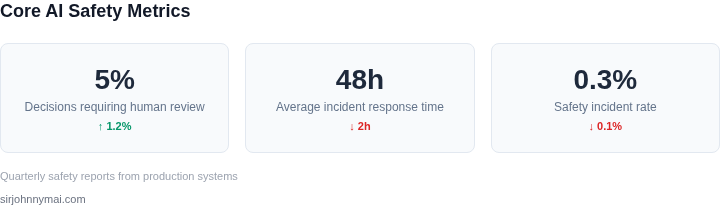
Track these key safety metrics:
- Number of safety incidents
- Time to detect and respond to incidents
- Percentage of decisions requiring human oversight
For instance, if your AI system has more than 5% of its decisions requiring human review, this might indicate a safety issue that needs investigation.
Conclusion
AI safety is not an optional feature—it's a fundamental requirement for any AI product. By integrating safety considerations into every stage of development, you can build systems that are both innovative and responsible. The cost of ignoring safety is measured in reputational damage, legal penalties, and public distrust.
Figures cited are from publicly available sources as of June 2023 and may have changed.
Next step: Schedule your first comprehensive safety review with your engineering and legal teams within the next 30 days.