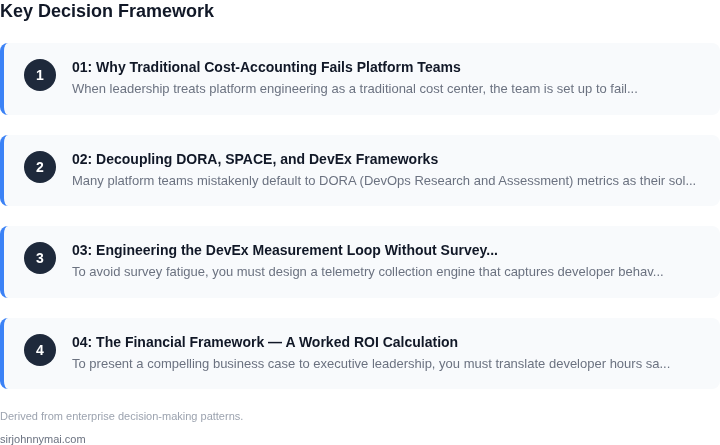
01: Why Traditional Cost-Accounting Fails Platform Teams
When leadership treats platform engineering as a traditional cost center, the team is set up to fail. Historically, infrastructure and tools teams have been budgeted similarly to corporate IT: keep the lights on, minimize operational expenses, and treat any software license or headquarter expansion as a net-negative cash flow. This mental model assumes that internal developer platforms (IDPs) are simply utility grids. The goal is to keep the grid running at the lowest possible cost per kilowatt-hour. However, treating developer enablement as a utility ignores the primary driver of software profitability: engineering velocity.
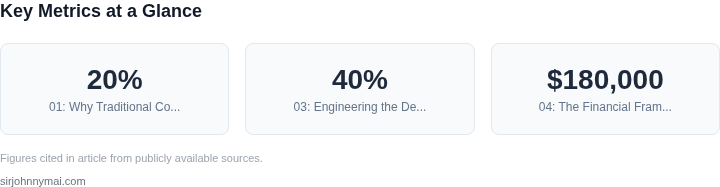
In software organization structures, the return on investment (ROI) of an internal platform is not realized through direct cost reduction of infrastructure. It is realized through the compounding velocity of the product teams that consume the platform. At Amazon and Microsoft, we treated our internal tools as products where the "customers" are our own developers. If your internal product teams spend 20% of their sprints fighting Kubernetes configurations, writing boilerplates, or waiting on manual DNS provisioning, your real waste is not infrastructure spend. It is the opportunity cost of delayed feature delivery and the engineering toil that drains your highest-value assets.
To shift this perception with your Vice President or Chief Financial Officer, platform PMs must move away from proxy metrics like "number of pipelines built" or "total VMs managed." These are activity metrics, not business value metrics. To prove ROI, you must demonstrate how the platform shortens the cycle time between a product requirement being conceived and that same requirement generating revenue in production. If you cannot tie platform initiatives directly to engineering output, your team will remain vulnerable during every budget planning cycle.
This paradigm shift requires a different approach to measurement. You cannot rely on standard IT Service Management (ITSM) frameworks to capture the subjective friction of a software engineer. You need a dedicated DevEx (Developer Experience) framework that marries operational telemetry with developer perception.
02: Decoupling DORA, SPACE, and DevEx Frameworks
Many platform teams mistakenly default to DORA (DevOps Research and Assessment) metrics as their sole measure of developer experience. While Deployment Frequency, Lead Time for Changes, Mean Time to Recovery (MTTR), and Change Failure Rate are vital for tracking operational stability and delivery capability, they are lag metrics. They tell you how your delivery pipelines are performing, but they fail to capture why developers are struggling. For example, a team can have a low Lead Time for Changes because they only ship trivial hotfixes, while their actual feature velocity is stalled due to highly fragmented local test environments.
The SPACE framework, developed by researchers at GitHub, Microsoft, and Victoria University, offers a more holistic alternative. SPACE stands for Satisfaction, Performance, Activity, Communication, and Efficiency. This framework recognizes that developer productivity is multi-dimensional. Satisfaction and well-being are leading indicators of retention and performance; activity metrics (like PR volume) only tell a partial story. When you run a platform team, you must select metrics from different dimensions of the SPACE framework to prevent gaming the system. If you measure Activity alone, developers will split PRs into smaller, low-value chunks to inflate their numbers.
| Measurement Dimension | DORA Metric Focus | SPACE Metric Focus | Platform Telemetry Focus |
|---|---|---|---|
| Core Objective | Operational delivery capability and stability. | Holistic developer productivity and well-being. | Friction reduction in internal developer workflows. |
| Primary Data Source | Git metadata, CI/CD runners, and incident trackers. | Developer surveys, cognitive load self-assessments, and Git. | Local build logs, IDE plugins, and internal portal API usage. |
| Major Limitation | Ignores the qualitative "inner loop" development experience. | Hard to automate; relies heavily on survey participation. | Requires custom telemetry integration in local environments. |
The limitation of the SPACE framework is its reliance on self-reported surveys. In large enterprises, survey fatigue sets in quickly. If developers receive quarterly 30-minute surveys about their tooling experience, response rates drop, and the data becomes skewed toward highly dissatisfied outliers. To build a robust measurement engine, platform teams must blend qualitative sentiment surveys with automated, quantitative telemetry gathered directly from the developer's workspace. This hybrid approach is what we define as modern DevEx measurement.
By measuring both the "inner loop" (coding, local testing, debugging) and the "outer loop" (code review, integration, deployment, monitoring), platform teams can isolate where cognitive load is highest. This enables product management to prioritize platform features based on real friction rather than loud opinions.
03: Engineering the DevEx Measurement Loop Without Survey Fatigue
To avoid survey fatigue, you must design a telemetry collection engine that captures developer behavior implicitly. We do this by instrumenting our golden paths. A "golden path" is a pre-packaged, opinionated set of tools and workflows that solve common engineering tasks. If you use Spotify Backstage, AWS Proton, or HashiCorp Terraform to template your microservices, you already have natural integration points to measure telemetry.
Your telemetry pipeline should capture three key areas of the inner loop without requiring manual developer input: Local Build Times (using custom hooks in Gradle, Maven, Webpack, or Cargo that log execution duration to a central OpenTelemetry endpoint), Local Environment Startup Failure Rates (tracking how often standard Docker Compose or Kubernetes-in-Docker setups crash during initialization), and Search Latency in Internal Documentation (monitoring what developers search for in your internal portals and whether they find successful answers without opening support tickets).
Let's look at how we measure local build performance. A platform team can distribute an internal IDE plugin or a lightweight shell wrapper around the company's build tools. When a developer runs a build command, the wrapper sends anonymous, structured logs to an observability tool (such as Amazon CloudWatch, Datadog, or an Elasticsearch cluster). This payload includes the project name, the build duration, the outcome (success or failure with exit codes), and the local system configuration (e.g., M-series Mac vs. legacy Intel x86 laptops). This allows the platform team to identify if 40% of the engineering organization is wasting 45 minutes a day waiting for bloated local builds to compile.
However, telemetry alone misses the human element of frustration. To capture sentiment without survey fatigue, employ "micro-surveys." Instead of long-form quarterly questionnaires, embed a single-question rating directly into the developer workflow. When a developer completes a build, merges a PR, or successfully deploys a microservice via the internal platform, trigger a non-blocking UI pop-up: "On a scale of 1-5, how painless was this deployment?" By capturing feedback directly at the point of interaction, your response rates will increase, and the feedback will be highly accurate because the experience is fresh in the developer's mind.
04: The Financial Framework — A Worked ROI Calculation
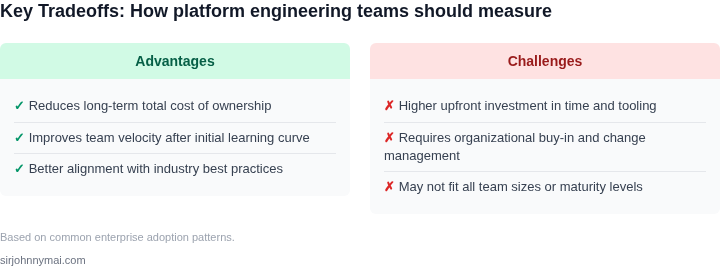
To present a compelling business case to executive leadership, you must translate developer hours saved into hard currency. You must also calculate the opportunity cost recovered. Let us walk through a concrete, real-world calculation for a mid-sized enterprise organization. We will use realistic engineering costs and conservative productivity gains based on standard industry baselines.
The Scenario
- Total Product Developers (N): 500 engineers.
- Average Fully Loaded Software Engineer Cost (C): $180,000 per year (including benefits,