How Engineering Managers Should Handle Reorganizations Without Losing Their Best People
Reorganizations are inevitable in fast-moving tech companies. The challenge for engineering managers is to navigate these changes while preserving team morale, productivity, and talent retention. This guide outlines a structured approach to handling reorganizations with minimal disruption.
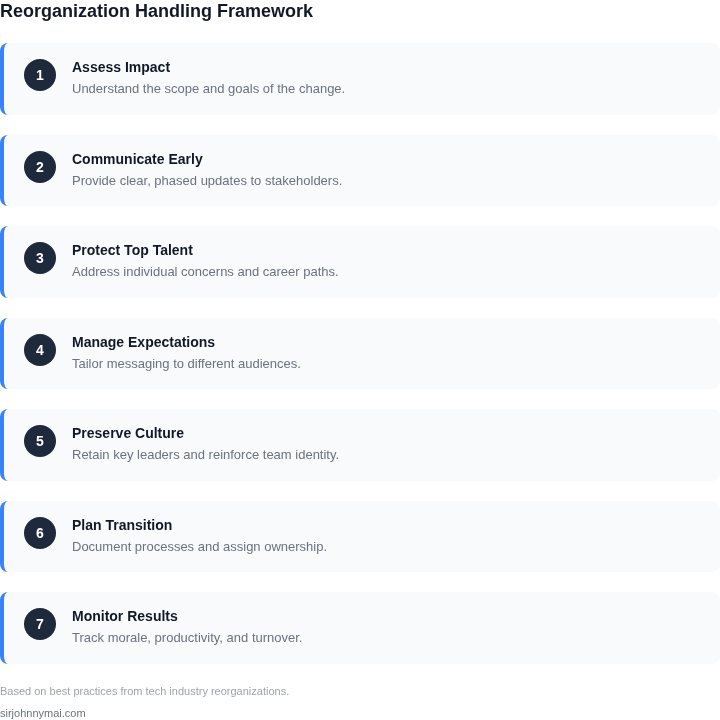
01. Assess the Reorganization's Impact
Before taking action, understand the full scope of the change. Key questions to answer:
- What teams are being merged, split, or eliminated?
- Who are the key stakeholders (executives, HR, affected teams)?
- What are the stated goals of the reorganization?
Example: If your team is being merged with another, identify shared priorities and potential synergies. If your team is being eliminated, focus on transitioning roles to other teams.
02. Communicate Early and Transparently
Timing and clarity are critical. Communicate in three phases:
- Initial Announcement: Share the high-level rationale and timeline. Avoid details that could create confusion.
- Detailed Updates: Provide specifics about roles, responsibilities, and team structures. Use clear language and avoid jargon.
- Ongoing Check-ins: Schedule regular updates to address questions and concerns.
Example: "We're merging Teams A and B to accelerate X. The new team will report to [Manager], and we'll share the detailed org chart next week."
03. Protect Your Top Performers
Retention of high performers is non-negotiable. Key strategies:
- Individual Conversations: Meet with top contributors to discuss their career goals and how the change affects them.
- Career Pathing: Proactively identify growth opportunities within the new structure.
- Compensation Review: Ensure no one is negatively impacted by the change.
Example: If a senior engineer is being moved to a less strategic role, negotiate a temporary promotion or additional responsibilities.
04. Manage Expectations Across the Team
Different team members will react differently. Tailor your messaging:
- For Affected Individuals: Focus on solutions and growth opportunities.
- For Unaffected Team Members: Emphasize the positive outcomes of the change.
- For the Broader Organization: Highlight how the change aligns with company goals.
Example: "This change will allow us to focus on Y, which will directly impact our ability to deliver Z."
05. Preserve Team Culture
Reorganizations often disrupt culture. Mitigation strategies:
- Retain Key Leaders: If possible, keep the same manager or bring in someone with a similar leadership style.
- Encourage Collaboration: Organize cross-team initiatives to build relationships.
- Recognize Achievements: Acknowledge past successes to reinforce team identity.
Example: "Our team has delivered X in the past year. Let's build on that momentum as we move forward."
06. Plan for Transition
Create a detailed transition plan with:
- Clear ownership of projects and responsibilities.
- Documentation of processes and knowledge.
- A timeline for knowledge transfer.
Example: "We'll document all legacy systems by [date] and hold a knowledge-sharing session on [date]."
07. Monitor and Adapt
After the reorganization, track key metrics:
- Team morale and engagement.
- Productivity and delivery timelines.
- Employee turnover rates.
Example: "We'll survey the team every two weeks to gauge satisfaction and adjust as needed."
Conclusion
Handling reorganizations requires a combination of strategic communication, proactive protection of talent, and a focus on preserving team culture. The key is to treat the change as an opportunity to realign around shared goals rather than a disruption.
Next Step: Schedule a team-wide meeting to discuss the reorganization and answer questions. Use this time to reinforce the company's vision and the team's role in achieving it.