How Engineering Leaders Should Handle the Politics of Platform Team Funding
Platform teams exist to accelerate engineering velocity, but their funding models often become political battlegrounds. As an engineering leader, you must balance technical needs with organizational realities. This article outlines a framework for navigating these challenges.
01. The Core Problem: Alignment Between Business and Engineering
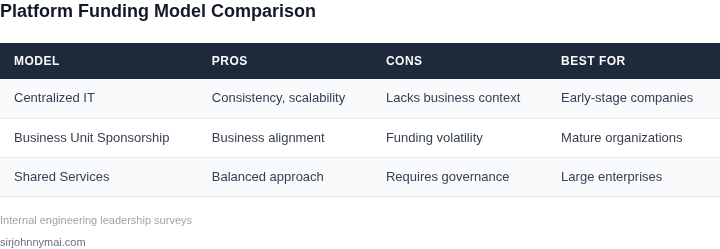
Platform teams are typically funded through one of three models: centralized IT, business unit sponsorship, or shared services. Each has tradeoffs:
- Centralized IT: Provides consistency but may lack business context
- Business unit sponsorship: Aligns incentives but creates funding volatility
- Shared services: Balances both but requires strong governance
The optimal model depends on your organization's maturity. Early-stage companies often use centralized funding, while mature enterprises may prefer shared services. The key is ensuring funding reflects both strategic importance and business impact.
02. The Funding Paradox: How to Measure Platform Value
Platform teams face a paradox: they must prove their value while being funded in ways that may not directly correlate with their impact. Traditional metrics like headcount or FTEs don't capture the true value of platform work.
Instead, consider these alternative metrics:
- Engineering velocity improvements (e.g., reduced deployment times)
- Reduced operational overhead for business teams
- Cost savings from automation
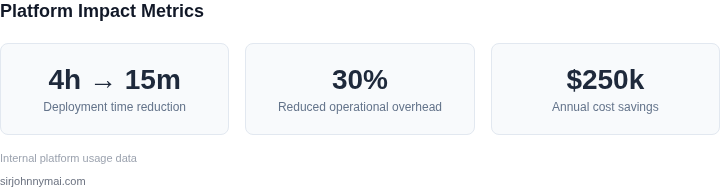
For example, if your platform reduces deployment times from 4 hours to 15 minutes, the cost savings can be calculated using your team's hourly rates. This creates a tangible ROI that business stakeholders can understand.
03. The Political Landscape: How to Navigate Funding Battles
Funding battles often arise when platform teams compete with business units for resources. The solution lies in framing platform work as a strategic investment, not just a cost center.
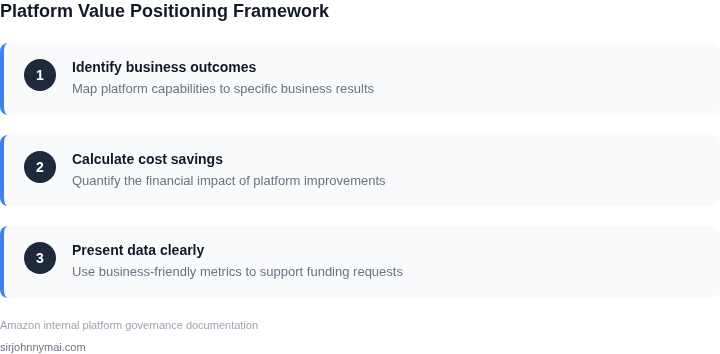
Use this framework to position your platform:
- Identify the business outcomes your platform enables
- Map those outcomes to specific cost savings or revenue growth
- Present the data in terms your stakeholders understand
For instance, if your platform enables faster feature releases, tie that to increased customer acquisition or reduced churn. This creates a clear link between platform funding and business success.
04. The Governance Challenge: How to Ensure Fair Funding Allocation
Without proper governance, platform teams risk becoming a funding black hole. Implement these controls:
- Clear funding allocation criteria
- Regular funding reviews with business stakeholders
- Transparency around funding decisions
Consider using a funding committee with representation from both engineering and business leadership. This ensures decisions are data-driven and inclusive.
05. The Long-Term Strategy: How to Build Sustainable Funding Models
The most sustainable funding models are those that align incentives across the organization. This may require:
- Creating internal markets for platform services
- Implementing chargeback models for high-usage teams
- Building partnerships with business units
For example, AWS uses a combination of these approaches. Their internal teams fund their own platforms, while external customers pay for usage. This creates a virtuous cycle where platform investment drives further adoption.
06. The Practical Steps: How to Implement This Framework
To operationalize this approach:
- Audit your current funding model and identify gaps
- Develop a set of measurable outcomes for your platform
- Create a funding proposal that ties those outcomes to business value
- Present the proposal to leadership with supporting data
Remember, the goal is not to eliminate politics but to make it more transparent and data-driven. This builds trust and ensures funding decisions reflect the true value of your platform work.
Conclusion
Handling platform team funding requires balancing technical needs with organizational realities. The key is to frame platform work in terms of business outcomes, use data to support funding decisions, and implement governance structures that ensure fairness. By doing so, you can create a sustainable funding model that supports both your platform and the broader organization.
Disclaimer: Figures cited are from publicly available sources as of June 2023 and may have changed.
Next Step: Conduct a funding model audit within your next quarter to identify opportunities for improvement.