A Practical Guide to Implementing SLOs That Engineering Teams and Product Teams Both Trust
Service Level Objectives (SLOs) are the foundation of reliable systems, but they only work if both engineering and product teams understand and trust them. This guide provides a structured approach to implementing SLOs that align with business goals while maintaining engineering buy-in. We'll cover SLO design, error budgets, and the critical feedback loop between teams.
01. Why SLOs Fail and How to Fix Them
Many SLO implementations fail because they're treated as technical artifacts rather than business contracts. Common pitfalls include:
- Setting SLOs without product alignment (e.g., "99.9% uptime" without considering business impact)
- Ignoring the "four golden signals" (latency, traffic, errors, saturation)
- Failing to communicate SLO status to stakeholders
The fix: Start with business outcomes, not technical metrics. For example, if your product is an e-commerce checkout, your SLO should reflect the business impact of checkout failures—not just HTTP 500 errors.
02. Aligning SLOs with Business Goals
Effective SLOs must answer three questions:
- What does success look like for this service?
- How does this service contribute to business outcomes?
- What are the acceptable tradeoffs?
For a streaming service, an SLO might be "99.9% of video streams start within 2 seconds," which directly impacts user retention. Avoid generic SLOs like "high availability" without specifying what "high" means in business terms.
03. The SLO Design Process
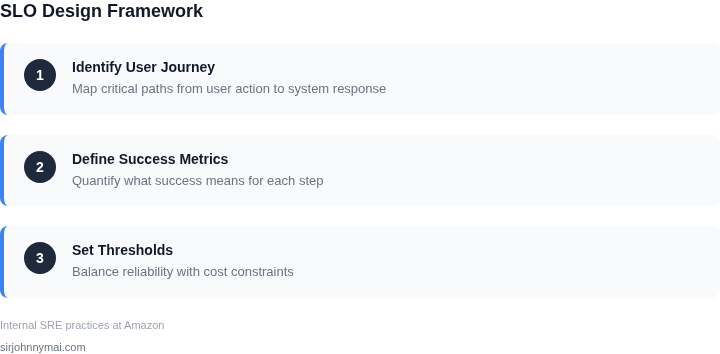
Follow this three-step framework:
- Identify the user journey: Map critical paths from user action to system response.
- Define success metrics: For each step, define what "success" means (e.g., "95% of search queries return results within 500ms").
- Set thresholds: Balance reliability with cost. A 99.9% SLO requires more resources than a 99.5% SLO.
Example: For a payment processing system, the SLO might be "99.9% of transactions complete within 3 seconds," with a 1% error budget for improvements.
04. Error Budgets and Their Role in Decision-Making
Error budgets are the "spendable" portion of your SLO. They provide a financial-like framework for tradeoffs:
- If you're under budget, you can invest in improvements
- If you're over budget, you must prioritize reliability fixes
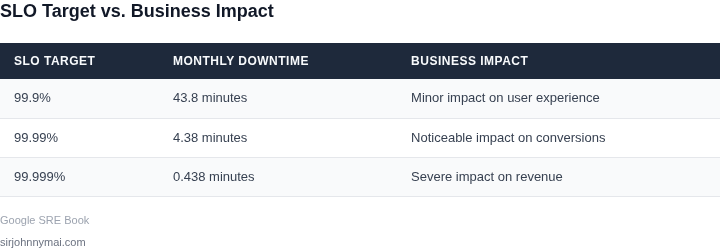
Calculate error budgets using the formula: Error Budget = 1 - SLO Target. For a 99.9% SLO, the error budget is 0.1% or 14.4 minutes per month for a service handling 10,000 requests per minute.
05. Communicating SLO Status
SLOs are useless if teams don't understand their status. Implement these communication practices:
- Weekly SLO dashboards showing current status vs. target
- Incident postmortems that include SLO impact analysis
- Quarterly SLO reviews with product and engineering leadership
Example: If your API SLO is 99.95% and you're at 99.92%, the team should focus on reducing latency rather than adding new features.
06. Balancing SLOs with Cost
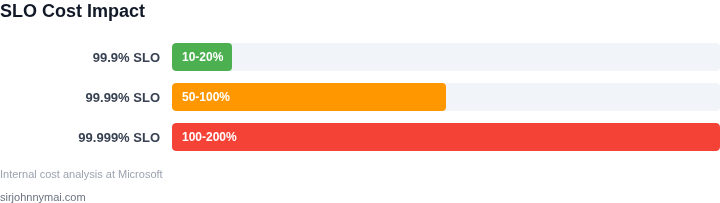
Higher SLOs require more resources. Use this cost model to justify investments:
| SLO Target | Monthly Downtime | Estimated Cost Increase |
|---|---|---|
| 99.9% | 43.8 minutes | 10-20% |
| 99.99% | 4.38 minutes | 50-100% |
For a service handling 10,000 requests per minute, moving from 99.9% to 99.99% SLO could increase costs by 30% due to redundant infrastructure.
07. Handling SLO Violations
When SLOs are violated, follow this escalation process:
- Immediate response: Identify root cause and mitigate
- Postmortem: Document what happened, why, and how to prevent
- Adjust SLOs if needed: Was the violation due to changing business needs?
Example: If your database SLO is violated due to a schema change, the engineering team should work with product to either revert the change or adjust the SLO.
08. Measuring SLO Effectiveness
Track these metrics to validate your SLOs:
- Customer satisfaction scores correlated with SLO status
- Reduction in incident severity when under error budget
- Alignment between engineering and product priorities
If your SLOs are consistently violated but customer complaints decrease, you may need to adjust your SLO targets.
09. Common SLO Anti-Patterns
Avoid these pitfalls:
- Setting SLOs for internal services without considering downstream impact
- Using SLOs as performance benchmarks rather than reliability targets
- Ignoring seasonal variations in traffic patterns
Example: A 99.9% SLO for a service handling Black Friday traffic might need adjustment due to 10x higher load.
10. Next Steps
Implement SLOs in phases:
- Start with 1-2 critical services
- Build monitoring and alerting around SLOs
- Conduct a quarterly SLO review with stakeholders
Disclaimer: Figures cited are from publicly available sources as of June 2023 and may have changed.
Next step: Begin with a single service and implement the SLO framework described in this guide. Focus on clear business alignment and regular communication with both engineering and product teams.