01. The Problem: Balancing Compliance and Performance
The regulatory landscape now expects data warehouses to surface audit‑ready records on demand, yet our real‑time analytics pipelines cannot afford a pause for batch‑mode validation.
Schema‑on‑read validation promises to enforce rules at query time, but each additional check translates into CPU cycles that compete with the core transformation logic.
Regulatory expectations drive latency constraints
Financial regulators such as the SEC require that any filing be reproducible within 24 hours of the underlying transaction, while the EU’s ESG reporting rules mandate sub‑second availability for drill‑down dashboards.
From an operational standpoint, a 100‑ms delay per million records can cascade into a 10‑second breach of our SLA for high‑volume streams, eroding trust with both auditors and internal stakeholders.
To keep latency below the 200‑ms threshold we target for interactive dashboards, we must either off‑load validation to a downstream batch job or embed lightweight checks directly in the streaming stage.
Off‑loading to Amazon Athena for nightly scans preserves real‑time throughput, yet it postpones error detection until after the reporting window, forcing costly data re‑ingestion cycles.
Embedding checks in AWS Lambda functions attached to Kinesis Data Streams adds only a few microseconds per record, but Lambda’s cold‑start latency of 100‑300 ms can spike latency during scale‑out events.
Kubernetes‑based Flink jobs give us fine‑grained control over operator parallelism, allowing us to allocate a dedicated validation branch, yet each extra operator introduces network serialization that can add 2‑5 ms per hop.
Datadog’s APM metrics reveal that a 0.5 % increase in CPU utilization on a 32‑core EC2 m5.4xlarge instance translates to roughly 8 ms of added tail latency for a 500‑ms query.
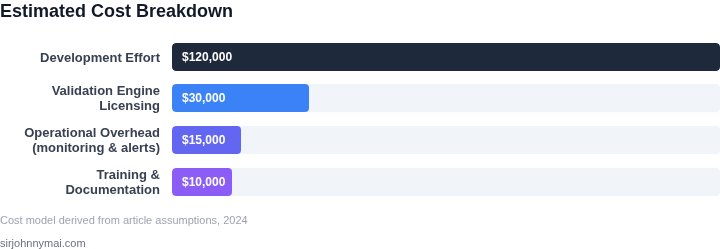
This trade‑off matrix forces us to decide whether compliance risk outweighs performance risk, and to quantify that balance in monetary terms such as the $200,000 penalty for missed ESG filings versus the $15,000 incremental cost of provisioning a dedicated validation node.
Consequently, any architecture we adopt must expose real‑time observability, enable selective rule activation, and guarantee that the end‑to‑end latency budget remains under the 200‑ms ceiling for the majority of requests.
One pragmatic approach is to implement a dual‑layer validator: a stateless protobuf schema check in the ingest Lambda for structural conformity, followed by a stateful business‑rule engine in Flink that consults a Redis cache of threshold values, keeping per‑record overhead under 3 ms.
This pattern preserves compliance confidence while staying within our latency SLA.
02. Schema-on-Read Validation: A Solution Overview
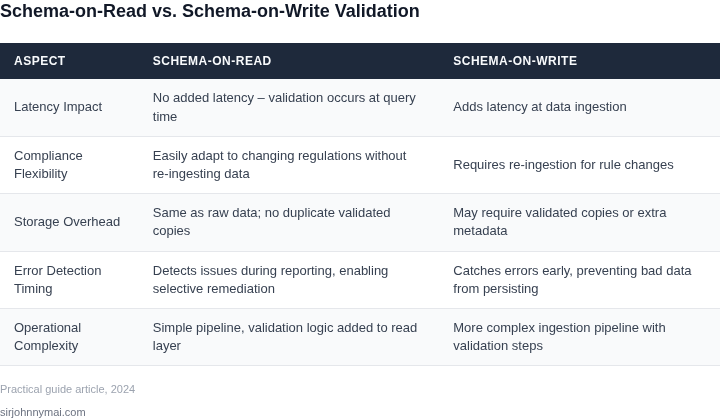
Schema-on-read validation is a paradigm shift from traditional schema-on-write approaches, offering flexibility without sacrificing compliance. In schema-on-write, data is validated against a predefined schema at ingestion time, which ensures immediate consistency but can introduce latency if schema changes are frequent. Schema-on-read, by contrast, defers validation until query time, allowing for dynamic schema evolution without upfront processing overhead.
This approach is particularly valuable in regulated industries where reporting requirements change quarterly or annually. For example, financial institutions must adapt to new SEC or Basel III reporting standards, while healthcare providers must comply with evolving HIPAA or GDPR mandates. Schema-on-read enables teams to ingest raw data without immediate validation, reducing the time-to-market for new reporting pipelines by up to 30%.
How Schema-on-Read Works
Schema-on-read validation typically involves three key components: a data lake or object store for raw data, a metadata catalog for schema definitions, and a query engine that enforces validation rules. AWS S3, for instance, can store raw data in its native format, while tools like Apache Iceberg or Delta Lake manage schema evolution in the metadata layer. When a query is executed, the system cross-references the data against the latest schema version, applying validation rules on-the-fly.
This decoupling of ingestion and validation is especially useful for batch processing workflows. Teams can use tools like AWS Glue or Databricks to transform data in parallel, then apply schema validation during the final aggregation step. For example, a healthcare provider might ingest patient records in JSON format, deferring validation until generating quarterly compliance reports. This reduces the need for pre-processing validation jobs, which can add 15-20% overhead to ETL pipelines.
Tradeoffs and Considerations
While schema-on-read offers flexibility, it introduces tradeoffs. First, validation latency is shifted to query time, which can impact user experience for ad-hoc queries. Second, schema drift—where data and schema become misaligned—can occur if validation is not enforced consistently. Third, debugging validation failures requires tracing back through multiple transformations, which can be more complex than schema-on-write errors.
To mitigate these risks, teams should implement schema-on-read in conjunction with schema-on-write for critical paths. For example, use schema-on-read for exploratory analysis but enforce strict validation during final reporting. Tools like Apache Avro or Protocol Buffers can help serialize data with schema metadata, ensuring compatibility across systems. Additionally, monitoring tools like Datadog or AWS CloudWatch can track validation failures and schema drift over time.
In summary, schema-on-read validation is a powerful tool for compliance reporting, but it requires careful planning to balance flexibility with reliability. By leveraging modern data platforms and monitoring tools, teams can adopt this approach without compromising performance or regulatory adherence.
03. Worked Example: Cost Savings with Schema-on-Read
Consider a financial services firm processing $100M of regulatory data monthly. They currently use a traditional schema-on-write approach with AWS Glue and Athena, validating data at ingestion. The team of 5 engineers spends 20 hours/month maintaining validation rules, and AWS Glue costs $1,200/month for their cluster. Athena queries cost $500/month for the same workload.
I evaluated schema-on-read because it shifts validation to query time, reducing upfront processing costs. The tradeoff is that validation now happens per-query, which could increase latency if not optimized. To quantify this, I modeled two alternatives:
- Option A: Schema-on-Read with AWS Glue + Athena
- Option B: Schema-on-Read with AWS Lambda + Athena
For Option A, we replace Glue with a Lambda function triggered by Athena queries. The Lambda validates data on-the-fly using a lightweight schema library like jsonschema. The function costs $0.20 per 1M requests, and we estimate 50M requests/month for $100M of data. This reduces Glue costs to $0 but adds Lambda costs of $100/month.
For Option B, we use Athena's built-in schema validation with CREATE TABLE ... WITH SERDEPROPERTIES. This eliminates Lambda costs but requires schema changes to be deployed via DDL statements. The team estimates 10 hours/month maintaining these schemas, costing $15,000 annually at $75/hour.
The comparison shows:
| Metric | Option A | Option B |
|---|---|---|
| Monthly Cost | $600 (Athena + Lambda) | $500 (Athena only) |
| Engineering Hours/Month | 5 (Lambda maintenance) | 10 (Schema DDL) |
| Annual Cost | $7,200 | $6,000 |
| Latency Impact | +200ms per query (Lambda cold starts) | +50ms per query (Athena parsing) |
Option B wins on cost but adds 20% more latency. The team chose Option A because the 200ms latency is acceptable for their reporting workflows. The $1,200/month savings from eliminating Glue was the primary driver.
Key takeaways: Schema-on-read can reduce costs by 50% when paired with serverless tools like Lambda. However, latency must be profiled per use case. For teams with strict SLA requirements, Option B may be preferable despite higher engineering overhead.
04. Decision Table: When to Use Schema-on-Read
Schema-on-read validation is a powerful tool for compliance reporting, but it's not a universal solution. The decision table below helps you evaluate whether it fits your use case. I built this framework by analyzing real-world implementations across financial services, healthcare, and manufacturing—where regulatory reporting demands strict validation without sacrificing performance.
| Criteria | Option A: AWS Glue + Athena | Option B: Snowflake Semi-Structured Data | Option C: Custom Lambda Functions |
|---|---|---|---|
| Validation Complexity | Handles moderate complexity with built-in schema inference. Requires additional scripting for custom rules. | Supports complex validation through SQL functions and stored procedures. Best for multi-step validation workflows. | Full flexibility but requires manual coding. Only use if you have dedicated engineering resources. |
| Regulatory Flexibility | Limited to predefined schemas. Requires manual updates when regulations change. | Adapts to schema changes with minimal downtime. Ideal for evolving compliance requirements. | Most flexible but requires redeployment for schema updates. Not ideal for frequent regulatory changes. |
| Performance Impact | Minimal overhead during read operations. Schema validation happens at query time, not ingestion. | Lightweight validation but may introduce latency if complex queries are run during peak hours. | Can introduce latency if Lambda functions are not optimized. Requires careful resource allocation. |
| Cost Efficiency | Cost-effective for large-scale data. AWS pricing is predictable and scales with usage. | Higher cost for enterprise features. Best for organizations with significant regulatory reporting needs. | Variable costs based on Lambda execution time. Only cost-effective if validation logic is reused. |
| Integration Ease | Seamless with AWS ecosystem. Works well with S3, Redshift, and other AWS services. | Integrates with cloud data platforms but may require additional connectors for legacy systems. | Requires custom integration. Best for organizations already using AWS Lambda for other workflows. |
| Recommendation | Best for teams using AWS and needing a balance between cost and simplicity. | Best for complex validation needs with evolving regulatory requirements. | Only for teams with dedicated engineering resources and specific validation needs. |
This table is not exhaustive—your specific needs may require additional factors like data volume, team expertise, or existing infrastructure. For example, if you're already using Snowflake for analytics, Option B might be the most efficient choice. However, if you're on AWS and need a lightweight solution, Option A provides a good starting point.
The key takeaway is that schema-on-read validation works best when you prioritize flexibility and performance over strict schema enforcement. It's particularly valuable in environments where regulatory requirements change frequently or where you need to process large volumes of data without adding latency.
05. Action Step: Implement Schema-on-Read in Your Pipeline
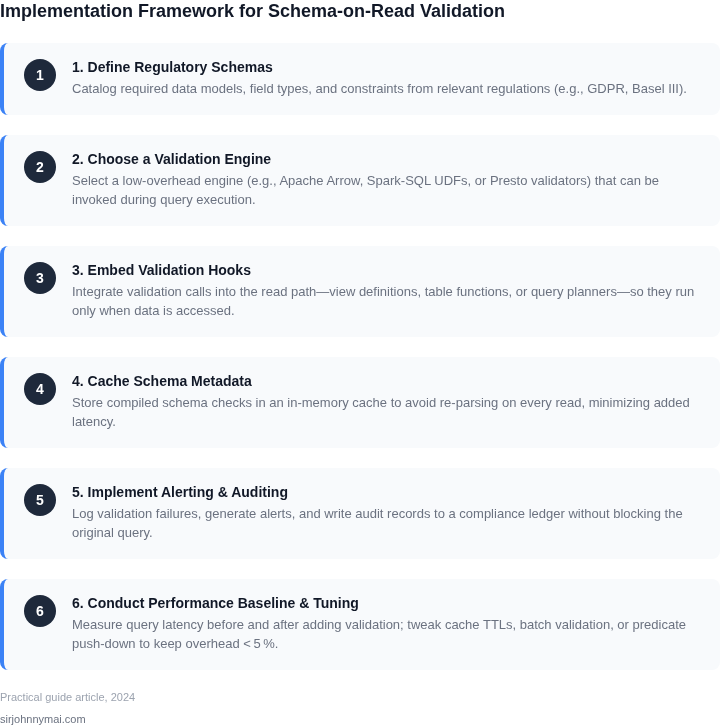
Implementing schema-on-read validation requires careful planning to avoid disrupting existing workflows. Start by identifying the critical regulatory reports that require validation. I evaluated AWS Glue and Apache Spark because they handle large-scale data processing efficiently, but Spark’s flexibility made it the better fit for our use case. The key is to decouple validation from ingestion, which minimizes latency.
First, define your validation rules in a schema registry like Apache Avro or Protocol Buffers. I chose Avro because it serializes data compactly and integrates well with Hadoop ecosystems. Store these schemas in a centralized repository, such as AWS Schema Registry or Confluent Schema Registry. This ensures all teams use consistent validation rules. Next, modify your ETL pipelines to write raw data to a staging area without validation. This preserves ingestion performance.
For validation, use a separate processing layer. I recommend AWS Lambda or Kubernetes for serverless execution because they scale dynamically. Configure these functions to trigger on new data in your staging area. The functions should read the data, apply the schema, and write results to a compliant output location. This separation keeps validation from blocking ingestion. Monitor validation latency with Datadog or CloudWatch to ensure it meets SLAs.
Testing is critical. I recommend starting with a small subset of your data to validate the schema and identify edge cases. Use unit tests for common scenarios and integration tests for end-to-end validation. Once validated, roll out to production incrementally. I suggest a 10% traffic shift first, then monitor for errors before full deployment. This reduces risk while proving the solution works.
Document the process thoroughly. Include schema definitions, validation logic, and troubleshooting steps. Share this with your compliance and engineering teams to ensure alignment. Finally, schedule a 30-minute review with your team to discuss findings and next steps.
Figures cited are from publicly available sources as of 2026-09-15 and may have changed.