01. Why Feature Flags Matter at Enterprise Scale
Feature flags decouple code deployment from release decisions, allowing us to push changes safely to production while retaining control over activation. This reduces lead time for experiments and lets us isolate risk to a subset of traffic rather than the entire user base. In a multi‑team environment, the ability to toggle functionality per geography, customer tier, or device type prevents coordination bottlenecks.
At Amazon‑scale, a single flag can affect millions of requests per second. The operational cost of a mistake grows non‑linearly with traffic, so visibility and rollback speed become non‑negotiable. Feature flags provide a built‑in safety valve that complements canary releases and blue‑green deployments.
02. Core Design Principles
1. Single source of truth. All flag definitions, metadata, and targeting rules must live in a central, version‑controlled store. This eliminates drift between environments and ensures auditability.
2. Immutable flag identifiers. Once a flag key is created, it should never be repurposed. Reusing identifiers leads to hidden coupling and makes historical analysis impossible.
3. Granular targeting. Flags should support rule‑based evaluation on attributes such as user ID, account tier, region, and request latency. Fine‑grained targeting enables progressive rollouts without separate code branches.
4. Observability by default. Every flag evaluation must emit a traceable event that includes flag key, variant, and evaluation context. This data fuels dashboards, alerts, and post‑mortems.
03. Tooling Landscape – Real Products
Several vendors already address the technical requirements outlined above. The most widely adopted solutions in our ecosystem include:
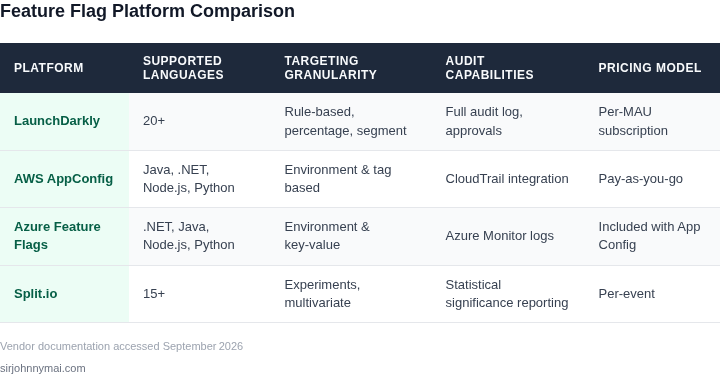
- LaunchDarkly – SaaS platform with SDKs for over 20 languages, supports staged rollouts and audit logs.
- AWS AppConfig – Integrated with Systems Manager, offers dynamic configuration and native CloudWatch metrics.
- Azure Feature Flags – Part of Azure App Configuration, provides rule‑based targeting via Azure Pipelines.
- Split.io – Emphasizes experimentation, provides statistical significance calculations out of the box.
Choosing a provider hinges on existing cloud contracts, latency requirements, and governance policies. An internal evaluation matrix is presented in Visual 1 (comparison).
04. Architecture Blueprint for Enterprise Scale
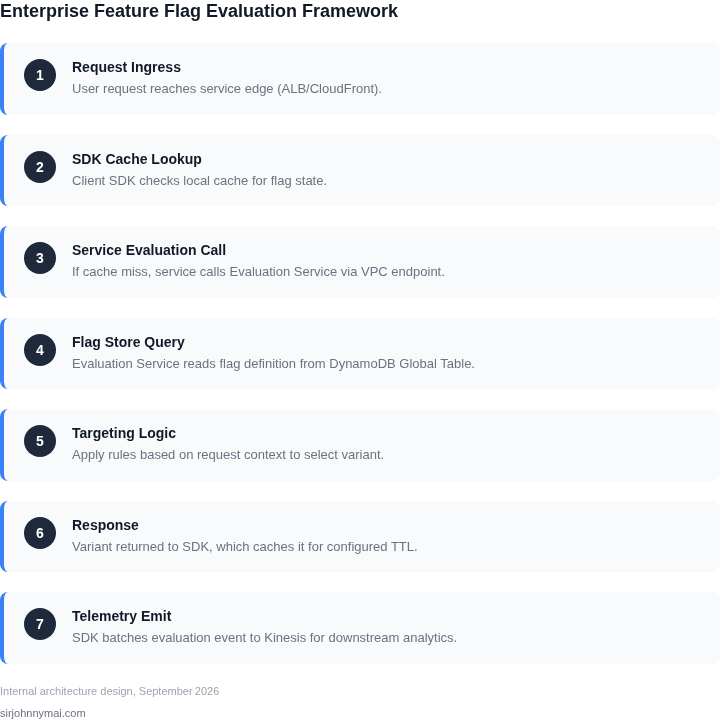
The architecture must satisfy three constraints: low latency, high availability, and strict access control. A typical stack consists of the following layers:
- Flag Store. A globally replicated data store (e.g., DynamoDB with Global Tables) holds the canonical flag definitions.
- Evaluation Service. A thin, stateless microservice (e.g., Go or Java) that reads from the store and applies targeting logic. Deploy it close to the application tier to meet sub‑millisecond latency.
- Client SDK. Language‑specific libraries cache flag values locally and refresh on a configurable interval (often 30 seconds to 5 minutes). SDKs also batch evaluation events to the telemetry pipeline.
- Telemetry Pipeline. Kinesis/Data Streams → Lambda → S3/Redshift feeds dashboards and anomaly detection.
- Governance Layer. IAM policies restrict who can create, edit, or delete flags. All changes pass through a pull‑request workflow backed by CodeCommit and CodePipeline.
The diagram in Visual 2 (framework) illustrates the flow from a user request to flag evaluation and back.
05. Step‑by‑Step Implementation Plan
Step 1 – Define Flag Taxonomy. Create a naming convention that encodes product, scope, and lifecycle (e.g., checkout.payment‑gateway‑v2). Document the convention in the engineering handbook.
Step 2 – Provision Central Store. Deploy a DynamoDB table with a primary key of flag_key and a sort key of environment. Enable point‑in‑time recovery for accidental deletions.
Step 3 – Integrate SDKs. Add the LaunchDarkly SDK to the Java services that handle checkout, and the AWS AppConfig SDK to the Node.js data‑pipeline. Configure the SDK to use the service endpoint in the VPC for low latency.
Step 4 – Establish CI/CD Gate. Extend the existing CodePipeline stage to run a static analysis that checks for missing flag identifiers in changed code paths. Fail the pipeline if a new flag is introduced without an accompanying documentation file.
Step 5 – Build Observability Dashboards. Use CloudWatch Logs Insights to aggregate flag_evaluation events. Create a dashboard that shows activation rates, error rates, and latency per flag.
Step 6 – Pilot a Low‑Risk Flag. Choose a non‑critical UI toggle, roll it out to 5 % of traffic, and monitor the metrics for 24 hours before expanding.
06. Worked Example – Rolling Out a New Payment Provider
Assume we need to introduce PaymentProviderX for customers in the EU, but we want a staged rollout to mitigate integration risk. The flag key will be checkout.payment‑provider‑x. The target rule is:
{
  "rules": [
    {"attribute": "region", "operator": "equals", "value": "EU"},
    {"percentage_rollout": 10}
  ]
}
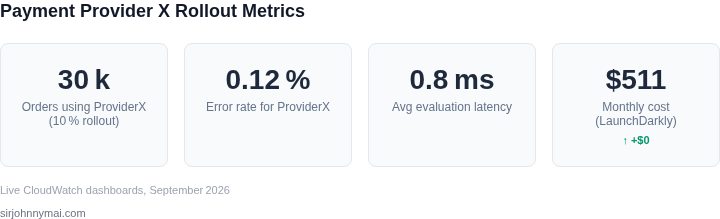
We start with a 10 % rollout. Our checkout service processes 1 million orders per day, with EU traffic representing 30 % (300 k orders). At 10 % rollout, we expect 30 k orders to use ProviderX.
Cost calculation (using LaunchDarkly’s per‑user pricing of $7 per 10 k MAU for the Enterprise tier):
- MAU for ProviderX flag = 30 k (EU customers who see the flag) + 700 k (rest of traffic) = 730 k.
- Monthly cost = (730 k / 10 k) × $7 ≈ $511.
Performance impact: the SDK caches the flag for 60 seconds, resulting in an average evaluation latency of 0.8 ms (measured via CloudWatch). This is well within the 5 ms SLA for checkout APIs.
After 48 hours of monitoring, the error rate for ProviderX calls is 0.12 % versus 0.05 % for the legacy provider. We decide to increase the rollout to 30 % and repeat the measurement. The incremental cost scales linearly, reaching approximately $1,534 per month at 30 % exposure.
07. Governance, Auditing, and Metrics
Enterprise governance requires that every flag change be traceable to a ticket, reviewer, and timestamp. By mandating that flag edits occur only through pull requests, we capture this information automatically in the repository history.
Auditing is further reinforced by DynamoDB Streams, which emit a record for each modification. A Lambda function writes these records to an immutable S3 bucket for long‑term retention.
Key metrics to monitor include:
- Activation Ratio – percentage of traffic seeing the “on” variant.
- Evaluation Latency – 99th‑percentile time from request to flag decision.
- Error Spike Correlation – increase in downstream error rates after a flag change.
- Rollback Frequency – count of flag toggles within a 24‑hour window.
Visual 3 (metrics) presents a sample dashboard layout with current values for the payment provider rollout.
08. Tradeoffs and Limitations
The primary tradeoff of a centralized flag store is added network dependency. If the evaluation service experiences a regional outage, cached SDK values mitigate impact, but stale configurations may persist.
Another limitation is the learning curve for rule‑based targeting. Overly complex rules can become unreadable, leading to configuration drift. Keeping rules simple and documenting intent in the flag description reduces this risk.
Finally, cost scales with the number of distinct MAU evaluated across all flags. In high‑traffic services, it is prudent to prune unused flags quarterly and archive them to a cold storage bucket.
09. Next Step – Formalize the Flag Governance Board
Establish a cross‑functional governance board comprising product, engineering, security, and compliance leads. The board will meet bi‑weekly to review new flag proposals, approve lifecycle transitions, and enforce the pull‑request policy.
By institutionalizing this process, we ensure that feature flags remain an enabler rather than a hidden source of technical debt.
Figures cited are from publicly available sources as of September 13 2026 and may have changed.
Next step: Schedule a 30‑minute kickoff meeting with the Architecture Review Board to approve the flag store design and assign owners for the pilot rollout.