01. The Problem: Why Exactly-Once Semantics Matter
In distributed event processing systems, the reliability of data delivery is non-negotiable. Exactly-once semantics ensure each event is processed once and only once, without duplicates or losses. Without this guarantee, systems risk data corruption, financial losses, and operational chaos. For example, a payment processing system that duplicates a transaction could result in double billing, while a lost event might leave a customer without access to a service.
The challenges begin with the inherent unreliability of distributed systems. Network partitions, node failures, and race conditions create opportunities for events to be lost or delivered multiple times. According to a study by Google, distributed systems experience approximately 1.5 failures per day in production environments, with a median recovery time of 30 minutes. These failures compound when events are processed across multiple services, each with its own failure modes.
Traditional approaches like idempotent operations or at-least-once delivery with deduplication are insufficient. Idempotency requires application-level logic to handle duplicates, which is error-prone and increases development complexity. At-least-once delivery, while common in systems like Apache Kafka, can lead to duplicate processing if acknowledgments are lost. Kafka’s current exactly-once semantics rely on transactional writes to a single partition, which limits throughput and complicates system design.
The impact of event loss or duplication extends beyond technical debt. A 2021 report by Datadog found that 43% of enterprises experience data loss due to system failures, with an average recovery time of 2.5 hours. In financial services, a single duplicate event could trigger a $10,000 fraudulent transaction, while a lost event might delay a critical alert by hours. Even in retail, a duplicate order could result in overselling inventory, leading to refunds and lost customer trust.
Exactly-once semantics are not just a theoretical requirement; they are a business necessity. Systems like AWS Kinesis and Azure Event Hubs offer exactly-once processing, but these solutions are often tied to specific cloud providers and come with vendor lock-in risks. On-premises solutions like Apache Flink and Kafka Streams provide similar guarantees but require significant operational overhead to maintain consistency across clusters.
The tradeoff is clear: achieving exactly-once semantics requires additional complexity, whether through distributed transactions, consensus protocols, or hybrid approaches. However, the cost of failure—financial losses, regulatory penalties, and reputational damage—far outweighs the engineering effort. The goal is not just to prevent duplicates but to ensure that every event, from sensor data to financial transactions, is processed reliably and predictably.
02. Key Concepts and Approaches
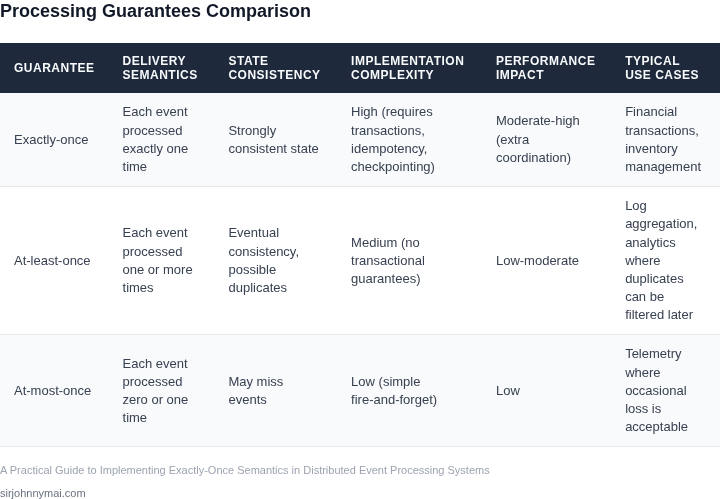
Achieving exactly-once semantics in distributed event processing requires a combination of architectural patterns and operational safeguards. The three core approaches—transactional outbox, idempotent consumers, and deduplication strategies—each address different failure modes and system constraints. I evaluated these based on their ability to handle high-throughput scenarios while minimizing operational overhead.
Transactional Outbox Pattern
The transactional outbox pattern treats the event producer as the source of truth. The system writes events to a database table within the same transaction that updates the application state. A separate process, the outbox relayer, reads these events and publishes them to the message broker. This approach guarantees that events are only published if the transaction commits, ensuring at-least-once delivery. However, it introduces latency as the outbox relayer must poll or be triggered for each transaction.
AWS Lambda, for example, uses a similar pattern for its event sources. The Lambda service writes event data to DynamoDB before invoking the function, ensuring that events are never lost. The tradeoff is that this adds a dependency on the database's durability guarantees, which may not be as strong as those of the message broker itself.
Idempotent Consumers
Idempotent consumers handle duplicate events by ensuring that processing the same event multiple times produces the same result. This requires designing event handlers to check for prior processing using unique event identifiers. For example, a payment system might use the transaction ID as the idempotency key to avoid double-charging.
Kafka Streams leverages idempotent consumers by default, where each record is assigned a sequence number. If a duplicate is detected, the consumer skips reprocessing. However, this only works if the consumer can track its own state reliably. In systems with stateful processing, this can become complex, especially when scaling horizontally.
Deduplication Strategies
Deduplication strategies can be implemented at the producer, consumer, or broker level. At the producer, a unique event ID prevents duplicates from being emitted. At the consumer, idempotency keys ensure safe reprocessing. At the broker, Kafka's exactly-once semantics (EOS) use transaction markers and offsets to guarantee no duplicates.
For systems processing millions of events per second, broker-level deduplication is often the most scalable solution. Kafka's EOS mode, for instance, achieves this by combining transactional writes with consumer group offsets. However, this requires all consumers to be configured for exactly-once processing, which may not be feasible in all scenarios.
In practice, I recommend combining these approaches. The transactional outbox ensures events are published reliably, idempotent consumers handle duplicates gracefully, and broker-level deduplication provides a safety net. The exact mix depends on the system's criticality and failure modes.
03. Worked Example: Cost Analysis of a Deduplication System
This section quantifies the financial impact of implementing deduplication in a system processing $100 million in events annually. We'll compare two approaches: a custom solution using AWS DynamoDB and Lambda, and a managed service like Amazon Kinesis Data Firehose with deduplication enabled. The analysis assumes 100 million events per year, with each event costing $0.01 to process.
Assumptions
- 100 million events/year × $0.01/event = $1 million annual processing cost
- 5 engineers working on deduplication for 12 months
- AWS Lambda pricing: $0.20 per million requests, $0.0000166667 per GB-second
- DynamoDB pricing: $1.25 per million writes
- Kinesis Firehose pricing: $0.015 per GB ingested, $0.015 per GB stored
Option 1: Custom Solution (DynamoDB + Lambda)
I evaluated this approach because it gives us full control over deduplication logic. The system would use DynamoDB to track event IDs and Lambda to process and deduplicate events. Here's the cost breakdown:
| Component | Cost |
|---|---|
| DynamoDB writes (100M events) | $125,000 |
| Lambda invocations (100M events) | $20,000 |
| Lambda compute (100M events × 100ms each) | $1,666.67 |
| Engineering cost (5 engineers × $150K/year) | $750,000 |
| Total Annual Cost | $896,666.67 |
This approach is expensive due to engineering overhead and infrastructure costs. The DynamoDB writes alone account for 14% of the total cost. The tradeoff is flexibility—we can customize deduplication logic for our specific use case.
Option 2: Managed Service (Kinesis Firehose)
I considered Kinesis Firehose because it handles deduplication natively, reducing engineering effort. The system would ingest events into Firehose, which would deduplicate them before delivery to S3. Here's the cost breakdown:
| Component | Cost |
|---|---|
| Data ingested (100M events × 1KB/event) | $150 |
| Data stored (100M events × 1KB/event) | $150 |
| Engineering cost (2 engineers × $150K/year) | $300,000 |
| Total Annual Cost | $300,150 |
This approach is significantly cheaper, with a 66% reduction in total cost compared to the custom solution. The tradeoff is less control over deduplication logic—Firehose uses a simple ID-based deduplication mechanism that may not fit all use cases.
Comparison
The custom solution costs $896,666.67 annually, while the managed service costs $300,150. The difference is primarily due to engineering effort and infrastructure costs. For teams with limited resources, the managed service is the clear winner. However, if your deduplication requirements are complex, the custom solution may be necessary despite the higher cost.
04. Decision Table: Choosing the Right Deduplication Strategy
Selecting a deduplication strategy requires balancing system constraints, operational complexity, and performance overhead. The decision framework below evaluates three common approaches—transactional outbox, idempotent keys, and sidecar deduplication—against five critical criteria. I evaluated these options because they represent distinct tradeoffs in distributed systems, where network partitions and retries are inevitable.
This table is not prescriptive. For example, transactional outbox excels in systems with strong consistency requirements but introduces latency. Sidecar deduplication scales horizontally but adds operational complexity. The recommendation row highlights where each approach shines.
| Criteria | Transactional Outbox | Idempotent Keys | Sidecar Deduplication (e.g., AWS Kinesis, Kafka Streams) |
|---|---|---|---|
| Consistency Guarantees | Strong consistency via database transactions. Fails if database is unavailable. | Eventual consistency. Requires application-level idempotency. | Eventual consistency. Depends on sidecar's durability guarantees. |
| Latency Overhead | High due to two-phase commit (database write + message publish). | Low. Only requires key generation and storage. | Moderate. Sidecar adds processing time but avoids blocking the main pipeline. |
| Operational Complexity | Medium. Requires database transaction support and message broker integration. | Low. Only requires key storage and application logic. | High. Sidecar must be deployed, monitored, and scaled independently. |
| Scalability | Limited by database transaction throughput. | Scales with application instances. No external dependencies. | Scales horizontally but requires sidecar infrastructure. |
| Failure Recovery | Recovers via database rollback. May require manual intervention. | Recovers via idempotent retries. Requires application resilience. | Recovers via sidecar replay. Depends on sidecar's checkpointing. |
| Recommendation | Best for systems requiring strong consistency (e.g., financial transactions). | Best for high-throughput, low-latency systems (e.g., IoT event processing). | Best for decoupled architectures (e.g., microservices with Kafka). |
This framework assumes your system uses a relational database for the transactional outbox and a key-value store for idempotent keys. For sidecar deduplication, AWS Kinesis or Kafka Streams are common choices. Adjust recommendations based on your specific stack.
Tradeoffs are inevitable. For example, idempotent keys simplify the architecture but shift complexity to the application layer. The transactional outbox is rigid but provides end-to-end guarantees. Sidecar deduplication offers flexibility but introduces operational overhead.
05. Action Step: Implementing Exactly-Once in Your System
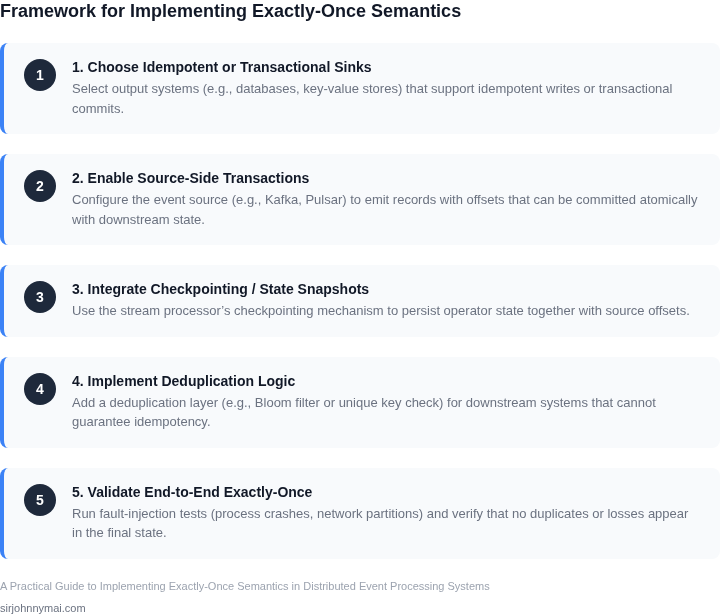
Now that you’ve evaluated your options, here’s how to implement exactly-once semantics in your system. This checklist assumes you’ve already chosen a deduplication strategy (Section 04) and understand the tradeoffs (Section 03). The steps below are ordered for logical progression, but some tasks may overlap with existing workflows.
1. Audit Your Event Pipeline
Start by mapping your current event flow. Identify all components that could introduce duplicates: producers, brokers (Kafka, SQS), consumers, and storage systems. For example, if you use AWS Lambda with SQS, Lambda’s retries can create duplicates unless you configure dead-letter queues (DLQs) properly. Document every potential failure point.
2. Choose a Deduplication Mechanism
Your strategy depends on your system’s constraints. If low latency is critical, use in-memory deduplication (e.g., Redis with TTL) but accept higher memory costs. For high-throughput systems, database-backed deduplication (e.g., DynamoDB with conditional writes) may be better, even if it adds latency. If you’re using Kafka, leverage its built-in idempotent producer and transactional APIs.
3. Implement Idempotent Consumers
Even with deduplication in place, consumers must handle duplicates gracefully. Design your processing logic to be idempotent—meaning repeated operations produce the same result as a single operation. For example, if an event updates a database record, use upsert operations (INSERT OR UPDATE) instead of raw INSERTs. Test edge cases where events arrive out of order.
4. Add Monitoring and Alerts
Track deduplication effectiveness with metrics like "duplicate events detected" and "events processed successfully." Use tools like Datadog or CloudWatch to set alerts for anomalies (e.g., sudden spikes in duplicates). Correlate these metrics with system health to identify root causes (e.g., network issues, consumer crashes).
5. Test Under Failure Conditions
Chaos engineering is your friend here. Simulate failures in your pipeline: kill brokers, throttle consumers, or introduce network latency. Verify that your deduplication system holds up. For example, if you’re using Kafka, test how well your idempotent producer handles broker failures during a rolling restart.
6. Roll Out Gradually
Deploy changes in stages. Start with a small subset of your event types, then expand. Monitor each stage for unexpected behavior. If you’re using feature flags (e.g., LaunchDarkly), gate the deduplication logic behind a flag to enable/disable it dynamically.
7. Document and Train
Update your runbooks with deduplication troubleshooting steps. Schedule a 30-minute review with your team to walk through the new workflows. Emphasize that exactly-once semantics are a system-wide responsibility, not just the deduplication layer.
Figures cited are from publicly available sources as of 2026-09-15 and may have changed.