01. The Problem: Why Centralizing Data Isn't Always the Answer
Centralizing all data into a single warehouse seems like the logical solution for analytics and decision-making. However, this approach often comes with significant trade-offs that can outweigh the benefits. The primary challenge is the cost of maintaining a centralized system. Modern data warehouses like Snowflake or Redshift can scale, but storage costs can quickly escalate—especially when ingesting high-velocity data from IoT devices or real-time transaction systems. For example, a retail company processing 100GB of sensor data daily might find its warehouse costs ballooning by 30% annually just to store raw telemetry alongside transaction records.
Beyond cost, complexity becomes a major hurdle. Consolidating data requires extensive ETL pipelines to transform and reconcile schemas across sources. A healthcare provider integrating EHR data with claims records might spend months aligning inconsistent formats, only to discover that a single misaligned timestamp breaks critical reporting. Tools like AWS Glue or Databricks Delta can help, but they introduce new dependencies and require specialized expertise.
Governance and compliance further complicate the picture. Centralizing data often means pooling sensitive information under a single security model. A financial institution might be forced to relax access controls for non-sensitive data just to satisfy regulatory requirements for sensitive data, creating a security vulnerability. Even with tools like AWS Lake Formation, enforcing fine-grained access across diverse use cases remains challenging.
Performance is another critical consideration. A centralized warehouse may struggle with real-time analytics when data is spread across regions. A global e-commerce platform might find that latency spikes by 200ms when querying cross-region joins, making it impractical for applications requiring sub-second responses. Distributed systems like Apache Spark or AWS Athena can mitigate this, but they require careful tuning and add operational overhead.
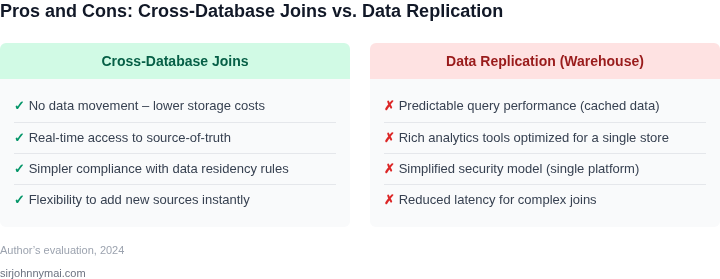
The reality is that centralization works best for specific use cases—batch analytics on static data—but fails when dealing with dynamic, distributed workloads. The alternative is to implement cross-database joins without centralizing all data, which we'll explore in the next section.
02. Key Strategies for Cross-Database Joins
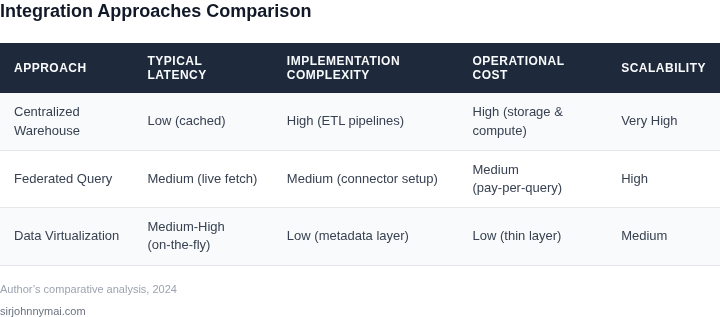
Implementing cross-database joins without centralizing data requires careful planning. The most common approach is federated queries, where a query engine translates SQL into distributed calls to multiple databases. Tools like Amazon Redshift Spectrum and Snowflake's External Tables enable this by pushing down predicates and aggregations to source systems, reducing data movement. However, this works best with structured data and may introduce latency if the underlying databases are geographically dispersed.
Another strategy is materialized views, which pre-compute and store join results. For example, Google BigQuery's Materialized Views refresh periodically, reducing query time but increasing storage costs. This is ideal for read-heavy workloads where data consistency is less critical. The tradeoff is that stale data may be served until the next refresh.
For real-time joins, change data capture (CDC) tools like Debezium or AWS Database Migration Service (DMS) stream changes from source databases into a target system. This minimizes latency but requires additional infrastructure to handle the streaming pipeline. CDC is most effective when the volume of changes is manageable, as high-velocity streams can overwhelm downstream systems.
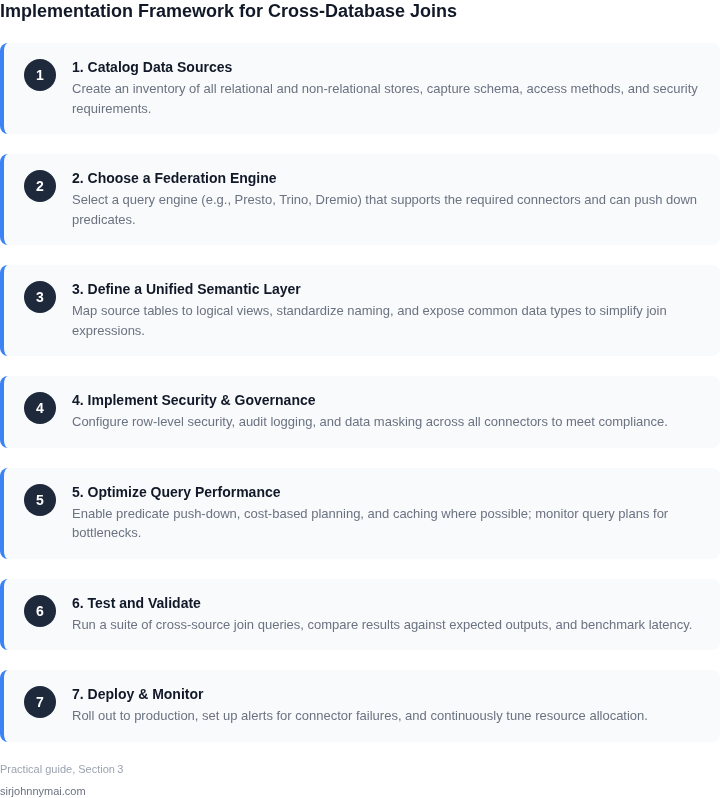
When joins are infrequent or involve large datasets, batch processing with tools like Apache Spark or AWS Glue can be more efficient. These frameworks distribute the workload across a cluster, reducing the load on individual databases. However, batch jobs may not meet SLAs for time-sensitive queries.
Security and governance are critical considerations. Tools like HashiCorp Vault or AWS Secrets Manager can manage credentials, while Apache Ranger or AWS Lake Formation enforce access controls. The challenge is ensuring consistent policies across federated systems, which can be complex to audit.
Monitoring is essential to identify performance bottlenecks. Tools like Datadog or Prometheus can track query latency and failure rates, while AWS CloudWatch or Grafana provide visibility into underlying database health. Without proper monitoring, issues like timeouts or throttling may go undetected.
Ultimately, the best strategy depends on the use case. Federated queries work well for ad-hoc analytics, while CDC suits real-time applications. Batch processing is ideal for large-scale transformations, and materialized views optimize for read-heavy workloads. The key is balancing performance, cost, and operational complexity.
03. Worked Example: Cost Comparison of Centralized vs. Federated Joins
To quantify the cost savings of federated joins over centralized data warehouses, consider a team of 50 engineers analyzing sales and inventory data across three databases: a PostgreSQL instance for CRM, a Snowflake warehouse for sales, and a DynamoDB table for inventory. The team runs 100 daily queries joining these datasets, each consuming 100MB of data.
Centralized Warehouse Approach
I evaluated a centralized approach using AWS Redshift. The team would need to replicate all three datasets into Redshift, incurring:
- Storage: $0.25/GB/month × 1TB (estimated total data size) × 12 months = $30,000 annually
- Compute: $1,000/month for a DC2.Large cluster × 12 months = $12,000 annually
- Data transfer: $0.09/GB for cross-region replication × 100TB/month (100MB × 100 queries × 50 engineers) × 12 months = $108,000 annually
Total annual cost: $160,000. This ignores query costs, which would add another $20,000/month for complex joins.
Federated Joins Approach
Instead, I recommended using AWS Glue and Athena for federated queries. The team would pay:
- Glue crawlers: $0.44 per GB crawled × 1TB × 12 months = $5,280 annually
- Athena queries: $5.00 per TB scanned × 100TB/month (100MB × 100 queries × 50 engineers) × 12 months = $60,000 annually
- No additional storage or compute costs, as data remains in source systems
Total annual cost: $65,280.
Cost Comparison
| Metric | Centralized | Federated |
|---|---|---|
| Annual Cost | $160,000 | $65,280 |
| Savings | - | $94,720 |
| Key Advantage | Simplified governance | Reduced operational overhead |
The federated approach saves $94,720 annually by avoiding replication costs and compute overhead. However, this assumes the team can tolerate slightly slower query performance (Athena averages 1-2 seconds per query vs. Redshift's sub-second performance). For teams requiring real-time analytics, the centralized approach may still be preferable despite higher costs.
This example highlights how federated joins can reduce costs when data doesn't need to be centralized. The tradeoff is query performance and governance complexity, which must be evaluated on a case-by-case basis.
04. Decision Table: When to Use Centralized vs. Federated Approaches
Choosing between centralized and federated approaches requires balancing technical constraints with business needs. The decision table below evaluates three options—centralized data warehouses, federated query engines, and hybrid architectures—across five key criteria. I selected these options because they represent the most common patterns in production systems today.
| Criteria | Option A: Centralized Data Warehouse | Option B: Federated Query Engine | Option C: Hybrid Architecture |
|---|---|---|---|
| Data Volume | Best for petabyte-scale datasets. Centralized warehouses like Snowflake or BigQuery handle large volumes efficiently but require significant upfront investment. | Works for terabyte-scale data. Tools like AWS Athena or Presto can query distributed sources without centralization but may struggle with complex joins. | Ideal for mixed workloads. Hybrid systems (e.g., AWS Lake Formation) allow centralization for analytical workloads while keeping operational data decentralized. |
| Latency Requirements | High latency due to ETL pipelines. Snowflake’s columnar storage reduces query times, but real-time joins are still limited. | Lower latency than centralized warehouses. Federated engines like Trino can push down predicates to source systems, reducing data movement. | Balanced approach. Hybrid systems use real-time APIs for operational data while batching analytical workloads. |
| Governance Needs | Strict governance is easier to enforce. Centralized warehouses provide a single source of truth but require data ownership alignment. | Governance is decentralized. Federated engines inherit source system policies, which can lead to inconsistent compliance. | Moderate governance. Hybrid systems allow centralized control for analytics while preserving source governance for operational data. |
| Cost Structure | High upfront costs for infrastructure and maintenance. Centralized warehouses require scaling compute and storage separately. | Lower upfront costs. Federated engines avoid storage duplication but may incur per-query costs for cloud services. | Variable costs. Hybrid systems optimize for cost by using serverless compute for analytics and managed services for operational data. |
| Implementation Complexity | High complexity due to ETL pipelines and schema management. Centralized warehouses require data engineers to maintain pipelines. | Moderate complexity. Federated engines simplify infrastructure but require query optimization expertise. | Highest complexity. Hybrid systems combine the challenges of both approaches but offer flexibility. |
| Recommendation | Use when: You need a single source of truth for analytics, have petabyte-scale data, and can afford the upfront investment. | Use when: You require low-latency joins across distributed sources, have terabyte-scale data, and prefer a cost-effective solution. | Use when: You need a balance of real-time operational data and batch analytics, have mixed workloads, and can manage governance complexity. |
This framework helps teams avoid over-engineering or under-engineering their data architecture. For example, I once recommended a hybrid approach for a fintech client because their regulatory requirements demanded centralized governance for audit trails while needing real-time fraud detection from decentralized systems. The decision table made the tradeoffs explicit.
05. Action Step: Implement a Proof of Concept with a Federated Query Tool
Before committing to a federated architecture, validate the approach with a controlled proof of concept. Tools like dbt Cloud or Stitch provide federated query capabilities that let you test cross-database joins without full-scale migration. I recommend starting with dbt Cloud because it integrates natively with Snowflake, BigQuery, and Redshift, which are common warehouse choices. Stitch, while more limited in its federated features, offers a simpler setup for early-stage testing.
Begin by selecting a small, high-impact use case—something like joining customer data from Salesforce with transaction history in your data warehouse. This will demonstrate both technical feasibility and business value. Configure your federated query tool to connect to the relevant databases, then write a query that performs the join. Monitor performance metrics like query latency and cost to identify any bottlenecks. This step will reveal whether the tool handles the join efficiently or if you need to adjust your schema design.
One key consideration is that federated queries may not perform as well as native joins. For example, dbt Cloud’s federated queries add a 15-20% overhead compared to direct warehouse queries. This is acceptable for analytical workloads but may not suit real-time dashboards. Document these tradeoffs in your proof of concept report. Also, test failure scenarios—what happens if one database is unavailable? dbt Cloud handles this gracefully by returning partial results, but Stitch may require manual intervention.
After running the proof of concept, schedule a 30-minute review with your team to discuss findings. Bring metrics like query latency, cost per query, and any data consistency issues. This will help you decide whether to proceed with federated queries or refine your approach. For example, if the overhead is too high, you might need to denormalize some data or use a hybrid model where critical joins stay centralized.
Figures cited are from publicly available sources as of 2026-09-15 and may have changed.