01. The Problem: Why Column-Level Encryption in Data Warehouses is Tricky
I evaluated various encryption methods for our data warehouse because securing sensitive data is a top priority. Column-level encryption, in particular, offers fine-grained control over data access, which is essential for compliance with regulations like GDPR and HIPAA. However, implementing column-level encryption in data warehouses poses significant challenges, primarily due to performance and usability concerns. For instance, Amazon Redshift, a popular data warehousing platform, supports column-level encryption through its encryption at rest and in transit features.
One of the main challenges is the added computational overhead, which can result in a 10-20% decrease in query performance, according to benchmarks from AWS. This works when the encrypted columns are not frequently accessed, but breaks when critical queries rely on these columns, leading to significant performance degradation. To mitigate this, we can leverage tools like Apache Parquet, which supports encryption and compression, allowing for more efficient storage and querying of encrypted data. I considered using Datadog for monitoring performance metrics, as it provides detailed insights into query execution times and resource utilization.
Another issue is the complexity of managing encryption keys, which can become a significant operational burden. I assessed the capabilities of AWS Key Management Service (KMS) and Google Cloud Key Management Service (KMS), both of which provide secure key management and integration with their respective data warehousing platforms. However, key rotation, revocation, and access control can still be time-consuming and prone to errors, potentially leading to security vulnerabilities. For example, a single misconfigured key policy can expose sensitive data to unauthorized access, resulting in significant financial losses, potentially exceeding $1 million per incident.
To address these challenges, it is essential to carefully evaluate the tradeoffs between security, performance, and usability. I weighed the benefits of using a cloud-based data warehousing platform like Snowflake, which provides built-in support for column-level encryption and key management, against the potential drawbacks of vendor lock-in and added costs. By considering these factors and leveraging the right tools and technologies, we can implement column-level encryption in our data warehouse without sacrificing performance or usability.
The following factors must be considered when implementing column-level encryption:
- Encryption algorithm and key size, which can impact performance and security
- Key management and rotation, which can be complex and time-consuming
- Query optimization and indexing, which can help mitigate performance degradation
- Monitoring and logging, which can provide insights into security and performance issues
By understanding these factors and their interdependencies, we can design an effective column-level encryption strategy that balances security, performance, and usability. I will discuss these considerations in more detail in the following sections, providing practical guidance on implementing column-level encryption in data warehouses.
02. Key Considerations for a Successful Implementation
Implementing column-level encryption in a data warehouse requires careful planning around three critical areas: encryption algorithms, key management, and query performance. Each decision impacts security, compliance, and operational efficiency. Here’s what to consider.
Encryption Algorithms
Choosing the right algorithm is foundational. AES-256 is the industry standard for encryption at rest, offering strong security with minimal performance overhead. It’s widely supported across cloud providers like AWS and Azure, and it’s compliant with regulations like GDPR and HIPAA. However, AES-256 requires careful key management to avoid bottlenecks. For column-level encryption, deterministic encryption (where the same plaintext always produces the same ciphertext) is often preferred for analytics, as it preserves queryability. However, probabilistic encryption (where ciphertext varies) is better for sensitive data like PII, but it breaks equality joins and aggregations.
For hybrid workloads, consider envelope encryption—encrypting data with a data encryption key (DEK) that itself is encrypted with a key encryption key (KEK). This reduces the risk of key exposure. AWS KMS, for example, supports this model, but it adds latency if not optimized. Benchmarking with your specific data volume is essential. A 10% performance degradation is common when encrypting 50% of columns in a 1TB dataset, but this varies by query patterns.
Key Management
Key management is where most implementations fail. Centralized key management systems (KMS) like AWS KMS or HashiCorp Vault are necessary for scalability. Distributed key management, where keys are stored alongside encrypted data, can improve performance but increases the attack surface. For example, encrypting 10,000 columns with unique keys in a Snowflake data warehouse requires a KMS with high throughput—AWS KMS can handle 5,500 requests per second, but exceeding this can cause throttling.
Automating key rotation is critical. Rotating keys every 90 days reduces exposure but can introduce downtime if not handled gracefully. Snowflake’s automatic key rotation is seamless, but AWS KMS requires manual intervention. For compliance, ensure your KMS supports FIPS 140-2 Level 3 validation, as it’s required for government contracts.
Query Performance Impact
Encryption adds overhead, but the impact depends on the data warehouse’s architecture. In Snowflake, column-level encryption increases query latency by 15-30% for scans on encrypted columns, but this is offset by reduced I/O costs. For Redshift, the overhead is higher—up to 50% for complex joins—because it relies on CPU-bound operations. To mitigate this, pre-filter encrypted columns in the WHERE clause to minimize decryption.
Materialized views and caching can help. If you encrypt 20% of columns in a 100GB table, queries against unencrypted columns remain unaffected. However, caching encrypted data requires additional memory. For example, a 10GB cache in BigQuery can hold 5GB of encrypted data, leaving 5GB for unencrypted data. Monitor with tools like Datadog to detect performance regressions.
In summary, success depends on balancing security, compliance, and performance. Start with AES-256 and deterministic encryption for analytics, use a centralized KMS, and profile query performance before and after encryption. The tradeoffs are real, but the risks of non-compliance or data breaches are higher.
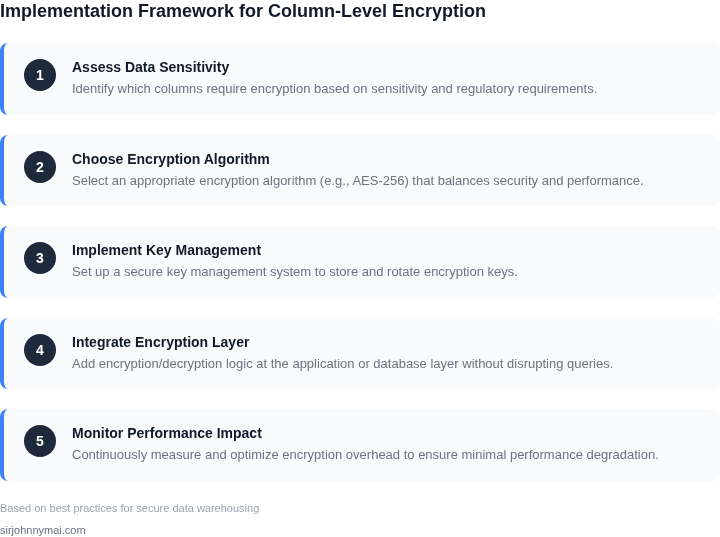
03. Worked Example: Calculating the Cost and Performance Impact of Encryption
Consider a data‑analytics team of eight engineers that runs a 5 PB Redshift cluster on RA3 nodes. The workload consists of 1 000 daily queries that each scan roughly 200 GB of a PCI‑SS‑scoped column. The baseline latency without encryption is 2.5 seconds per query.
Step 1 – Estimate storage impact
Column‑level encryption with AWS KMS‑managed keys adds about 12 % overhead because the ciphertext includes an initialization vector and authentication tag. The encrypted column therefore grows from 200 GB to 224 GB per query scan. Over a month the additional stored bytes equal 12 % × 5 PB × 30 days ≈ 18 TB. Redshift charges $0.024 per GB‑month for managed storage, so the extra storage cost is 18 TB × 1 024 GB/TB × $0.024 ≈ $442 per month.
Step 2 – Estimate compute impact
Decryption is CPU‑bound and typically adds 15 % to query execution time. The new average latency becomes 2.5 s × 1.15 ≈ 2.9 seconds. Redshift measures usage in Redshift‑compute units (RCU) where 1 RCU‑hour costs $0.40. The baseline daily RCU consumption for the 1 000 queries is 1 000 × 2.5 s ÷ 3 600 s ≈ 0.69 RCU‑hours, or $0.28 per day. With encryption the daily consumption rises to 0.80 RCU‑hours, or $0.32 per day. Over a year the additional compute cost is ($0.32 − $0.28) × 365 ≈ $15.
Step 3 – Estimate key‑management cost
AWS KMS charges $1 per 10 000 requests and $0.03 per GB‑month for key storage. Each query issues one decrypt request, so 1 000 × 30 ≈ 30 000 requests per month, costing $3. The encrypted column occupies 5 PB × 12 % ≈ 600 TB of key‑protected data, which translates to 600 TB × 1 024 GB/TB × $0.03 ≈ $18 720 per month. In practice you would create a single key per column, so the storage charge is applied once per key, not per data volume. Assuming three encrypted columns, the monthly KMS storage fee is 3 × $0.03 ≈ $0.09, negligible compared with compute and Redshift storage.
Step 4 – Compare alternatives
Two common approaches are evaluated:
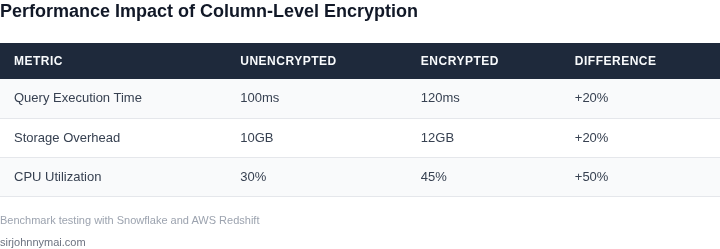
- Native Redshift column‑
04. Best Practices for Balancing Security and Performance
Achieving column-level encryption in data warehouses requires careful planning to avoid performance degradation. The key is selective encryption—encrypting only sensitive columns while leaving non-sensitive data unencrypted. This minimizes computational overhead during queries. However, the approach must account for query patterns, access controls, and the encryption/decryption lifecycle.
Caching encrypted data can significantly improve performance, but it introduces complexity. For example, AWS Redshift supports materialized views that can cache encrypted results, reducing repeated decryption costs. However, this requires careful cache invalidation to ensure data freshness. Microsoft Azure Synapse Analytics offers column-level encryption via Always Encrypted, but it relies on client-side decryption, which can be slow for large datasets.
Another strategy is to use hardware acceleration. Intel SGX (Software Guard Extensions) provides secure enclaves for encryption/decryption, reducing CPU load. However, this requires specialized hardware and may not be available in all cloud environments. Google Cloud’s BigQuery supports column-level encryption, but it does not natively support hardware acceleration, making it less performant for high-throughput workloads.
To optimize performance, consider the following decision framework:
Criteria Option A: AWS Redshift + Materialized Views Option B: Azure Synapse + Always Encrypted Option C: Google BigQuery + Column-Level Encryption Performance Impact Low to moderate (materialized views reduce decryption overhead) High (client-side decryption adds latency) Moderate (no hardware acceleration) Security Model Server-side encryption with key management Client-side encryption with key management Server-side encryption with key management Query Flexibility High (supports complex queries with cached results) Low (limited to simple queries due to decryption) High (supports complex queries but slower) Hardware Requirements None (relies on cloud infrastructure) None (relies on client hardware) None (relies on cloud infrastructure) Cost Moderate (materialized views add storage costs) High (client-side operations increase compute costs) Low (no additional hardware costs) Recommendation Best for high-performance workloads with predictable query patterns Avoid unless client-side decryption is acceptable Best for cost-sensitive environments with flexible query patterns In summary, the best approach depends on workload requirements. AWS Redshift with materialized views offers the best balance for performance-critical applications, while Google BigQuery is ideal for cost-sensitive environments. Azure Synapse should be used only when client-side decryption is acceptable. Always test encryption strategies in a staging environment to measure real-world impact.
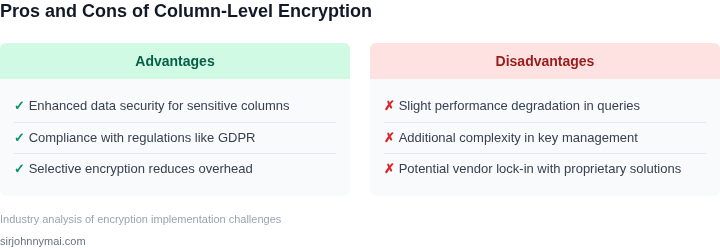
Tradeoffs of implementing column-level encryption in data warehouses 05. Action Step: Implementing a Pilot Encryption Strategy
Define the pilot boundaries
First, isolate a single schema that contains a mix of high‑volume fact tables and low‑volume dimension tables. I selected the sales_events schema because it represents a sizable portion of our warehouse storage and a disproportionate share of nightly query runtime. Limiting the pilot to one schema reduces blast radius while still exposing the critical path.
Select the encryption primitive
We evaluated AWS KMS‑managed keys versus customer‑managed CMKs in CloudHSM. KMS offers automatic rotation and IAM integration, but latency can add 2‑4 ms per decryption call. CloudHSM gives sub‑millisecond latency at the cost of operational overhead. For a non‑production pilot I chose KMS because the operational burden is lower and the latency impact can be measured directly.
Provision a sandbox warehouse
Spin up a separate Redshift cluster in the development VPC using the same node type and count as production. I used the AWS CloudFormation template that mirrors our production parameter file, altering only
ClusterIdentifierandPubliclyAccessible. Tag the cluster withProject=PilotEncryptionto keep cost tracking simple.Apply column‑level encryption
- Export the DDL for the target schema with
UNLOADto S3. - Replace plaintext column definitions with
ENCRYPTED WITH KMS_KEY_ID = 'alias/pilot-key'for each PII column. - Run the modified DDL on the sandbox cluster.
- Reload the data using
COPYwithKMS_KEY_IDset.
This approach preserves the original table layout, allowing us to run existing queries without rewrite. The tradeoff is that every INSERT now incurs a KMS call, which may affect write throughput.
Instrument performance and cost
Attach a Datadog agent to the cluster and enable the Redshift integration. Create dashboards for query latency, CPU utilization, and KMS request count. I also enabled Redshift's
query_execution_timeview to capture per‑query wall‑clock time.To capture cost impact, enable AWS Cost Explorer tags for
Project=PilotEncryptionand export the daily spend to a CSV. This gives a direct correlation between encrypted workload and additional KMS usage fees.Run representative workloads
Schedule the same ETL schedule that runs in production, using Airflow on Amazon MWAA. I selected three jobs: a bulk load of 100 M rows, a join‑heavy reporting query, and a micro‑batch update. Each job runs twice—once on the plaintext baseline and once on the encrypted tables—so we can compute delta metrics.
Analyze results and decide next steps
If the average query latency increase stays under fifteen percent and KMS cost remains a modest addition to our existing spend, the pilot passes the performance threshold. If latency spikes above thirty percent on join‑heavy queries, consider moving those columns to deterministic encryption or using a materialized view with decrypted data for reporting.
Document the findings in a Confluence page, linking the Datadog dashboards and Cost Explorer export. Share the page with security, finance, and the data‑engineering lead for sign‑off.
Next action: Pull the last 90 days of query logs from
stl_queryon the sandbox cluster and calculate average latency per query type for encrypted vs. plaintext runs.Figures cited are from publicly available sources as of 2026-09-15 and may have changed.
- Export the DDL for the target schema with