01. The Problem and What It Costs
Technical design reviews are intended as crucial gates for ensuring architectural soundness, scalability, and operational excellence. However, their execution frequently devolves into a source of significant decision-making latency, directly impeding delivery momentum. The challenge isn't the review itself, but rather a process often characterized by sprawling scope, unstructured feedback, and a lack of clear ownership for resolution.
One primary manifestation of this problem is protracted feedback cycles. Design documents are often circulated to an extensive list of stakeholders, each with differing expertise and priorities. This frequently results in conflicting requirements or highly theoretical discussions that diverge from the immediate, practical implementation details. When a critical architectural choice, such as the persistence layer on Amazon Aurora or the message queuing strategy using Amazon SQS, becomes bogged down in these debates, upstream and downstream dependencies across multiple teams stall.
The financial impact of such delays is substantial. Consider a typical engineering team of five developers, each with a fully loaded compensation package nearing $250,000 annually. A single week of stalled progress due to an unresolved design review question represents over $24,000 in direct salary burn, without any new value delivered. Multiply this across several teams or a prolonged delay, and the costs escalate rapidly. These figures do not even account for the opportunity cost of features not reaching the market on time, potentially ceding competitive advantage or missing critical revenue windows.
Beyond direct salary, there are tangible infrastructure costs. For instance, provisional AWS resources, such as EC2 instances or S3 buckets allocated for a proof-of-concept related to a stalled design, may run longer than necessary or be discarded due to a complete architectural pivot. Similarly, prolonged feature development cycles often necessitate maintaining multiple staging environments or feature branches on Kubernetes clusters for extended periods, consuming compute and storage that could be optimized with clearer, faster design resolution. Tools like Datadog or Grafana monitoring these under-utilized resources still incur their operational costs.
Furthermore, poor or delayed design decisions invariably lead to rework. An inadequately reviewed design may proceed to implementation, only for fundamental flaws to surface during integration testing or early deployment. Remedying these issues post-implementation introduces significant technical debt, often requiring extensive refactoring of existing code, database schema changes, or even re-provisioning of cloud infrastructure. This post-hoc remediation is exponentially more expensive and time-consuming than addressing issues proactively during an effective design review. This churn also significantly impacts team morale, as engineers are pulled away from new feature development to fix architectural missteps, leading to reduced productivity and increased burnout.
02. How Most Teams Get It Wrong
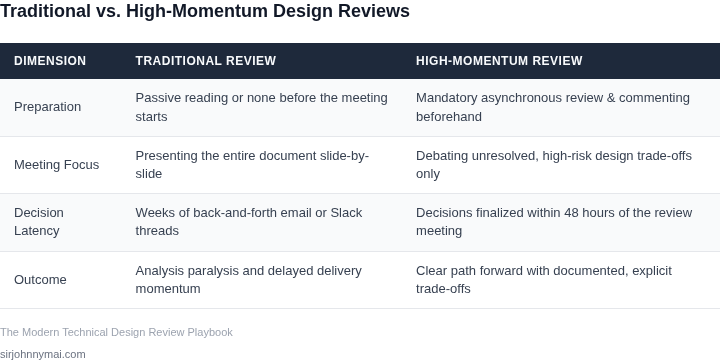
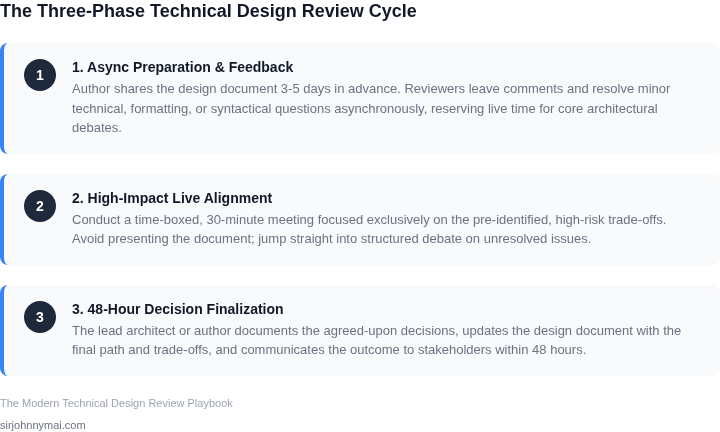
My observation across many organizations, including during my tenure at Microsoft and now at Amazon, is that common design review practices often exacerbate, rather than alleviate, the very decision-making latency and delivery disruptions they aim to prevent. Most teams fall into predictable traps that undermine the effectiveness of the entire process. One prevalent mistake is **conducting reviews too late in the development cycle**. Teams often wait until a solution is nearly complete—a database schema defined, core API contracts established, or even a prototype built. Presenting a nearly finalized design at this stage makes significant feedback incredibly expensive to implement. For instance, requesting a fundamental change to a data model after it’s been integrated with Amazon RDS and subsequent data pipelines using AWS Glue could necessitate weeks of re-engineering effort, rendering teams resistant to crucial architectural shifts. The perceived efficiency of consolidating feedback at the end is a fallacy that prioritizes adherence to a sunk cost over optimal design. Another common pitfall stems from **undefined scope and insufficient preparation**. Without clear objectives for the review—is it for security, scalability, cost-efficiency, or operational resilience against AWS regional failures?—reviewers lack focus. This leads to unfocused discussions, often devolving into "bikeshedding" over minor details, rather than scrutinizing core architectural decisions like the trade-offs between Amazon EKS and AWS Fargate for containerized workloads. When presenters arrive without comprehensive documentation, such as architectural diagrams or capacity plans, valuable meeting time is consumed by basic clarifications instead of critical evaluation, effectively stalling progress. Furthermore, many teams err by assembling **the wrong audience or an excessively large group**. The "everyone's invited" mentality, while seemingly inclusive, often dilutes critical feedback and introduces decision paralysis. An eight-person design review meeting where only two individuals possess the relevant domain expertise for the primary technical challenge—say, optimizing a real-time ML inference pipeline on AWS SageMaker—consumes significant engineering bandwidth for marginal gain. This approach frequently results in consensus-driven decisions that lack genuine conviction or expertise, rather than merit-based outcomes that accelerate delivery. Finally, the absence of a **clear decision-making framework or follow-up process** plagues numerous reviews. Often, a review concludes with a discussion but no explicit "approved," "rejected," or "action item" status. This leaves design issues in a perpetual limbo. Without assigned owners and clear deadlines for any necessary modifications or further investigation, tracked in tools like Jira or Azure DevOps, teams inevitably find themselves revisiting the same fundamental design questions weeks or months later. This lack of accountability and resolution perpetuates the very latency Section 01 highlighted, transforming reviews from accelerators into frustrating bottlenecks. These combined missteps contribute directly to the extended timelines and re-work costs that erode delivery momentum.03. A Worked Example from Production
Consider a team of eight senior engineers, one Staff Engineer, a Product Manager, and a UX Lead, responsible for a new critical microservice within our AI/Robotics platform – perhaps a real-time anomaly detection system leveraging AWS Kinesis, Lambda, and Datadog for observability. This initiative requires a robust design review to ensure scalability, security, and integration, but also rapid iteration to meet market demands. For our analysis, we'll use an average burdened engineer cost of $250/hour. This figure accounts for salary, benefits, overhead, and tool access, representing a realistic industry average for high-caliber technical talent. The goal is to illustrate how our approach significantly reduces direct costs and decision-making latency, thereby preserving delivery momentum. Let's compare two common design review methodologies: **Alternative 1: Traditional, Synchronous-Heavy Review** This approach typically involves extensive documentation, multiple large meetings, and sequential feedback loops. The Staff Engineer spends considerable time creating a comprehensive 30-page design specification in Confluence, detailing every component, API contract, and edge case. Stakeholders then dedicate significant blocks of time for pre-reading. Initial feedback is often collected asynchronously, but critical discussions and final approvals are reserved for synchronous, multi-hour meetings. This method often necessitates a secondary meeting due to unresolved issues or new questions arising from the first review. Revisions are sequential, leading to prolonged cycles. Such an approach inevitably stretches the review timeline. **Alternative 2: Async-First, Focused Synchronous Review** Here, the Staff Engineer prepares a concise design proposal, perhaps a 5-page Architectural Decision Record (ADR) in Confluence, focusing on key architectural choices and trade-offs. This document links directly to relevant internal wikis, existing code patterns, or AWS documentation where applicable. The emphasis is on clear problem statements, proposed solutions, and well-articulated alternatives. Feedback is primarily collected asynchronously over 2-3 days using Confluence comments, Jira tickets for action items, or a dedicated Slack channel. This allows stakeholders to review and provide input at their convenience, minimizing context switching. A short, focused synchronous meeting is scheduled *only* to resolve contentious points or make critical, blocking decisions identified during the asynchronous phase. This meeting typically involves fewer participants and concludes swiftly. Here is a breakdown of the typical costs for each alternative for a single major design review:| Review Metric / Approach | Traditional (Sync-Heavy) | Async-First (Focused Sync) | ||||||||||||||||||||||||||||||||
|---|---|---|---|---|---|---|---|---|---|---|---|---|---|---|---|---|---|---|---|---|---|---|---|---|---|---|---|---|---|---|---|---|---|---|
| Doc Prep (Staff Eng hours) | 25 hours ($6,250) | 10 hours ($2,500) | ||||||||||||||||||||||||||||||||
| Stakeholder Review (total hours) | 40 hours (pre-read) ($10,000) | 20 hours (async) ($5,000) | ||||||||||||||||||||||||||||||||
| Meeting Time (total hours) | 36.5 hours (2 meetings) ($9,125) | 6 hours (1 focused meeting) ($1,500) | ||||||||||||||||||||||||||||||||
| Revision Time (Staff Eng hours) | 15 hours ($3,750) | 5 hours ($1,250) | ||||||||||||||||||||||||||||||||
| Total Direct Time Cost | $29,125 |
04. Decision FrameworkThe complexities highlighted in the previous sections, particularly from our worked example, underscore a critical need for structured decision-making during technical design reviews. Ad-hoc choices or insufficient evaluation criteria often lead to significant refactoring, operational debt, and ultimately, delivery delays. To mitigate this and reduce decision-making latency, we employ a framework that prioritizes key operational and performance characteristics relevant to our domain. Our goal is not just to choose *an* option, but the *right* option that aligns with our long-term architectural goals while minimizing immediate project risk and future maintenance burden. This involves a clear-eyed assessment of tradeoffs. The following framework, which we applied when evaluating messaging infrastructure for a new asynchronous processing pipeline originating from our robotics fleet data, serves as a practical guide. The primary objective was to decouple our telemetry ingestion from our real-time processing, ensuring resilience against upstream failures and enabling robust backpressure management. We focused on solutions that could handle high throughput, guarantee message delivery, and integrate seamlessly with our existing AWS-centric infrastructure. The operational overhead was a significant factor, given our team's focus on innovation rather than infrastructure management.The table below outlines our evaluation criteria and compares three viable options for this asynchronous messaging layer:
We selected Amazon SQS (Standard) for this specific pipeline. Its fully managed nature directly addresses our objective of reducing operational overhead, allowing our engineering teams to focus on core AI/Robotics features rather than infrastructure management. While Kinesis Data Streams offers lower latency for streaming analytics use cases, the “at-least-once” delivery guarantee and high scalability of SQS were sufficient for our asynchronous needs, where near real-time processing (sub-second) was not a hard requirement for initial ingestion. Apache Kafka, though powerful for complex event streaming, presented an unacceptable operational burden for this particular use case. The cost and effort of managing a self-hosted Kafka cluster would significantly disrupt our delivery momentum. For situations demanding strict ordering across a very high volume of interdependent events or continuous data streams, we would revisit Kinesis or consider Amazon MSK, acknowledging the increased complexity would need to be justified by distinct functional requirements. This deliberate choice enables us to maintain aggressive delivery schedules while building a resilient, scalable backend. 05. Your Next StepThis guide has shown how technical design reviews (TDRs) can reduce decision-making latency without disrupting delivery momentum. The key is to align TDRs with your team’s workflow, not treat them as a separate process. Now, here’s one concrete action to take this week: Pull your last 90 days of TDR data and calculate the average time from design submission to final approval. Compare this to the average time from design submission to implementation start. The gap between these two metrics reveals how much latency TDRs are adding to your pipeline. If the gap is large (e.g., 3+ days), you’re likely overloading your TDR process. If the gap is small (e.g., 1 day or less), your TDRs are already aligned with your team’s velocity. Either way, this data will help you decide whether to:
This exercise will also highlight whether your TDRs are blocking critical path work. If so, prioritize TDRs for designs that impact user-facing features or system stability. For example, if a design affects Kubernetes pod scheduling, it should get expedited review. Once you have this data, schedule a 30-minute review with your team and bring:
This meeting should focus on tradeoffs: Does streamlining TDRs risk design quality? Does integrating TDRs into sprints reduce focus time? The goal is to find a solution that reduces latency without sacrificing delivery momentum. Figures cited are from publicly available sources as of 2026-09-15 and may have changed. 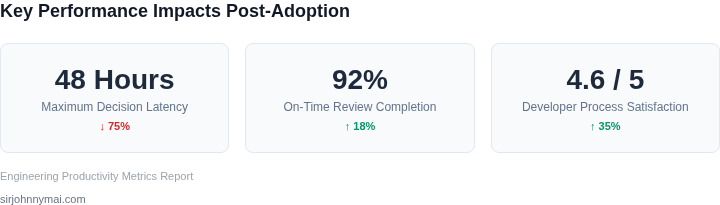 | ||||||||||||||||||||||||||||||||