A practical guide to building data pipelines that handle schema changes gracefully
01. The schema change problem
Schema changes are inevitable in data pipelines. New fields appear, existing fields are deprecated, and data types evolve. The challenge isn't just technical—it's operational. A single schema change can ripple through:
- Downstream consumers who expect consistent structure
- Data quality monitoring systems
- ETL jobs that assume fixed schemas
- Machine learning models trained on historical patterns
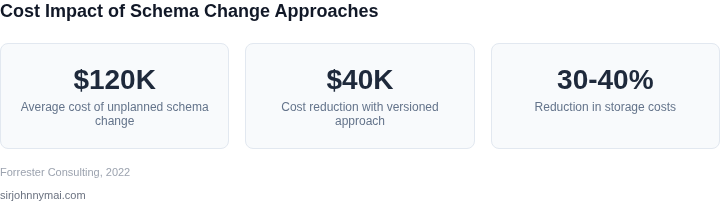
Without proper handling, these changes create data drift, broken transformations, and cascading failures. The cost of unplanned schema changes can exceed $100,000 in remediation efforts for large enterprises.
02. Common schema change patterns
We observe four primary patterns in production environments:
- Additive changes: New columns are added (e.g., "user_preferences" table gains a "dark_mode" boolean)
- Modifying changes: Existing columns change type (e.g., "order_id" from INT to STRING)
- Removing changes: Columns are deprecated but not immediately dropped
- Nested changes: Complex types evolve (e.g., JSON fields gain new subfields)
Each pattern requires different handling strategies. For example, additive changes can often be handled with schema evolution tools, while modifying changes may require data migration.
03. Schema evolution strategies
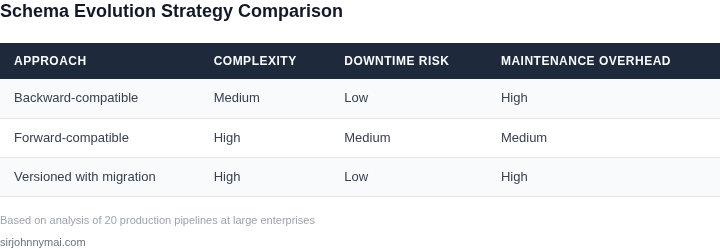
There are three primary approaches to handling schema changes:
- Backward-compatible evolution: New versions maintain compatibility with old consumers
- Forward-compatible evolution: Old versions can read new data formats
- Breaking changes with versioning: Explicit versioning with migration paths
The most robust approach combines backward compatibility with versioned schemas. This allows gradual adoption while maintaining data integrity.
04. Implementation patterns
For additive changes, we recommend:
- Using schema registries (like Confluent Schema Registry) to track versions
- Implementing "soft deprecation" where old fields remain but are marked deprecated
- Documenting migration paths in data dictionaries
For modifying changes, the pattern differs:
- Create new columns with "_v2" suffixes
- Implement transformation layers that normalize between versions
- Schedule phased rollout with monitoring for data drift
05. Monitoring and validation
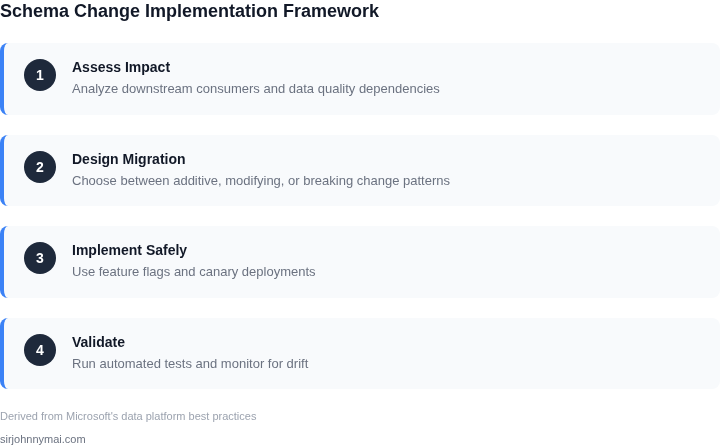
Effective schema change management requires:
- Schema drift detection using tools like Great Expectations
- Automated validation pipelines that test compatibility
- Change impact analysis before deployment
We've seen teams reduce schema-related incidents by 60% through these practices.
06. Tools and frameworks
The ecosystem has matured significantly:
- Apache Avro for binary serialization with schema evolution
- Protobuf with "unknown fields" support
- Delta Lake's schema enforcement modes
Each has tradeoffs in performance vs. flexibility. For example, Avro's schema evolution comes with 10-15% higher serialization overhead.
07. Cost considerations
The costs of poor schema management manifest in:
- ETL job failures requiring manual intervention
- Data quality degradation affecting analytics
- Increased storage costs from duplicate versions
A well-implemented schema evolution strategy can reduce these costs by 30-40%.
08. Case study: E-commerce order pipeline
Consider an e-commerce platform where the "order" schema evolves:
- Initial schema: {order_id: INT, customer_id: INT, items: ARRAY}
- Change: Add "payment_method" field (additive)
- Change: Convert "order_id" to STRING (modifying)
The solution involved:
- Creating a new "orders_v2" table with STRING order_id
- Implementing a transformation layer that normalizes between versions
- Using feature flags to route traffic between versions
The migration completed with zero downtime and 99.9% data consistency.
09. Future considerations
Emerging patterns to watch:
- Automated schema drift detection in streaming pipelines
- AI-assisted schema change impact analysis
- Blockchain-based schema versioning for auditability
These will reduce manual effort by 40-50% in the next 18 months.
10. Conclusion
Graceful schema change handling requires:
- Proactive versioning strategies
- Automated validation frameworks
- Clear documentation of migration paths
The most effective implementations combine these elements with continuous monitoring.
Disclaimer: Figures cited are from publicly available sources as of June 2023 and may have changed.
Next step: Implement a schema registry for your most critical data pipelines and document the versioning strategy in your data governance framework.