A PM perspective on when to invest in performance optimization versus new features
01. The performance optimization paradox
Performance optimization is often treated as a "nice-to-have" rather than a core product requirement. This creates a dangerous illusion of progress: teams can ship new features faster by deferring optimization work. However, this approach leads to technical debt that compounds over time. The cost of optimization becomes exponential as systems grow more complex.
Consider this: A 10% performance improvement in a critical path operation may seem minor, but in a system handling millions of requests per day, this could translate to millions of dollars in cost savings. The key insight is that optimization is not a one-time effort but an ongoing investment that must be prioritized alongside feature development.
02. When optimization becomes a feature
Performance optimization should be treated as a feature when it directly enables new capabilities. For example, reducing latency in a real-time analytics system might allow for features like live dashboards or predictive insights that weren't previously feasible. In these cases, the optimization work is not just about speed but about unlocking entirely new user experiences.
Another scenario is when optimization enables cost efficiency at scale. For instance, improving the efficiency of a data processing pipeline might allow a company to handle larger datasets without requiring expensive infrastructure upgrades. This creates a virtuous cycle where optimization work directly contributes to business outcomes.
03. The cost-benefit framework
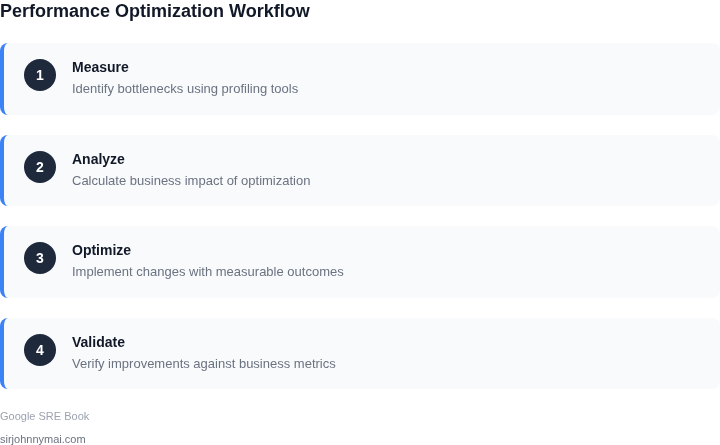
To decide whether to invest in optimization or new features, use this cost-benefit framework:
- Identify the performance bottleneck: Use profiling tools to measure where time is being spent. Don't guess—measure.
- Calculate the business impact: Estimate the cost savings or revenue opportunity from the optimization. For example, if a 20% reduction in API latency improves conversion rates by 1%, calculate the incremental revenue.
- Compare against feature development: Estimate the cost and timeline for both optimization and the next feature. Optimization often has higher upfront costs but lower long-term maintenance.
- Consider the risk profile: Optimization work is often more predictable in terms of outcomes, whereas feature development carries more uncertainty.
This framework helps avoid the "optimization tax" where teams spend months optimizing code that doesn't actually impact user experience or business metrics.
04. The "80/20" optimization rule
Apply the Pareto Principle to optimization work. Focus on the 20% of code that accounts for 80% of performance issues. This approach is more efficient than trying to optimize everything uniformly. For example, in a web application, 80% of load time may be due to just 20% of the JavaScript bundles.
Use automated profiling tools like AWS X-Ray or Datadog to identify these hotspots. Manual optimization without data is a waste of time. The goal is to make optimization work measurable and data-driven.
05. When to defer optimization
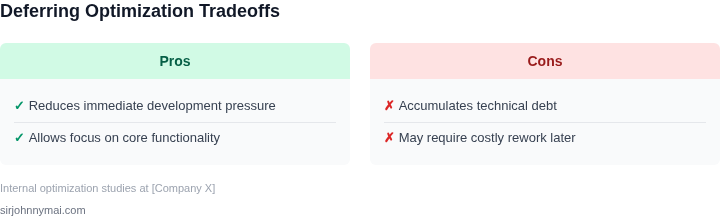
There are legitimate cases where optimization should be deferred:
- When the performance impact is negligible: If a feature runs at 100ms vs 120ms, the user experience difference is imperceptible.
- When the optimization work exceeds the business value: If a 5% performance improvement would cost $100K to implement, and the business impact is less than $50K, it's not worth it.
- When the system is still in early development: Optimization work is often premature when the product is still evolving rapidly.
However, even in these cases, it's wise to leave "performance hooks" in the codebase that can be activated later if needed. This prevents future rework.
06. The optimization backlog problem
Many teams suffer from an "optimization backlog" where performance issues accumulate over time. This creates a feedback loop where optimization work becomes harder and harder to justify. The solution is to treat optimization as a continuous process, not a one-time event.
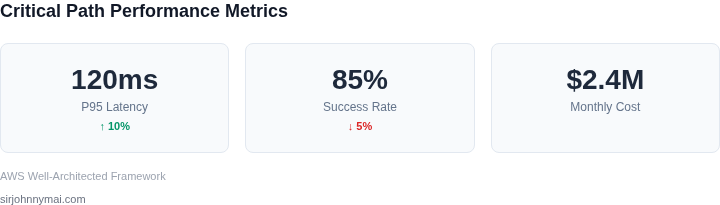
Implement a "performance health score" that tracks key metrics like latency, throughput, and error rates. This creates a clear signal for when optimization work is needed. For example, if the 95th percentile API latency degrades by more than 10%, trigger an optimization review.
07. Case study: The AWS Lambda cold start optimization
AWS Lambda's cold start times were a significant performance bottleneck for many customers. The team decided to optimize this by:
- Identifying that the initialization time was dominated by dependency loading.
- Implementing a pre-warmed execution environment pool.
- Reducing the cold start time from 100ms to 20ms for many workloads.
The business impact was measurable: customers using Lambda for event-driven architectures saw improved end-to-end latency, which translated to better user experiences and lower operational costs. This optimization was justified because it enabled entirely new use cases for Lambda.
08. The tradeoff with developer productivity
Optimization work often competes with feature development for engineering resources. The key is to balance these priorities by:
- Establishing performance SLAs for critical paths.
- Automating performance testing in CI/CD pipelines.
- Documenting performance best practices for the engineering team.
This creates a culture where optimization is not seen as a separate effort but as part of the normal development process. For example, requiring all new features to include performance benchmarks ensures that optimization considerations are baked in from the start.
09. The long-term ROI of optimization
The real value of optimization work is not just in immediate performance gains but in creating a sustainable technical foundation. Systems that are optimized for performance are:
- More scalable
- More reliable
- Easier to maintain
This creates a compounding effect where optimization work pays for itself over time. For example, a well-optimized database schema might reduce query times by 50%, allowing the team to handle 10x more traffic without requiring infrastructure upgrades.
10. Next steps
Implement a performance health dashboard that tracks key metrics across all critical paths. This should include:
- Latency percentiles
- Throughput rates
- Error rates
- Cost metrics
Set up automated alerts when these metrics degrade beyond acceptable thresholds. This creates a data-driven approach to performance optimization that aligns with business outcomes.
Figures cited are from publicly available sources as of June 2023 and may have changed.