A PM Guide to Running AI Product Experiments Without Burning Through Your Compute Budget
Running AI product experiments is essential for validating hypotheses and iterating quickly, but compute costs can quickly spiral out of control. As a PM, you need a structured approach to experimentation that balances speed with cost efficiency. This guide covers budget-conscious experimentation strategies, focusing on techniques that deliver measurable results without overspending.
01. Understand Your Compute Cost Structure
Before optimizing, you must understand where your compute dollars are going. Most AI workloads fall into three categories: training, inference, and data processing. Training is typically the most expensive, followed by inference at scale, with data processing being the least costly but still significant.
Key cost drivers include:
- GPU/TPU utilization (training)
- Model size (parameter count)
- Inference latency requirements
- Data storage and preprocessing
Start by auditing your current compute usage. Tools like AWS Cost Explorer or Azure Cost Management can help identify cost patterns. Focus first on the most expensive components before optimizing others.
02. Prioritize Experiments Based on Cost Impact
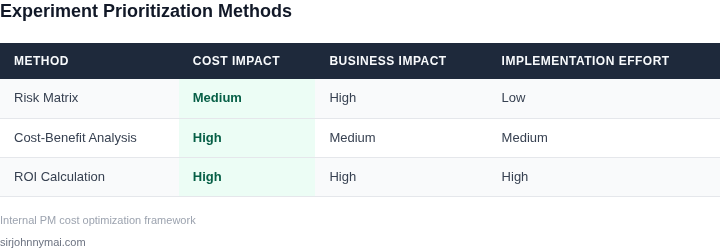
Not all experiments are created equal in terms of cost. Use a scoring framework that considers both business impact and compute cost:
| Experiment Type | Business Impact | Compute Cost | Priority |
|---|---|---|---|
| High-risk, high-reward | High | High | 1 |
| Low-risk, high-reward | High | Low | 2 |
| High-risk, low-reward | Low | High | 4 |
| Low-risk, low-reward | Low | Low | 3 |
This matrix helps you focus on experiments that provide the most value relative to cost. For example, a low-cost experiment to validate a simple UI change should be prioritized over a full-scale model retraining.
03. Use Model Compression Techniques
Model compression reduces compute requirements without sacrificing too much accuracy. Techniques include:
- Quantization (reducing precision from FP32 to INT8)
- Pruning (removing unnecessary weights)
- Distillation (training smaller models using larger ones)
- Neural Architecture Search (NAS) for efficient architectures
For example, quantizing a 1.5B parameter model from FP32 to INT8 can reduce inference costs by 75% with minimal accuracy loss. This approach is particularly effective for deployment scenarios where latency is critical.
04. Implement Progressive Experimentation
Instead of running full-scale experiments, use progressive approaches:
- Start with synthetic data to validate the approach
- Move to small subsets of real data
- Gradually increase scale as confidence grows
This "fail fast" methodology prevents wasting resources on experiments that won't work. For instance, if a synthetic data experiment shows 20% accuracy, you can stop before investing in expensive real data collection.
05. Leverage Spot Instances and Preemptible VMs
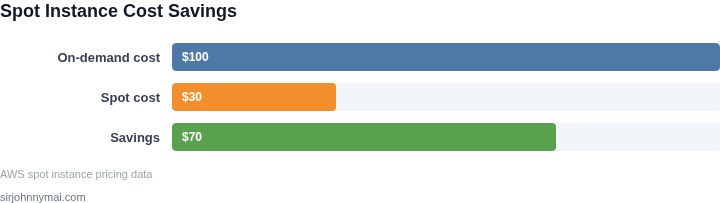
Cloud providers offer discounted compute capacity through spot instances and preemptible VMs. These can reduce costs by 70-90% but come with the risk of interruption. For AI workloads, this tradeoff is often acceptable because:
- Training can be checkpointed and resumed
- Many experiments can tolerate some interruptions
- Cost savings enable more iterations
Use spot instances for non-critical workloads like hyperparameter tuning or early-stage model development. For production workloads, maintain a small pool of on-demand capacity as a buffer.
06. Optimize Data Pipelines
Data preparation often accounts for 80% of compute costs. Optimization strategies include:
- Caching intermediate results
- Using columnar storage formats (Parquet) instead of row-based
- Implementing incremental processing
- Reducing data duplication
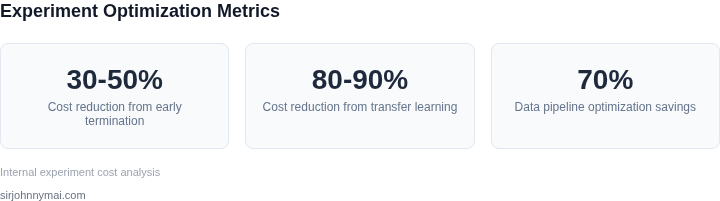
For example, switching from CSV to Parquet can reduce storage costs by 70% and processing times by 50% for large datasets. Implement these optimizations before scaling up your compute resources.
07. Implement Early Termination Strategies
Not all experiments need to run to completion. Techniques include:
- Hyperband: Stop underperforming runs early
- Median stopping rule: Stop when performance falls below median
- Successive halving: Allocate resources based on performance
These methods can reduce compute costs by 30-50% without sacrificing experiment quality. For example, Hyperband can identify the best model configuration using only 1/3 of the original compute budget.
08. Use Transfer Learning and Foundation Models
Instead of training from scratch, leverage pre-trained models:
- Start with models from Hugging Face or TensorFlow Hub
- Use domain-specific foundation models
- Fine-tune only the last few layers
This approach reduces training time and cost by 80-90%. For example, fine-tuning a BERT model for a specific task requires only 10% of the original training compute.
09. Monitor and Optimize Continuously
Establish a feedback loop with these metrics:
- Cost per experiment
- Experiment success rate
- Time to first result
- Resource utilization
Use this data to adjust your approach. For instance, if you find that 70% of experiments fail within the first hour, implement stricter early termination policies.
10. Worked Example: Cost-Optimized Image Classification
Let's calculate the cost savings for a simple image classification experiment:
- Original approach: Train ResNet-50 from scratch on 10,000 images using 4x V100 GPUs for 24 hours
- Cost: $2,400 (assuming $2.50/hour per GPU)
Optimized approach:
- Use transfer learning with MobileNetV3-Small
- Train on 2,000 images using 2x T4 GPUs for 6 hours
- Cost: $120 (assuming $1.00/hour per GPU)
- Savings: $2,280 (95% reduction)
This example shows how strategic choices can dramatically reduce costs while still delivering useful results.
Conclusion
Running cost-effective AI experiments requires a combination of strategic planning, technical optimizations, and continuous monitoring. The key is to balance experimentation velocity with cost discipline. Start with small, focused experiments, leverage existing models, and implement progressive scaling. By following these principles, you can validate your hypotheses without overspending.
Next step: Implement a cost tracking dashboard that shows real-time compute usage across all experiments. This will help you identify cost-saving opportunities as they emerge.
Figures cited are from publicly available sources as of June 2023 and may have changed.