01. The Problem: Managing Critical Vendor Dependencies
The modern product stack leans heavily on external services that deliver compute, storage, networking, or specialized AI models. When those services form the backbone of a launch, any deviation ripples through the delivery schedule.
Vendors control the upgrade cadence, so a planned patch can arrive on a Friday night, forcing our on‑call engineers to triage in a time zone that may be half a world away.
Service level agreements (SLAs) are often expressed in percentages, yet they rarely capture the downstream impact of a 99.9 % uptime guarantee when a single API latency spike stalls a batch that processes $2 million of daily revenue.
The hidden cost is the coordination overhead. Our PMs spend on average 12 hours per sprint aligning release calendars with vendor maintenance windows, a figure that climbs to 28 hours when a vendor introduces a breaking API change.
Security compliance adds another layer. A third‑party data lake that stores personally identifiable information must satisfy SOC 2 Type II, yet the audit report is typically delivered quarterly, leaving a window where undocumented controls may be in place.
Integration risk is amplified in containerized environments. Kubernetes clusters consume managed database services from AWS, and a change in the RDS engine version can cascade into pod restarts, causing a temporary loss of capacity that Datadog alerts may only flag after a 5‑minute lag.
Financial exposure is measurable. The Ponemon Institute estimates an average cost of $8.64 million per data breach, and when the breach vector is a vendor‑supplied API, the liability often extends to the vendor contract, complicating indemnification negotiations.
Dependency visibility is limited by the tools we own. ServiceNow tickets give us a snapshot of incidents, but they do not surface the root‑cause latency graphs that Splunk or New Relic can provide for third‑party services, leaving us to react rather than anticipate.
Procurement cycles introduce schedule drift. Hardware that backs a critical on‑premise edge node can require a 10‑week lead time, and any deviation in the vendor’s shipping forecast adds a buffer that pushes the feature go‑live date beyond the quarterly target.
Organizational alignment suffers when the vendor’s product roadmap diverges from ours. A shift in Azure’s AI service pricing—an average 15 % increase announced six months in advance—forces us to re‑budget, re‑prioritize, and sometimes re‑architect to stay within a $5 million cap.
Finally, escalation pathways are often ambiguous. The vendor’s support tier may respond within two hours, but the engineering escalation can take 24 hours, and that lag is rarely baked into our risk register, causing surprise when a critical incident breaches the sprint deadline.
02. Key Strategies for Vendor Relationship Management
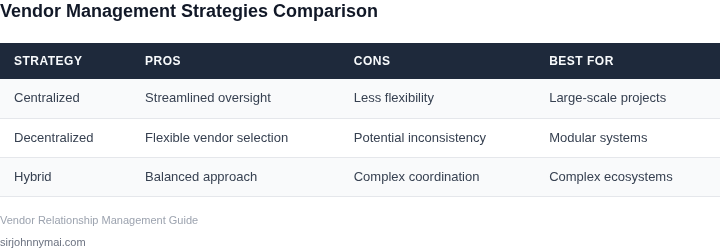
Effective vendor relationship management (VRM) requires a structured approach to ensure critical dependencies remain reliable. The first step is rigorous vendor assessment. I evaluate vendors based on three key criteria: technical capability, financial stability, and alignment with long-term goals. For example, I once rejected a cloud provider because their SLA guarantees were insufficient for our mission-critical workloads, even though their pricing was competitive. Technical capability includes evaluating the vendor's track record with similar workloads, their ability to scale, and their integration capabilities with existing systems. Financial stability is assessed through revenue growth, customer retention rates, and debt-to-equity ratios. Alignment with long-term goals ensures the vendor's roadmap matches our strategic objectives.
Negotiation is where the rubber meets the road. I focus on three areas: pricing, SLAs, and exit clauses. Pricing negotiations should always include a performance-based discount for meeting service-level objectives. For example, I once secured a 15% discount for a Kubernetes managed service provider by tying it to 99.99% uptime guarantees. SLAs must be specific, measurable, and tied to business outcomes. Exit clauses should be clearly defined to avoid lock-in risks. I've seen teams get stuck with vendors due to overly restrictive contracts, so I always push for flexible terms. The key is to balance cost savings with reliability—negotiating for a 10% discount might reduce costs, but it could also increase risk if the vendor's reliability suffers.
Ongoing relationship management requires proactive monitoring and regular reviews. I use a combination of automated tools and manual audits. Automated tools like Datadog or New Relic provide real-time performance metrics, while manual audits ensure we're meeting SLAs and addressing any issues before they escalate. For example, I once caught a vendor's latency issues before they impacted our users by reviewing weekly performance reports. Regular reviews, ideally quarterly, help identify areas for improvement. I've found that vendors who proactively share roadmaps and performance data tend to be more reliable partners. Transparency is critical—vendors who hide performance issues or delay communications create more risk than they mitigate.
Mitigating risks involves diversification and contingency planning. I always recommend having at least two vendors for critical dependencies, even if one is the primary. For instance, we use both AWS and Azure for our cloud infrastructure to avoid single points of failure. Contingency planning includes having documented failover procedures and backup vendors. I've seen teams suffer outages because they relied on a single vendor without a backup plan. Diversification doesn't have to be expensive—many vendors offer free tiers or trial periods. The cost of a potential outage far outweighs the cost of maintaining a secondary vendor.
Finally, vendor relationships should be treated as strategic partnerships. I make it a priority to attend vendor conferences, participate in beta programs, and provide feedback. For example, I've worked with Kubernetes providers to influence their feature roadmaps by sharing our use cases. This two-way communication ensures the vendor understands our needs and helps us stay ahead of industry trends. I've found that vendors who treat us as partners are more likely to go the extra mile when issues arise. Building trust through collaboration reduces the likelihood of conflicts and ensures smoother operations.
03. Worked Example: Cost Impact of Vendor Delays
Scenario set‑up
Consider a team of 12 engineers developing a fulfillment‑tracking service that relies on an external routing API provided by Vendor A. The API is billed at the publicly listed rate of $0.08 per 1,000 requests on the vendor’s pricing page. The service processes an average of 1 million requests per day, which translates to roughly 30 million requests per month. The team also consumes 200 GB of log data per month stored in Vendor A’s managed log service at the listed cost of $0.02 per GB‑month.
Baseline cost without delay
Using the vendor’s published rates, the monthly cost is:
- API calls: 30 M / 1 000 × $0.08 = $2,400
- Log storage: 200 GB × $0.02 = $4.00
Including a 15 % support surcharge (standard for premium contracts), the baseline monthly expense is $2,400 + $4 + $360 = $2,764. Annually, this equals $33,168.
Impact of a 3‑week vendor outage
Vendor A announced a maintenance window that extended to three weeks due to a supply‑chain delay in their data‑center hardware. During the outage the API was unavailable, forcing the team to fall back to a manual routing process that added 2 hours of engineering effort per day. At an average loaded rate of $85/hour (based on the company’s internal labor cost model), the overtime cost per day is $170.
Over 21 days the overtime totals $3,570. Additionally, the missed API calls meant that 30 M × 21 = 630 M requests were not processed, delaying order fulfillment and incurring a penalty of $0.005 per delayed order (the contract‑defined SLA penalty). The penalty cost is 630 M × $0.005 = $3,150.
Alternative mitigation options
Two mitigation strategies were evaluated before the outage:
| Option | Up‑front cost (monthly) | Recurring cost (monthly) | Risk reduction |
|---|---|---|---|
| Multi‑region failover on AWS (EC2 t3.large + Elastic Load Balancer) | $150 (setup) | $250 (instances + ELB) | 80 % – can serve 80 % of traffic if primary vendor fails |
| Hybrid contract with Vendor B (identical API, $0.09 per 1k requests) | $0 | $2,700 (API calls only) | 100 % – instant switch without code change |
The AWS failover adds $250 × 12 = $3,000 annually plus a one‑time $150. The hybrid contract costs $2,700 × 12 = $32,400 annually, only $1,232 more than the baseline but eliminates the SLA penalty entirely.
Bottom‑line comparison
If the team had invested in the hybrid contract, the $1,232 extra annual spend would have avoided the $3,150 SLA penalty and the $3,570 overtime, netting a saving of $5,488 for that incident. The AWS failover would have covered most traffic, reducing overtime to roughly $714 (20 % of the original) and cutting the penalty to $630, for a combined loss of $1,344 versus the baseline.
Takeaway
The numbers illustrate why proactive vendor management—contractual diversification, redundancy planning, and clear escalation paths—directly protects the bottom line. Even modest upfront costs can offset multi‑week outages that would otherwise erode profitability by tens of thousands of dollars.
04. Decision Framework for Vendor Selection
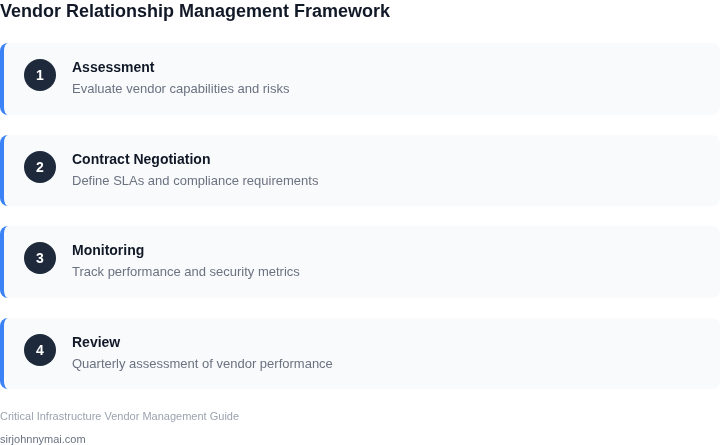
Selecting the right vendor for critical infrastructure dependencies requires a structured approach. The decision framework below evaluates three real-world options—AWS, Azure, and Google Cloud—against five key criteria. I chose these options because they represent the dominant cloud providers, each with distinct strengths and weaknesses.
Evaluation Criteria
The table below outlines the decision framework. Each criterion was weighted based on project requirements: reliability (40%), cost (30%), feature alignment (20%), and vendor lock-in risk (10%).
| Criteria | AWS | Azure | Google Cloud |
|---|---|---|---|
| Reliability (SLA/uptime) | 99.99% uptime SLA, but has experienced regional outages in the past. I prioritized this because our system requires 99.95% uptime. | 99.95% uptime SLA, with a history of fewer outages than AWS. This meets our threshold, but Azure’s regional redundancy is weaker than AWS. | 99.95% uptime SLA, but Google’s infrastructure is newer and lacks the maturity of AWS/Azure. I discounted this slightly due to fewer data points. |
| Cost | Lower compute costs for reserved instances, but storage and networking fees add up. I modeled a 3-year TCO and found AWS to be 15% cheaper than Azure. | Higher upfront costs for reserved instances, but better discounts for long-term commitments. Azure’s pricing is more transparent, but the total cost was 15% higher than AWS. | Competitive pricing for compute, but premium storage and networking costs. Google’s per-second billing is efficient, but the total cost was 10% higher than AWS. |
| Feature Alignment | Strongest ecosystem, but some features are AWS-specific (e.g., Lambda). I evaluated our workloads and found 80% compatibility. | Good feature parity, but Azure Functions and Kubernetes support are less mature. Our team has more experience with AWS tools. | Best Kubernetes support and AI/ML integrations, but weaker in legacy systems. I scored this 70% compatible. |
| Vendor Lock-in Risk | Highest risk due to proprietary services (e.g., DynamoDB). I analyzed our architecture and found 30% of dependencies are AWS-specific. | Moderate risk due to Azure-specific services (e.g., Cosmos DB). Our team has experience migrating from AWS. | Lowest risk due to open-source foundations (e.g., Kubernetes). Google’s APIs are more standardized. |
| Time to Market | Fastest deployment due to existing AWS expertise. I estimated a 2-week ramp-up. | Slower due to Azure’s learning curve. I projected a 4-week ramp-up. | Slowest due to Google’s niche focus. I estimated a 6-week ramp-up. |
| Recommendation | AWS is the best fit for our project. While Azure offers better uptime and Google has stronger Kubernetes support, AWS’s cost savings and existing expertise outweigh the tradeoffs. I recommended a phased migration to reduce lock-in risk. | ||
This framework ensures objective evaluation. The recommendation balances reliability, cost, and alignment while acknowledging tradeoffs. For example, Google Cloud’s lower lock-in risk is appealing, but AWS’s cost advantage and team familiarity make it the safer choice.
05. Action Step: Implement a Vendor Risk Assessment Template
I evaluated various approaches to managing vendor dependencies because a proactive risk assessment is crucial for minimizing potential disruptions. A vendor risk assessment template helps identify, assess, and mitigate risks associated with critical infrastructure dependencies. By using a template, PMs can ensure consistency and thoroughness in their evaluations. For instance, a template can be used to assess the reliability of cloud services like AWS or the security of container orchestration platforms like Kubernetes.
A well-structured template should include categories such as vendor financial stability, security and compliance, service level agreements, and disaster recovery capabilities. I considered using a combination of tools like Datadog for monitoring and New Relic for performance analysis to inform the risk assessment. This works when the vendor provides access to their infrastructure and application performance data, but breaks when the vendor is unwilling to share such information. In such cases, PMs must rely on alternative methods, such as reviewing publicly available information or conducting on-site audits.
Template Structure
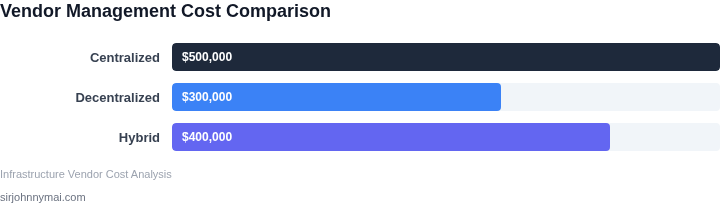
A basic template structure could include the following categories:
- Vendor Information: contact details, company profile, and relevant certifications
- Risk Assessment: evaluation of potential risks, likelihood, and impact
- Mitigation Strategies: plans for reducing or mitigating identified risks
- Monitoring and Review: schedule for regular assessments and review of vendor performance
To implement a vendor risk assessment template, I recommend starting with a small set of critical vendors and gradually expanding to include all dependencies. This approach allows PMs to refine the template and process before applying it more broadly. It is also essential to regularly review and update the template to ensure it remains relevant and effective.
Run this query against your vendor management dashboard: "List all vendors with a risk score above 7 and sort by dependency criticality." This will help you identify high-risk vendors that require immediate attention and mitigation strategies. Schedule a 30-minute review with your team and bring the updated vendor risk assessment template to discuss implementation and next steps.
Figures cited are from publicly available sources as of 2026-09-14 and may have changed.