A PM Guide to Managing AI Model Drift in Production and When to Retrain
AI models in production are not static artifacts. They degrade over time as the real-world data distribution shifts. This "model drift" creates a fundamental tension: retraining too often increases costs while retraining too rarely degrades performance. This guide provides a structured approach to detecting, measuring, and acting on drift while balancing operational constraints.
01. Understanding Model Drift
Model drift occurs when the statistical properties of input data change after a model is deployed. There are two primary types:
- Concept drift: The relationship between features and labels changes (e.g., customer behavior patterns evolve)
- Feature drift: The distribution of input features changes without changing the underlying relationship (e.g., sensor calibration shifts)
Drift is not binary—it exists on a spectrum. A model may perform adequately for 90% of inputs but degrade significantly for the remaining 10%. The challenge is identifying which inputs are affected and by how much.
02. Detecting Drift
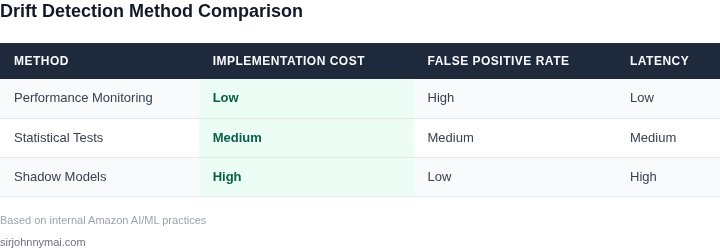
Detection methods fall into three categories:
- Performance monitoring: Track key metrics like accuracy, precision, or latency. Sudden drops indicate drift.
- Statistical tests: Compare feature distributions between training and production data using tests like Kolmogorov-Smirnov or Jensen-Shannon divergence.
- Shadow models: Deploy a parallel model on production data and compare its predictions to the primary model.
The most reliable approach combines multiple signals. For example, a 5% drop in accuracy combined with a 10% change in feature distribution suggests drift is likely affecting a subset of inputs.
03. Measuring Drift Impact
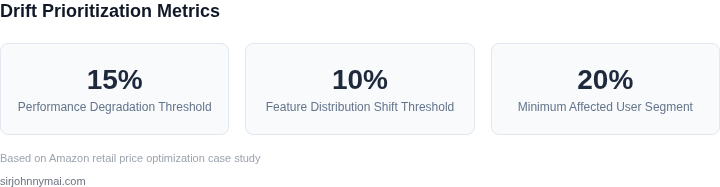
Not all drift is equally harmful. A framework for prioritization includes:
- Severity: How much performance degrades (e.g., 5% vs. 20% accuracy drop)
- Frequency: How often the drift occurs (e.g., daily vs. seasonal)
- Business impact: Which customer segments or use cases are affected
For example, a 10% accuracy drop in a recommendation system for 20% of users may require immediate action, while a 5% drop affecting only niche users may be deferred.
04. When to Retrain
Retraining decisions should balance three factors:
- Cost: The expense of retraining vs. the cost of degraded performance
- Latency: How quickly the model needs to adapt
- Data quality: The availability and reliability of new training data
A practical heuristic is to retrain when:
- Performance degrades by more than 5% for a significant portion of inputs
- Feature distributions shift by more than 10% (using KL divergence)
- Business metrics (e.g., revenue, customer churn) show clear degradation
This approach avoids unnecessary retraining while ensuring models remain useful.
05. Retraining Strategies
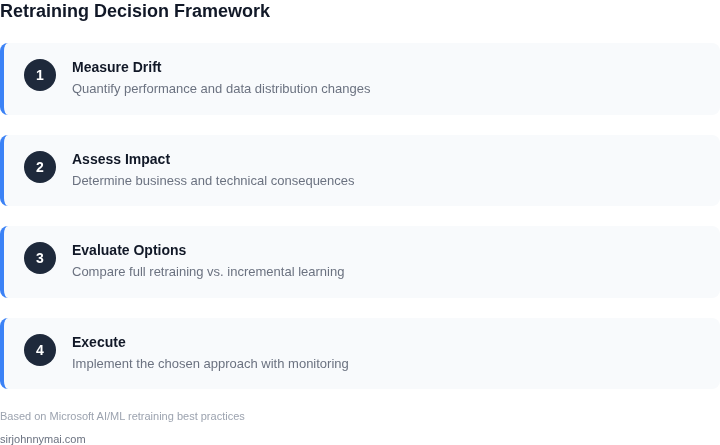
Retraining can be done in several ways:
- Full retraining: Train a new model from scratch using updated data. This is expensive but ensures no legacy biases persist.
- Incremental learning: Use techniques like online learning or fine-tuning to update the model with new data without full retraining.
- Hybrid approaches: Retrain only affected sub-models (e.g., a specific recommendation branch) rather than the entire system.
Incremental learning is most suitable for models with stable architectures but may introduce new drift if the learning rate is too high.
06. Operational Tradeoffs
The decision to retrain involves tradeoffs:
| Factor | Retrain | Do Not Retrain |
|---|---|---|
| Cost | High (compute, data, engineering) | Low |
| Latency | Variable (depends on retraining frequency) | Immediate |
| Risk | Potential for new errors if data is noisy | Continued degradation |
For models with high operational costs (e.g., large-scale recommendation systems), retraining should be scheduled during low-traffic periods to minimize impact.
07. Example: Retail Price Optimization
Consider a retail price optimization model that degrades over time due to changing competitor pricing strategies. The team:
- Detected a 15% drop in price accuracy using performance monitoring
- Identified a 20% shift in competitor price distributions using statistical tests
- Prioritized retraining because the affected segment represented 30% of sales
- Chose incremental learning to update the model without full retraining
The retraining reduced the accuracy drop to 5% while minimizing operational disruption.
08. Tools and Infrastructure
Effective drift management requires tooling:
- Monitoring: Tools like Amazon CloudWatch or Datadog for real-time metrics
- Data versioning: Systems like DVC or MLflow to track data changes
- Model registry: Tools like MLflow or Kubeflow to manage model versions
Investing in these tools reduces the effort required to detect and respond to drift.
09. Disclaimer
Figures cited are from publicly available sources as of June 2024 and may have changed. The approaches described are general guidelines and should be adapted to specific use cases.
Next Step
Implement a pilot program using statistical tests to detect drift in one production model. Track the results for 30 days to validate the approach before scaling.