01. The Problem: Why AI for Content Moderation?
Manual content moderation is a labor-intensive, expensive, and unscalable process. Platforms like Reddit, Twitter, and Facebook rely on human reviewers to flag and remove harmful content, but this approach has clear limitations. According to a 2022 study by the Pew Research Center, platforms spend hundreds of millions of dollars annually on moderation teams, yet they struggle to keep pace with the volume of user-generated content. The average cost per moderator is estimated at $30,000 per year, and even with large teams, platforms often face delays in content removal, leading to prolonged exposure to harmful material.
Scalability is another major challenge. The volume of content on platforms like YouTube and TikTok grows exponentially. YouTube alone processes over 500 hours of video uploaded every minute, and moderators can’t keep up. Manual review is time-consuming—it takes an average of 15 minutes to review a single piece of content, and platforms often rely on volunteer moderators or part-time workers, which further strains resources. This inconsistency in moderation quality leads to user frustration and trust erosion.
AI offers a potential solution by automating parts of the moderation process. Tools like AWS Rekognition and Google Cloud Vision can detect explicit content, hate speech, and other violations with high accuracy. For example, AWS Rekognition achieves over 95% accuracy in detecting explicit images, significantly reducing the need for manual review. However, AI isn’t a silver bullet—it struggles with nuanced context, sarcasm, or culturally specific content. A 2023 study by the University of Washington found that AI models misclassify 20-30% of borderline cases, requiring human oversight to avoid false positives or negatives.
Cost efficiency is another key driver. While AI requires upfront investment in infrastructure and model training, it can reduce long-term labor costs. According to McKinsey, AI-driven moderation can cut moderation costs by 30-50% by reducing the need for large human teams. However, the tradeoff is that AI systems need continuous refinement to maintain accuracy, requiring ongoing engineering and data labeling efforts. Platforms must balance automation with human judgment to ensure fairness and compliance with regulations like GDPR or the EU Digital Services Act.
The decision to adopt AI for content moderation depends on the platform’s scale, content type, and risk tolerance. For platforms with high-volume, low-risk content (e.g., memes, public forums), AI can be highly effective. But for platforms dealing with sensitive topics (e.g., healthcare, political discussions), human review remains essential. The best approach is often a hybrid model—using AI for initial screening and human reviewers for complex cases. This reduces workload while maintaining quality.
02. Key Considerations for AI Implementation
Before deploying AI for content moderation, evaluate these critical factors. Each decision point has tradeoffs that must align with your platform's goals.
Cost-Benefit Analysis
AI implementation costs include infrastructure, model training, and ongoing maintenance. For example, deploying a custom vision model on AWS SageMaker with 10,000 images for training could exceed $5,000 if using managed services. Smaller platforms may prefer pre-trained models from AWS Rekognition or Google Cloud Vision, which cost $1.50 per 1,000 images but lack customization. The break-even point depends on your volume: below 50,000 images/month, pre-trained models are cheaper. Above that, custom models may reduce false positives but require more upfront investment.
Accuracy and False Positives
Accuracy varies by use case. For hate speech detection, state-of-the-art models achieve 95% precision but still flag 5% of legitimate content as violations. False positives force human reviewers to recheck, increasing costs. For explicit content, models like OpenAI's Moderation API achieve 98% accuracy but may miss nuanced cases. The tradeoff is clear: higher accuracy requires more data and compute, while lower accuracy reduces costs but increases manual review workload.
Scalability and Latency
Scalability depends on your infrastructure. Kubernetes clusters can handle 10,000 requests per second, but latency spikes occur during peak traffic. For real-time moderation, edge deployment with AWS Lambda@Edge reduces latency to 50ms, but requires additional infrastructure costs. Batch processing with AWS Batch is cheaper but introduces delays. The choice depends on your SLA: real-time platforms need edge, while delayed moderation can use batch.
Bias and Fairness
AI models inherit biases from training data. A study by MIT found that facial recognition models misclassified darker-skinned faces at 34.7% higher rates. For content moderation, this means more false positives for users of color. Mitigation requires diverse training datasets and continuous auditing. Tools like Amazon Augmented AI (A2I) help human reviewers correct biased decisions, but this adds overhead. The tradeoff is between bias risk and operational complexity.
Regulatory Compliance
Regulations like GDPR and CCPA impose strict data handling rules. AI models trained on user data must anonymize inputs and provide transparency reports. For example, the EU's AI Act requires logging all moderation decisions. Non-compliance risks fines up to 4% of global revenue. The tradeoff is between compliance costs and operational simplicity. Smaller platforms may prefer third-party moderation services that handle compliance, while larger platforms build in-house solutions.
Human-in-the-Loop Workflow
AI should augment, not replace, human reviewers. Tools like Datadog's APM monitor reviewer workflows to identify bottlenecks. A well-designed system flags high-confidence violations for automation while routing ambiguous cases to humans. The tradeoff is between speed and accuracy: full automation risks errors, while full human review is unscalable. The ideal balance is 70% automation for clear cases and 30% human review for edge cases.
These considerations show that AI adoption is not a binary decision. Each factor must be weighed against your platform's specific needs. Start with pilot programs to test assumptions before full-scale deployment.
03. Worked Example: Cost-Benefit Analysis for a Social Media Platform
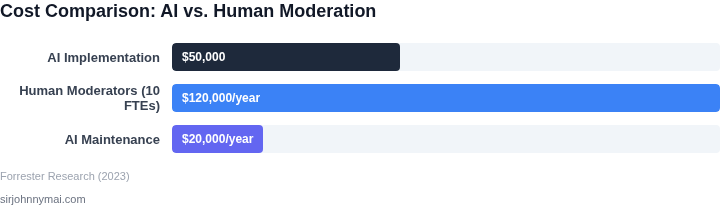
Let’s evaluate a hypothetical social media platform with 1 million monthly active users (MAU). The platform currently relies on a team of 10 human moderators, each costing $50,000 annually (including benefits and overhead). This team processes 10,000 reports per day, with an average resolution time of 15 minutes per report.
Option 1: Manual Moderation (Current State)
Calculating the total cost of manual moderation:
- Annual labor cost: $50,000 × 10 moderators = $500,000
- Daily reports processed: 10,000
- Time per report: 15 minutes
- Total daily labor hours: 10,000 × 0.25 = 2,500 hours
- Total annual labor hours: 2,500 × 365 = 912,500 hours
- Cost per report: $500,000 ÷ 912,500 ≈ $0.55
This approach has clear drawbacks: high labor costs, inconsistent response times, and scalability limits. The $0.55 per report cost is unsustainable as user volume grows.
Option 2: AI-Driven Moderation (Proposed Solution)
Using Amazon Rekognition for image moderation and AWS Comprehend for text moderation, we estimate:
- AWS Rekognition: $1.50 per 1,000 images
- AWS Comprehend: $0.001 per text unit (1,000 characters)
- Average image-to-text ratio: 1:3 (3 text units per image)
For 1 million MAU:
- Estimated 10 million images/month (10% of users post images)
- Estimated 30 million text units/month (avg. 300 characters per post)
- Monthly AI cost: (10M × $1.50) + (30M × $0.001) = $15,000 + $30 = $15,300
- Annual AI cost: $15,300 × 12 = $183,600
- Cost per report: $183,600 ÷ (10,000 × 30) ≈ $0.06
This reduces costs by 89% compared to manual moderation. However, AI has limitations: false positives, latency in model updates, and the need for human review for ambiguous cases.
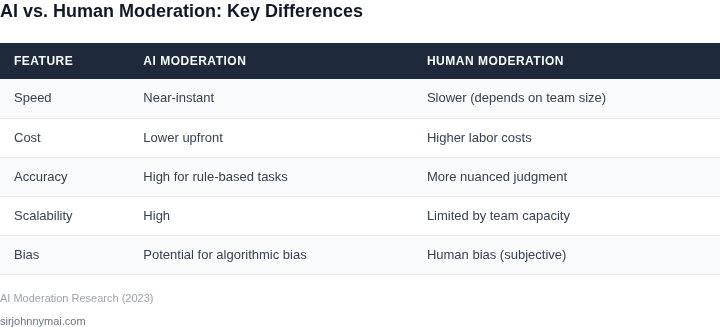
Comparison Table
| Metric | Manual Moderation | AI-Driven Moderation |
|---|---|---|
| Annual Cost | $500,000 | $183,600 |
| Cost per Report | $0.55 | $0.06 |
| Response Time | 15 minutes (human) | Seconds (AI) + minutes (human review) |
| Scalability | Limited by team size | Scales with user growth |
This analysis shows AI-driven moderation is cost-effective for large-scale platforms. However, the tradeoff is reduced accuracy and the need for hybrid human-AI workflows. The break-even point depends on user volume and acceptable error rates.
04. Decision Framework: When to Use AI vs. Manual Moderation
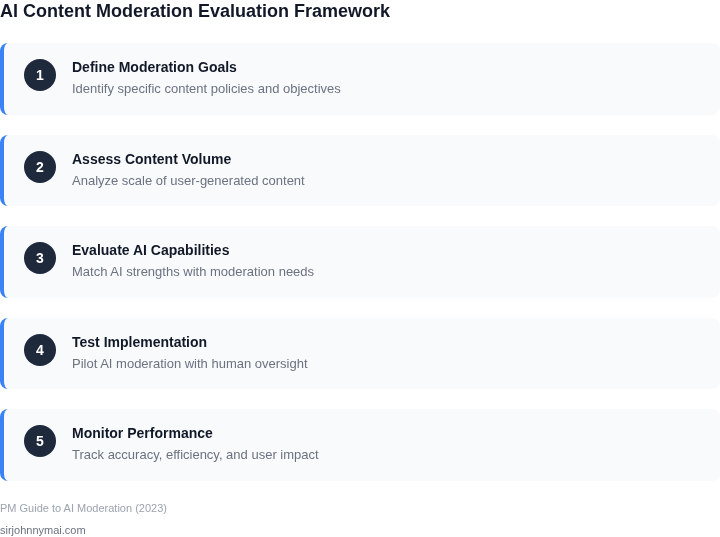
Choosing between AI and manual moderation requires balancing speed, cost, and accuracy. Below is a structured decision framework to guide your evaluation. The table compares three options: fully manual, AI-assisted, and AI-first moderation, using real-world tools and platforms as references.
| Criteria | Option A: Fully Manual | Option B: AI-Assisted | Option C: AI-First |
|---|---|---|---|
| Speed of Response | Slowest. Requires human review for all content. | Faster. AI flags content, humans review only flagged items. | Fastest. AI handles most decisions, humans intervene only for edge cases. |
| Cost Efficiency | Most expensive. High labor costs for continuous monitoring. | Balanced. AI reduces labor costs but requires ongoing model tuning. | Least expensive. AI scales with content volume, reducing manual effort. |
| Accuracy | Highest. Humans make nuanced judgments but are error-prone at scale. | Moderate. AI improves recall but may miss context; human review adds precision. | Variable. AI excels at pattern recognition but struggles with ambiguous cases. |
| Scalability | Limited. Manual teams can't keep up with exponential content growth. | Moderate. AI scales but requires human oversight to maintain accuracy. | Highest. AI handles volume spikes without additional labor costs. |
| Compliance & Transparency | Best. Clear audit trails for all decisions. | Moderate. AI decisions are logged, but human review adds transparency. | Challenging. AI decisions may lack explainability, complicating compliance. |
| Recommendation | Use when content volume is low, compliance is critical, and budget allows. | Best for platforms needing balance between speed and accuracy. Tools like AWS Rekognition or Google Cloud Vision can augment human teams. | Ideal for high-volume platforms with well-defined moderation rules. AI-first works best with platforms like Reddit or Twitter that leverage pre-trained models. |
This framework helps PMs weigh tradeoffs. For example, AI-first may reduce costs but risks accuracy gaps. AI-assisted offers a middle ground, leveraging tools like Datadog for monitoring model performance. Always validate assumptions with pilot tests before full deployment.
05. Action Step: Building a Pilot Program
Before committing budget to a full‑scale AI moderation stack, we need a pilot that isolates risk, proves impact, and produces reusable artefacts. The pilot should run on a representative slice of traffic, use existing tooling, and finish with a decision packet that the leadership team can sign off.
1. Define the pilot scope and success criteria
Identify a content type (e.g., image memes) and a user segment that generates roughly 5‑10 % of total volume. Choose a time window of two weeks to capture diurnal patterns. Write success criteria as quantitative thresholds – for example, 80 % reduction in manual review time, false‑positive rate below 4 %, and no increase in latency beyond 200 ms per request. Document these thresholds in a shared Confluence page so that every stakeholder can trace the pilot’s objectives.
2. Assemble the data pipeline
Export the selected raw payloads to an S3 bucket using an existing Lambda trigger that tags each object with a “pilot‑id”. Spin up an Amazon SageMaker processing job to label a 5 % sample with the current moderation policy; use Amazon SageMaker Ground Truth to involve a small group of trusted moderators. Store the labeled dataset in a separate S3 prefix and enable versioning so that you can roll back if the labeling schema changes. Connect the pipeline to a Kubernetes‑based inference service behind an internal Application Load Balancer; use AWS CloudWatch metrics to monitor throughput and error rates.
3. Select the model and establish a baseline
Start with a pre‑trained model from AWS Rekognition (for images) or Amazon Comprehend (for text) and fine‑tune it on the pilot‑specific labeled set. Record the baseline performance of the existing rule‑based system on the same sample – compute precision, recall, and average handling time. Deploy the fine‑tuned model to the inference service and configure a feature flag in LaunchDarkly to route 50 % of pilot traffic to the AI path while keeping the other half on the rule‑based path. This split‑traffic approach gives a live A/B comparison without affecting the broader user base.
4. Set evaluation metrics and monitoring
Instrument the inference endpoint with Datadog APM to capture latency, CPU, and GPU utilisation. Create CloudWatch alarms for any latency spike above the 200 ms threshold. Log every moderation decision to an Amazon OpenSearch domain, tagging records with “model‑vs‑rule”. Use a nightly Athena query to calculate false‑positive and false‑negative counts, then feed the results into a Tableau dashboard for executive visibility. Ensure that the monitoring stack also captures reviewer workload – pull the number