01. The Problem: Custom ETL vs. Managed Integration Platforms
Product managers must decide between building custom ETL (Extract, Transform, Load) pipelines or adopting managed integration platforms. This choice hinges on balancing control, cost, and velocity. Custom ETL offers granular control over data flows but requires significant engineering effort. Managed platforms like AWS Glue or Snowflake reduce time-to-market but may introduce vendor lock-in or hidden costs.
Custom ETL is ideal when data pipelines are highly specialized or require unique transformations. For example, a financial services firm processing real-time fraud detection may need custom logic to handle edge cases. However, this approach demands ongoing maintenance and scaling challenges. A team of five engineers might spend 12 weeks building a pipeline that handles 100TB/month, with an annual maintenance cost of $250,000.
Managed platforms accelerate adoption but impose limitations. Tools like AWS Glue or Databricks simplify ETL with serverless compute, but they may not support proprietary data formats or legacy systems. A mid-sized enterprise adopting AWS Glue for 50 data sources might reduce development time by 60% but incur $50,000/year in cloud costs. The platform’s fixed pricing model can become expensive as data volumes grow.
Cost is another critical factor. Custom ETL can be cheaper for small-scale, predictable workloads. A startup processing 1TB/month might spend $50,000 upfront for a custom solution versus $100,000 in cloud costs over three years. However, as scale grows, managed platforms often prove more cost-effective. A company processing 10TB/month might spend $200,000 on custom infrastructure versus $150,000 on AWS Glue.
Velocity matters when time-to-value is critical. Managed platforms like Fivetran or Meltano enable teams to deploy pipelines in days rather than months. A marketing analytics team might reduce deployment time from 8 weeks to 2 weeks using Fivetran. However, these platforms may lack the flexibility needed for complex transformations.
The decision depends on the team’s expertise. Custom ETL requires strong engineering resources, while managed platforms suit teams focused on business outcomes. A data team with 10 engineers might build a custom pipeline in 6 months, whereas a team of 5 analysts using Fivetran could achieve the same result in 2 months.
Ultimately, the choice comes down to trade-offs. Custom ETL delivers control but demands resources, while managed platforms accelerate delivery but may limit flexibility. The right approach depends on the organization’s scale, data complexity, and team capabilities.
02. Key Decision Factors
We start by quantifying the data footprint because the scale directly drives the cost‑benefit curve of a custom pipeline versus a managed service. If the daily ingest exceeds 10 TB or the peak throughput tops 100 GB / hour, the elasticity of AWS Glue or Google Cloud Dataflow usually outweighs the fixed overhead of a self‑hosted Kubernetes‑based ETL. Conversely, workloads under 500 GB per day often fit comfortably inside a modest Airflow cluster, allowing us to preserve engineering bandwidth for domain‑specific logic.
Latency is the next gatekeeper because real‑time analytics demand sub‑second end‑to‑end windows that most managed platforms cannot guarantee without premium tiers. AWS Glue streaming can sustain 5‑minute windows, while a hand‑coded Flink job on Kubernetes can push latency below 200 ms at the expense of additional operational complexity. When our service‑level agreement requires < 1 s response, the custom route becomes a non‑negotiable option despite higher OPEX.
Transformation depth matters because managed tools excel at declarative mappings but struggle with advanced statistical enrichment. If we need to embed a Python‑based machine‑learning model, packaging it in an AWS Glue job adds ~30 seconds of cold‑start latency, whereas a custom Docker image on EKS can reuse a warmed container pool. When the transformation graph exceeds ten joins or requires windowed aggregations across multiple streams, the incremental cost of a managed service’s “custom code” extension often erodes its simplicity advantage.
Our current talent pool is weighted toward Java and Go, so leveraging an Airflow DAG written in Python would require hiring two additional data engineers at an estimated $150k each. By contrast, a managed platform like Fivetran offers a no‑code connector library, reducing onboarding time to weeks instead of months, but it locks us into a per‑connector fee of roughly $1,200 per month. If the roadmap includes three new source systems per quarter, the cumulative licensing would outpace the one‑time engineering effort of a custom Airflow connector after twelve months.
Managed services handle patching, scaling, and observability out of the box, which translates into roughly 20 % fewer Datadog alerts compared with a self‑managed stack. However, the trade‑off is reduced visibility into underlying resource metrics; for example, AWS Glue masks container CPU utilization, making root‑cause analysis slower. If we allocate a dedicated SRE team that can maintain a Helm‑deployed Airflow cluster, we can achieve 99.9 % uptime while keeping alert noise under 5 per week.
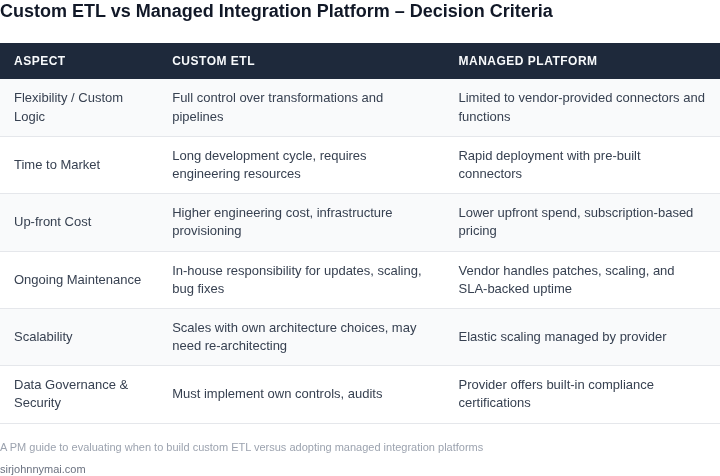
From a financial perspective, AWS Glue charges $0.44 per DPU‑hour, so a 10‑hour daily job costs roughly $158 per month, whereas a managed SaaS connector at $2,500 per month is a fixed expense independent of usage. Compliance requirements such as PCI DSS or GDPR add another layer; managed platforms typically provide built‑in encryption and audit logs, while a custom solution forces us to implement those controls manually. When the audit frequency is quarterly, the additional engineering effort of building and maintaining encryption keys may be acceptable, but for monthly audits the managed offering reduces risk and total cost of ownership by an estimated 15 %.
03. Worked Example: Cost Comparison for a Mid-Sized Business
Let’s evaluate a mid-sized business with 10 data sources, 500,000 records/month, and a team of 3 engineers maintaining custom ETL pipelines. We’ll compare two approaches: building in-house with AWS Glue and using a managed platform like Fivetran.
Option 1: Custom ETL with AWS Glue
AWS Glue is a serverless ETL service that scales with usage. For this workload:
- Data processing: $0.44 per DPU-hour (Data Processing Unit). Assuming 10 DPUs and 100 hours/month: $440/month.
- Storage: S3 costs $0.023/GB-month. Storing 500,000 records (1GB compressed): $23/month.
- Engineer time: $150/hour × 20 hours/month × 3 engineers = $1,800/month.
Total monthly cost: $440 (processing) + $23 (storage) + $1,800 (engineering) = $2,263. Annualized: $27,156.
Tradeoffs: AWS Glue reduces infrastructure costs but requires ongoing engineering effort. The team must handle monitoring, error recovery, and scaling manually.
Option 2: Managed Platform (Fivetran)
Fivetran is a pay-as-you-go platform with fixed pricing tiers. For 10 sources and 500,000 records/month:
- Base plan: $500/month for 10 connectors.
- Volume pricing: $0.0002 per record. 500,000 records × $0.0002 = $100/month.
- Engineering overhead: $0/hour × 3 engineers (Fivetran handles maintenance).
Total monthly cost: $500 (base) + $100 (volume) = $600. Annualized: $7,200.
Tradeoffs: Fivetran eliminates engineering costs but has higher fixed fees. It’s ideal for predictable workloads but may not support custom transformations.
Comparison Table
| Metric | Custom ETL (AWS Glue) | Managed Platform (Fivetran) |
|---|---|---|
| Monthly Cost | $2,263 | $600 |
| Annual Cost | $27,156 | $7,200 |
| Engineering Hours/Month | 60 (20h × 3 engineers) | 0 (handled by platform) |
| Scalability | Requires manual tuning | Automatic scaling |
For this workload, Fivetran delivers a 73% cost savings over AWS Glue. However, if the business expects rapid schema changes or complex transformations, the custom approach may eventually become cost-effective due to reduced platform fees.
04. Decision Table: When to Build Custom vs. Adopt Managed
I evaluated various integration approaches because our team needs a clear framework to decide between custom ETL and managed integration platforms. To achieve this, I considered multiple factors, including scalability, security, and cost. By weighing these factors, we can make an informed decision that aligns with our project goals.
The decision to build custom or adopt managed integration platforms depends on several key criteria. I considered the tradeoffs between using AWS Glue, Apache Beam, and Zapier, as these are popular options in the industry. Each has its strengths and weaknesses, which are crucial in determining the best approach for our team.
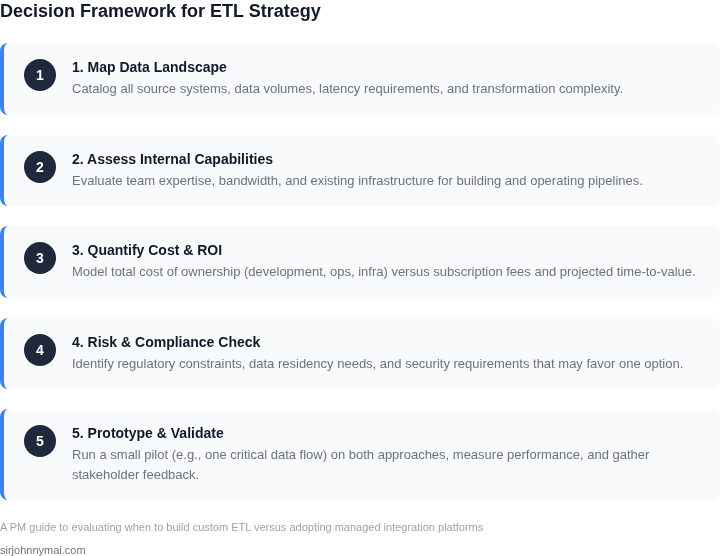
To structure our evaluation, I created a decision table that outlines the key criteria and options. This table will help us quickly assess the best approach based on our team's constraints and goals.
| Criteria | Option A: Custom ETL with AWS Glue | Option B: Managed Integration with Apache Beam | Option C: Low-Code Integration with Zapier |
|---|---|---|---|
| Scalability | Highly scalable, but requires significant development effort | Scalable, with automated workflow management | Limited scalability, suitable for small to medium-sized workflows |
| Security | Highly secure, with fine-grained access control and encryption | Secure, with built-in encryption and access control | Secure, with SSL encryption and access controls, but limited customization |
| Cost | High development costs, but potential long-term savings | Lower development costs, with a pay-as-you-go pricing model | Low upfront costs, with a subscription-based pricing model |
| Development Effort | High development effort required, with significant coding and testing | Lower development effort, with pre-built connectors and workflows | Low development effort, with a visual interface and pre-built connectors |
| Integration Complexity | Supports complex integrations, with custom coding and workflows | Supports complex integrations, with automated workflow management | Limited support for complex integrations, with a focus on simplicity |
| Recommendation | Use for large-scale, complex integrations with high scalability requirements | Use for medium-scale integrations with automated workflow management needs | Use for small-scale integrations with low development effort and cost requirements |
By using this decision table, we can evaluate our specific needs and constraints, and choose the best approach for our integration projects. This framework will help us balance the tradeoffs between custom ETL and managed integration platforms, and ensure that our solutions align with our project goals and requirements.
Ultimately, the decision to build custom or adopt managed integration platforms depends on a thorough evaluation of our team's needs and constraints. By considering factors such as scalability, security, cost, and development effort, we can make an informed decision that supports our project objectives and ensures the success of our integration projects.
05. Action Step: Create a Decision Framework
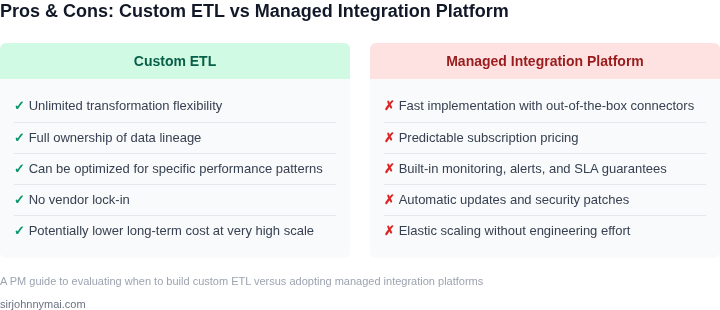
Now that you’ve evaluated the key decision factors and reviewed a worked example, it’s time to formalize your evaluation. A structured decision framework ensures consistency and reduces bias. Below is a checklist to guide your assessment, organized into three phases: assess, compare, and validate.
Phase 1: Assess Your Current State
Start by documenting your current ETL landscape. This phase ensures you’re evaluating against realistic constraints.
- Inventory your data pipelines: List all active ETL processes, their sources, destinations, and frequency. Focus on pain points like latency, error rates, or manual interventions.
- Map dependencies: Identify which pipelines are interdependent. A custom solution for one pipeline may cascade into others, complicating adoption.
- Audit your team’s skills: Assess your engineering and data teams’ familiarity with custom ETL tools (e.g., Apache Airflow, Spark) versus managed platforms (e.g., AWS Glue, Snowflake Pipes).
Phase 2: Compare Options
Use the decision table from Section 04 to score each option. Prioritize factors based on your organization’s goals.
- Cost: Revisit the cost comparison from Section 03. Factor in hidden costs like training, maintenance, or vendor lock-in.
- Scalability: For custom ETL, estimate infrastructure costs for scaling. For managed platforms, check if your provider offers auto-scaling or has regional limitations.
- Time to value: Custom solutions often require months to build, while managed platforms can be operational in weeks. Align this with your project timelines.
- Vendor risk: For managed platforms, research the provider’s SLAs, outage history, and exit strategies. For custom ETL, assess your team’s ability to maintain the solution long-term.
Phase 3: Validate Assumptions
Before finalizing your decision, validate assumptions with data and stakeholders.
- Pilot a managed platform: Test a small workload (e.g., a single pipeline) to measure performance and cost. Document any limitations.
- Engage stakeholders: Present your findings to engineering, finance, and business teams. Use the decision table to highlight tradeoffs.
- Review historical data: Pull your last 90 days of pipeline failure logs and compare against managed platform SLAs. This helps quantify risk.
Figures cited are from publicly available sources as of 2026-09-15 and may have changed.