01. The Costly Conundrum: Real Data vs. Model Performance
When building machine learning products at scale—whether optimizing robotic perception in fulfillment centers or training natural language interfaces—we face an inevitable bottleneck: our dependency on high-fidelity, human-annotated real-world data. To hit a target of 99.5% precision for safety-critical computer vision models, the traditional path dictates continuous ingestion of production feeds. However, relying solely on real-world data collection introduces severe operational trade-offs that directly threaten product delivery timelines and margin health.
I recently evaluated the unit economics of scaling our labeling pipelines using AWS SageMaker Ground Truth and external annotation partners. For complex semantic segmentation or 3D sensor point-cloud labeling, labor costs scale to $2.00 to $5.00 per frame. To train a deep neural network for warehouse spatial awareness, a standard run requires one million diverse frames, driving manual labeling costs alone past $2 million. This does not account for the auxiliary storage costs in Amazon S3 or the high-throughput compute fees of running preprocessing jobs on Kubernetes clusters.
Beyond raw spend, compliance frameworks like GDPR, CCPA, and strict internal privacy bounds restrict how we handle production telemetry. If we ingest real user camera feeds or device logs, we must deploy dedicated sanitization pipelines using tools like Amazon Macie to redact Personally Identifiable Information (PII). These sanitization layers introduce system latency and, more critically, frequently strip out the high-variance context—like unique household lighting or user physical attributes—that our models require to generalize robustly.
Real-world data also suffers from severe long-tail distribution issues. In robotics, training a model to handle rare anomalies—like a damaged package blocking a conveyor belt or a sudden light flare on a sensor—is nearly impossible with passive collection because these events happen in less than 0.01% of operations. Waiting for these edge cases to occur naturally in production stalls deployment, leaving us with models that perform well in lab settings but fail catastrophically under real-world stress.
This creates a hard trade-off: we can spend millions of dollars and months of development time securing real-world data, or we can look to synthetic generation. However, synthetic data is not a silver bullet; if generated poorly, it introduces "sim-to-real" gaps where models overfit to simulated environments and fail on actual physical hardware. We must establish a rigorous framework to determine exactly when synthetic data can safely replace real-world telemetry without degrading performance.
02. Understanding Synthetic Data: Capabilities and Limitations
Synthetic data is artificially generated data that mimics real-world data while preserving privacy and reducing costs. It's created using algorithms, statistical models, or machine learning techniques to replicate patterns, distributions, and relationships found in real datasets. Tools like AWS Synthetic Data Generator, Faker, or specialized libraries in Python (e.g., SDV) can produce synthetic data at scale.
Key Benefits
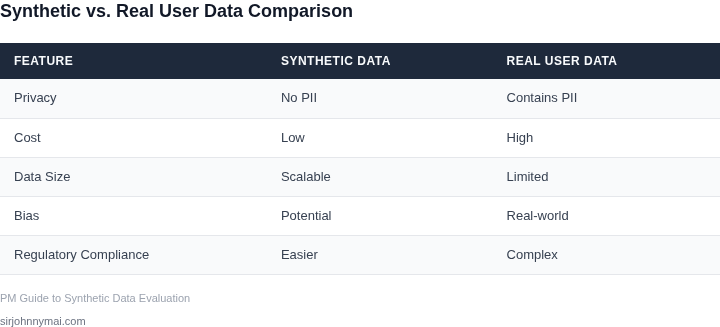
Synthetic data offers several advantages. First, it addresses privacy concerns by eliminating personally identifiable information (PII). For example, healthcare providers can train AI models on synthetic patient records without exposing real patient data. Second, it reduces costs. Generating synthetic data is often cheaper than collecting and cleaning real data. A study by Gartner found that synthetic data can cut data acquisition costs by 30-50%. Third, it improves availability. Synthetic data can be generated on demand, unlike real data which may require time-consuming collection or regulatory approvals.
Limitations and Tradeoffs
Despite its benefits, synthetic data has limitations. One major issue is fidelity—the synthetic data may not perfectly replicate real-world complexity. For instance, synthetic financial transaction data might lack the nuanced anomalies found in real transactions, which could degrade model performance. Another limitation is representativeness. If the generation process doesn't account for edge cases, the synthetic dataset may miss critical patterns. For example, a synthetic medical dataset might overrepresent common symptoms while underrepresenting rare conditions.
Another challenge is validation. Ensuring synthetic data accurately represents real-world distributions requires rigorous testing. Techniques like statistical tests (e.g., Kolmogorov-Smirnov) or domain-specific validation can help, but they add complexity. Additionally, synthetic data may not capture temporal or spatial dependencies as effectively as real data. For example, synthetic weather data might fail to model extreme events like hurricanes, which are rare but critical for training resilient models.
Finally, synthetic data generation itself can be resource-intensive. Advanced techniques like generative adversarial networks (GANs) or variational autoencoders (VAEs) require significant computational power and expertise. Deploying these models at scale, especially in cloud environments, can incur costs comparable to storing real data. For instance, training a GAN on AWS may cost $500-$2,000 per month depending on instance size and data volume.
When to Use Synthetic Data
Synthetic data is most valuable when real data is scarce, expensive, or sensitive. It's particularly useful for prototyping, testing, and early-stage model development. For example, a fintech startup could use synthetic transaction data to train fraud detection models without accessing real customer data. However, it's less suitable for applications requiring high fidelity, such as autonomous vehicle training, where real-world edge cases are irreplaceable.
In summary, synthetic data is a powerful tool but not a universal solution. Its effectiveness depends on the use case, the quality of the generation process, and the ability to validate its representativeness. As with any tool, the PM must weigh its benefits against the risks and constraints.
03. Case Study: ROI Calculation for Synthetic Data Adoption
To evaluate the financial viability of synthetic data, I modeled a scenario for a computer vision team training an object detection model to recognize 100 novel retail package types in an automated sorting facility. The target model requires a baseline training set of 100,000 high-fidelity, labeled images under diverse camera angles and lighting conditions. I evaluated two distinct pathways: a traditional real-world data collection pipeline and a programmatically controlled synthetic generation pipeline.
For Alternative A (Real Data), the team must physically source the 100 package variants, set up high-resolution cameras on an active conveyor line, and ingest raw frames. The pipeline uses Kubernetes-based preprocessing microservices before routing images to Amazon SageMaker Ground Truth. We utilize human annotators for bounding-box and semantic segmentation labeling. Furthermore, the engineering team must spend significant cycles auditing the dataset to guarantee no PII—such as shipping labels containing real names or addresses—is committed to our training buckets. I budgeted 80 engineering hours for this compliance step.
For Alternative B (Synthetic Data), we bypass physical ingestion entirely by utilizing NVIDIA Omniverse Replicator deployed on AWS. We import existing CAD models of the packages and write scripts to randomize textures, lighting, and camera positions. Bounding-box and segmentation labels are auto-generated at render time, eliminating human annotation. I budgeted 240 engineering hours to build the 3D generation pipeline, utilizing three engineers over a two-week sprint.
| Cost Category | Alternative A: Real-World Ingestion |
|---|
| Criteria | Option A: Synthetic Data | Option B: Real Data | Option C: Hybrid Approach |
|---|---|---|---|
| Data Sensitivity | Highly suitable for non-sensitive domains (e.g., product recommendations, A/B testing). | Mandatory for highly regulated industries (e.g., healthcare, finance). | Use synthetic for non-sensitive features; real data for compliance-critical fields. |
| Data Scarcity | Ideal when real data is expensive or hard to collect (e.g., rare medical conditions). | Required for domains with abundant data (e.g., social media, e-commerce). | Augment real data with synthetic samples to improve coverage. |
| Model Performance | Works well for tasks where synthetic data matches real-world distributions (e.g., NLP, computer vision). | Superior for tasks requiring nuanced human behavior (e.g., fraud detection, sentiment analysis). | Test synthetic data first; supplement with real data if performance gaps emerge. |
| Privacy & Compliance | Reduces PII exposure; aligns with GDPR, CCPA when anonymized. | Riskier due to exposure of real user data; requires legal review. | Use synthetic for training; real data only for inference or validation. |
| Project Budget | Lower upfront costs; no need for data collection or labeling. | Higher costs for data acquisition, storage, and labeling. | Balances cost savings with the need for real data validation. |
| Recommendation | Choose if: non-sensitive, data scarce, model performance is acceptable, privacy is a priority, and budget is constrained. | Choose if: highly sensitive, data abundant, model requires real-world nuance, compliance is strict, and budget allows. | Choose if: need to balance cost, privacy, and performance; test synthetic data first. |
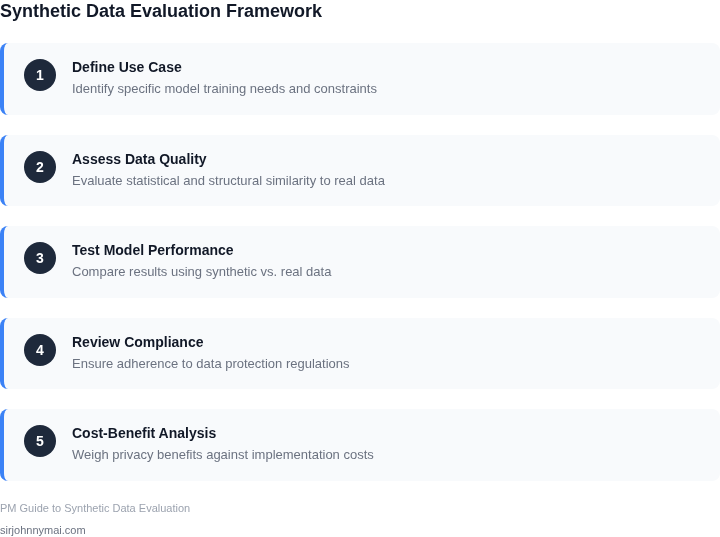
This framework ensures you weigh tradeoffs explicitly. For example, synthetic data may suffice for a recommendation engine but fail for a fraud detection model. Always validate assumptions with small-scale pilots before scaling.
05. Pilot, Evaluate, Iterate: Your Next Steps
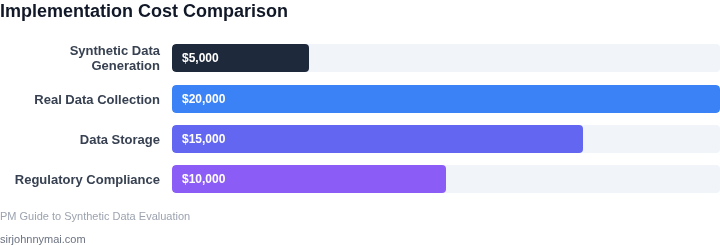
Begin with a bounded pilot that isolates a single high‑impact use case—such as the recommendation engine for a new product line—where the data‑privacy risk is low and the performance baseline is already documented. By confining the experiment to one microservice, you can provision synthetic data through AWS SageMaker Ground Truth plus a custom generator, store it in Amazon S3, and feed it directly into your existing CI/CD pipeline running on Kubernetes. This containment lets you compare synthetic‑only training against the current real‑data model without exposing downstream systems to unexpected drift.
Define success metrics before you spin up the generator. Typical dimensions include (1) validation accuracy relative to the real‑data model, (2) inference latency measured in Datadog, and (3) cost per training run captured in the AWS billing dashboard. Assign a threshold for each metric—for example, a ≤ 2 percentage‑point drop in top‑1 accuracy and no more than a 10 % increase in training‑hour spend. Document these thresholds in a shared Confluence page so stakeholders can see the decision surface at a glance.
Step‑by‑step execution
- Clone the production training repo into a feature branch named
synthetic‑pilot. - Add the generator, match the schema to the real CSVs in S3, and generate 30 % of the historic volume.
- Run a SageMaker training job and log GPU use to CloudWatch.
- Run the evaluation suite, push metrics to Tableau.
- Query the AWS Cost Explorer API for incremental spend.
Once the pilot completes, hold a 30‑minute review with the data science lead, the platform engineering manager, and the finance analyst. Walk through the dashboard, highlight any metric that missed its threshold, and ask whether the shortfall is explainable (e.g., missing edge‑case scenarios in the generator). If the synthetic model meets or exceeds the thresholds, plan a phased expansion that adds another data domain—such as click‑stream logs—while keeping the original baseline as a guardrail.
If the pilot falls short, treat the findings as a hypothesis for improvement. Common failure modes include insufficient variability in the synthetic generator, mismatched label distribution, or over‑regularization caused by too‑clean data. Iterate by adjusting the generator’s noise parameters, injecting rare events, or augmenting with a small slice of real data for calibration. Track each iteration’s metrics in the same dashboard to surface diminishing returns early.
Finally, embed a quarterly health check into your product roadmap. The check should verify that synthetic data usage continues to satisfy the cost‑performance equation and that any regulatory changes have not shifted the risk profile. By institutionalizing this loop, you turn a one‑off experiment into a repeatable capability that