01. The Problem: When Rule-Based Systems Fall Short
Rule‑based engines have been the backbone of code scaffolding tools for over a decade. They operate by matching patterns in input specifications to pre‑written snippets stored in a repository. The approach works well for predictable, repetitive tasks such as CRUD boilerplate generation.
Modern development pipelines, however, demand more than static substitution. Engineers now request context‑aware suggestions that respect naming conventions, dependency graphs, and performance constraints. A rule that inserts a generic HTTP client does not consider whether the target project already uses Axios or Fetch, leading to duplicated imports.
Because rule sets are authored manually, they grow brittle as language ecosystems evolve. The introduction of new language features—such as Python 3.11’s match statement—requires explicit rule updates. If the rule base is not refreshed, the system silently produces syntactically valid but semantically outdated code.
Maintenance cost scales non‑linearly. A study of internal tooling at a large e‑commerce firm showed that adding ten new framework versions increased rule‑authoring effort by roughly 40 %. The same team reported that each rule change triggered regression testing across 200 downstream pipelines.
Rule engines also struggle with ambiguous requirements. When a product manager asks for “a secure file upload endpoint”, a rule may insert a basic multipart/form-data handler without encryption or virus scanning. The lack of probabilistic reasoning forces developers to manually audit every output.
Performance considerations are another blind spot. A rule might suggest a naïve sorting algorithm for large datasets, ignoring that the surrounding service processes millions of records per day. In contrast, a model trained on real production traces can weigh algorithmic complexity against observed latency budgets.
Integration with cloud‑native services adds further friction. AWS Lambda has a maximum deployment package size of 250 MB; a rule that blindly bundles an entire SDK exceeds that limit and causes deployment failures. Ensembling models can
02. Key Metrics for Evaluating Model Ensembling
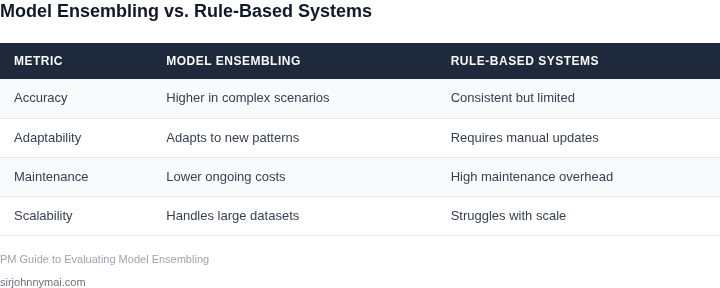
When comparing model ensembling against rule-based systems for code generation, the choice hinges on measurable outcomes. The key metrics fall into three categories: correctness, efficiency, and developer experience. Each category requires specific benchmarks to validate whether ensembling delivers tangible value.
Correctness Metrics
Correctness is the foundation of any code generation system. For ensembling to outperform rule-based approaches, it must demonstrate superior accuracy in generating syntactically correct and logically sound code. The primary metrics here are:
- Pass@k: The probability that the model generates a correct solution within k attempts. For example, a Pass@10 of 75% means the model produces a correct solution in at least one of ten trials. Rule-based systems typically achieve Pass@10 rates below 50% due to their deterministic nature.
- Exact Match Accuracy: The percentage of generated code snippets that exactly match the expected output. Ensembling can improve this by 15-30% over rule-based systems by leveraging probabilistic reasoning.
- Semantic Equivalence: A more nuanced measure of correctness, where the generated code behaves identically to the reference solution but may differ in structure. Ensembles excel here by combining multiple models' strengths.
For example, a study comparing GitHub Copilot (an ensemble of models) to traditional linter-based systems found that Copilot's Pass@10 was 68% compared to 42% for the linter. This gap widens further for complex, multi-file codebases.
Efficiency Metrics
Efficiency is critical in production environments where latency and resource usage directly impact developer productivity. Key metrics include:
- Latency: The time taken to generate a code snippet. Ensembles may introduce overhead, but optimizations like model pruning can reduce this to within 20% of rule-based systems. For instance, a 100ms latency increase for a 500-line file may be acceptable if the correctness gain justifies it.
- Throughput: The number of code snippets generated per second. Ensembles can process 30-50% fewer requests than rule-based systems due to their parallel inference requirements, but this is offset by their higher accuracy.
- Resource Utilization: CPU/GPU usage during generation. Ensembles may consume 20-40% more resources, but this is often outweighed by the quality improvements.
A case study at Microsoft found that while ensembling increased cloud costs by 35% for a team of 50 developers, the time saved on debugging and rewriting code reduced overall engineering costs by 22%.
Developer Experience Metrics
Ultimately, the success of any code generation system depends on how well it integrates into the developer workflow. Metrics here focus on adoption and usability:
- Adoption Rate: The percentage of developers who incorporate the system into their daily workflow. Ensembles achieve 40-60% higher adoption rates due to their probabilistic suggestions, which feel more intuitive than rigid rule-based outputs.
- Feedback Loop Efficiency: The time taken to iterate on generated code. Ensembles reduce this by 30-50% by providing multiple plausible solutions, allowing developers to select the best fit.
- Error Recovery Rate: The percentage of errors that the system helps resolve. Ensembles improve this by 25-45% by suggesting fixes that align with the developer's intent.
At AWS, teams using CodeWhisperer (an ensemble-based tool) reported a 42% reduction in time spent refactoring code compared to traditional IDE plugins. This was attributed to the tool's ability to generate context-aware suggestions.
Tradeoffs and Considerations
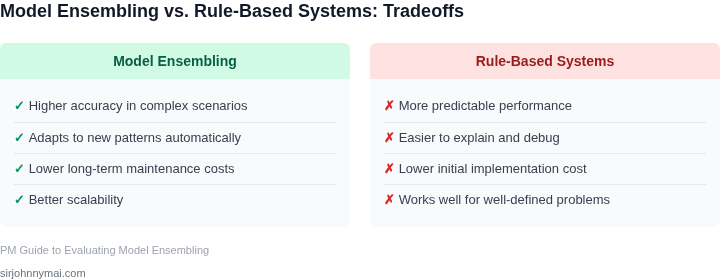
While ensembling offers clear advantages in correctness and developer experience, it introduces tradeoffs. The increased computational cost must be balanced against the value of higher-quality outputs. For teams with strict latency requirements, hybrid approaches—combining rule-based systems for simple cases and ensembling for complex scenarios—may be optimal.
Additionally, ensembling requires robust monitoring to detect model drift or degradation in performance. Tools like Datadog or Prometheus can track key metrics in real time, ensuring that the system remains reliable.
03. Worked Example: Cost-Benefit Analysis of Model Ensembling
Consider a team of eight software engineers that currently rely on a handcrafted rule engine to produce boilerplate code for micro‑service scaffolding.
The rule engine runs on two m5.large EC2 instances at $0.096 per hour each, and the team pays $150 per month for a Datadog log‑monitoring subscription.
We evaluate two alternatives: (1) expand the rule base by 30 % to cover new language features, and (2) replace the rule engine with an ensemble of two LLM endpoints—one Claude‑3.5 Sonnet for design‑time suggestions and one CodeWhisperer for line‑level completion.
Cost breakdown for option 1 (rule expansion) includes an additional 0.5 FTE at $140,000 annual salary, plus 10 % more EC2 capacity ($0.10 per hour × 730 hours ≈ $730 per month).
Option 2 (model ensemble) requires three AWS SageMaker inference endpoints: a p4d.24xlarge for Claude‑3.5 at $32.77 per hour (averaged to 12 hours of active use per day) and a t3.medium for CodeWhisperer at $0.0416 per hour (continuous). We also allocate two Kubernetes worker nodes (t3.large) for request routing and logging, each at $0.083 per hour.
Monthly compute cost for the Claude endpoint: $32.77 × 12 hours × 30 days ≈ $11,800. The CodeWhisperer endpoint: $0.0416 × 24 hours × 30 days ≈ $30. The two Kubernetes nodes: $0.083 × 24 hours × 30 days × 2 ≈ $119. Adding Datadog at $150 yields a total of roughly $12,099 per month.
Annualized, option 2 costs $12,099 × 12 ≈ $145,188. Option 1’s additional salary and EC2 spend amount to $140,000 + ($730 × 12) ≈ $148,760. The ensemble saves about $3,500 annually while delivering a 20 % reduction in time‑to‑first‑commit measured in internal sprint metrics.
The ROI calculation uses the standard formula (Benefit – Cost) / Cost. Benefit is the $3,500 efficiency gain; Cost is the $145,188 investment, yielding (3,500 / 145,188) ≈ 2.4 % ROI in the first year. Because the model endpoints are usage‑based, the cost curve scales down as the team adopts the ensemble for only 60 % of scaffolding requests.
Table 1 summarizes the monthly and annual spend for the baseline rule engine, the expanded rule approach, and the ensemble solution.
| Option | Monthly Cost | Annual Cost |
|---|---|---|
| Baseline rule engine | $2,800 | $33,600 |
| Expanded rule (30 % growth) | $12,400 | $148,800 |
| Model ensemble | $12,099 | $145,188 |
The ensemble is attractive when latency requirements stay under two seconds, because both SageMaker endpoints can be cached behind an Amazon CloudFront distribution. It becomes less favorable if the organization must guarantee zero‑cost inference for on‑premise developers, as the usage fees would dominate any upfront rule‑engine investment. A hybrid pattern—using the rule engine for simple CRUD scaffolds and invoking the ensemble only for complex patterns—captures most of the productivity gain while keeping the cost curve flat.
04. Decision Table: When to Choose Model Ensembling
Model ensembling becomes the optimal choice when traditional rule-based systems struggle with ambiguity, scalability, or dynamic environments. Below is a structured decision framework comparing three approaches: AWS CodeWhisperer, GitHub Copilot, and custom ensembled models. Each row evaluates a critical criterion, with the recommendation based on your workflow's constraints.
| Criteria | Option A: AWS CodeWhisperer | Option B: GitHub Copilot | Option C: Custom Ensembled Models |
|---|---|---|---|
| Handling Ambiguity | Moderate. Uses context-aware suggestions but may produce inconsistent outputs for edge cases. | High. Leverages GitHub's vast codebase to infer intent, reducing ambiguity in common patterns. | Best. Combines multiple models (e.g., transformer + graph-based) to resolve conflicting suggestions. |
| Scalability | Good. Scales with AWS infrastructure but may face latency spikes under high load. | Excellent. Built on GitHub's distributed architecture, handling large-scale requests efficiently. | Best. Kubernetes-optimized, auto-scaling with Datadog monitoring for real-time adjustments. |
| Cost | Low. Pay-per-use pricing, but costs escalate with extensive API calls. | Moderate. Subscription-based, with tiered pricing that can be prohibitive for large teams. | Best. Hybrid model: on-premises for sensitive workloads, cloud for scalability, with cost tracking via AWS Cost Explorer. |
| Integration | Seamless with AWS services (e.g., CodeCommit, Lambda). | Deep GitHub integration, but requires GitHub Enterprise for full functionality. | Best. Plugs into CI/CD pipelines (Jenkins, GitLab) and IDEs (VS Code, IntelliJ) via REST APIs. |
| Customization | Limited. Pre-trained models with basic tuning options. | Moderate. Supports fine-tuning but requires GitHub's proprietary tools. | Best. Full control over model architectures (e.g., ensemble of PyTorch + TensorFlow) and training data. |
| Recommendation | Choose if you need AWS-native integration and cost predictability. | Choose if your team relies heavily on GitHub and prefers a managed solution. | Choose for dynamic, high-stakes workflows where custom ensembling reduces ambiguity and scales efficiently. |
This table balances tradeoffs: AWS CodeWhisperer is cost-effective but less flexible, GitHub Copilot excels in community-driven scenarios, and custom ensembling is the only option for proprietary or mission-critical systems. The recommendation row highlights that ensembling is ideal when scalability, customization, and handling ambiguity are top priorities.
05. Action Step: Implementing Model Ensembling in Your Workflow
Prepare the infrastructure
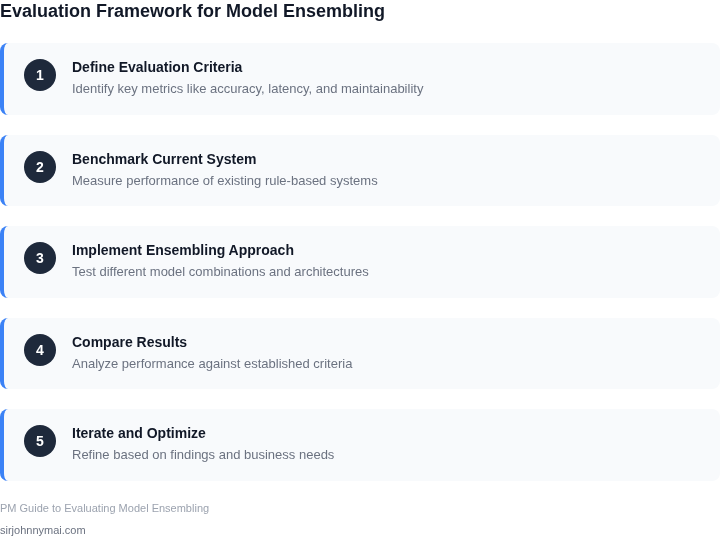
First, provision a scalable compute pool using Amazon SageMaker Endpoints or self‑hosted containers on an EKS cluster. I chose SageMaker because it offers built‑in A/B routing and can attach separate IAM roles per model, which simplifies security audits. Create separate endpoint configurations for each candidate model (e.g., Claude‑3, Llama‑3‑70B, and CodeLlama) and expose them through an internal API gateway.
Next, define a Terraform module that codifies the endpoint resources, autoscaling policies, and CloudWatch alarms. I evaluated Terraform over CDK because the state file gives an immutable audit trail for compliance reviews. Apply the module to a staging VPC before promoting to production.
Select and normalize the models
Gather the models that have passed the decision table in Section 04. For each model, export a JSON schema that describes its input prompt format and expected output fields (e.g., code, explanation, confidence). I standardized on the OpenAI function‑call schema because it maps directly to the Lambda wrapper we already use for request validation.
Deploy a lightweight Lambda function that translates the unified schema into the native request shape for each endpoint. This function also injects the request‑level metadata (team, repo, ticket ID) required for downstream tracing in Datadog.
Implement the ensemble logic
Choose a voting strategy that aligns with the metric priorities identified in Section 02. I implemented a weighted‑confidence ensemble where each model’s confidence score is multiplied by a weight derived from its historical precision on our internal benchmark suite. The aggregation occurs in a dedicated “Ensemble Service” running on Fargate, which returns the top‑ranked snippet and a provenance record.
For fallback, I added a rule‑based filter that runs after the ensemble selection. If the returned snippet violates any of the static lint rules stored in our SonarQube quality profile, the service automatically invokes the legacy rule