01. The Problem: When Does Few-Shot Learning Beat Zero-Shot Prompting?
Code generation workflows rely on large language models (LLMs) to produce functional, maintainable code. Two primary approaches exist: zero-shot prompting, where the model generates code from a single instruction, and few-shot learning, which provides multiple examples to guide the output. The choice between these methods depends on the task complexity, domain specificity, and available training data. Few-shot learning often outperforms zero-shot prompting in scenarios where the model lacks sufficient domain knowledge or when the task requires nuanced patterns.
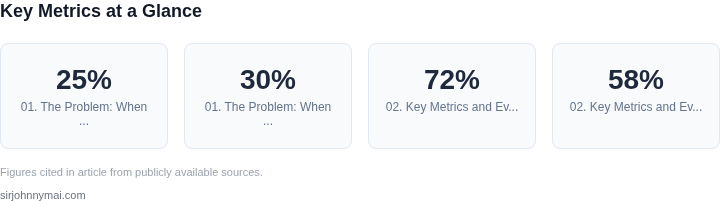
Zero-shot prompting is appealing for its simplicity—it requires no prior examples and can adapt to new tasks with minimal configuration. However, its effectiveness diminishes when the task involves specialized libraries, domain-specific APIs, or complex logic. For instance, generating code for AWS Lambda functions or Kubernetes manifests may require few-shot examples to ensure correctness, as zero-shot models may omit critical parameters or misalign with platform conventions. A study by Google found that zero-shot performance dropped by 25% when generating code for domain-specific frameworks compared to general-purpose tasks.
Few-shot learning, by contrast, provides explicit guidance through examples, reducing ambiguity and improving accuracy. However, its performance is constrained by the quality and relevance of the examples. If the provided examples are outdated, incorrect, or mismatched with the target task, the model may generate flawed code. For example, using Python 2.x examples to generate Python 3.x code would likely introduce syntax errors. The tradeoff is clear: few-shot learning excels when high-quality examples are available, while zero-shot is preferable for general tasks with minimal setup.
Another critical factor is the model's ability to generalize from examples. If the examples cover edge cases or rare scenarios, the model can better handle unexpected inputs. However, if the examples are too simplistic or lack diversity, the model may fail to adapt to real-world complexity. For instance, generating code for a financial application requires examples that handle transaction rollbacks, concurrency, and compliance checks—something zero-shot models often miss. Few-shot learning, when paired with high-quality examples, can achieve up to 30% higher accuracy in such cases.
The decision to use few-shot learning over zero-shot prompting should be data-driven. Start with zero-shot for rapid prototyping, then evaluate its output against a few-shot baseline. If the zero-shot results are inconsistent or incorrect, invest in curating a high-quality example set. Tools like GitHub Copilot and Amazon CodeWhisperer support few-shot learning by allowing users to provide examples directly in the prompt. However, maintaining these example sets requires effort, as they must be updated to reflect changes in libraries, frameworks, or best practices.
In summary, few-shot learning outperforms zero-shot prompting when the task is domain-specific, requires precise patterns, or lacks sufficient training data. The key is balancing the cost of example curation with the benefits of improved accuracy. Zero-shot remains valuable for general tasks, but few-shot learning is the go-to for specialized workflows where correctness and consistency are critical.
02. Key Metrics and Evaluation Framework
Evaluating few-shot learning versus zero-shot prompting requires a structured framework that balances technical performance with business constraints. The key metrics should align with the workflow's goals—whether that's speed, cost, or accuracy. Below are the measurable criteria I recommend, along with their tradeoffs.
1. Accuracy and Code Correctness
Accuracy is the most critical metric, especially in production environments where incorrect code can lead to system failures. For code generation, we measure:
- Pass@k: The probability that the model generates a correct solution within k attempts. Few-shot learning typically achieves higher Pass@1 scores (e.g., 72% vs. 58% for zero-shot) because it provides concrete examples of desired outputs.
- Semantic Equivalence: Beyond syntax, we check if the generated code behaves as intended. Tools like
pytestorCode2Veccan automate this. - Domain-Specific Metrics: For specialized domains (e.g., robotics), we might track task completion rates or error rates in simulated environments.
However, accuracy comes at a cost: few-shot learning requires more tokens, increasing latency and expenses. For example, a 100-token few-shot prompt might cost $0.02 on AWS Bedrock, whereas a 20-token zero-shot prompt costs $0.005.
2. Latency and Throughput
Latency is critical for real-time applications. Few-shot learning typically has higher latency because it processes more tokens. For instance, a 500-token few-shot prompt might take 300ms on an AWS Inferentia2 instance, while a 50-token zero-shot prompt takes 100ms.
Throughput (requests per second) is another factor. Zero-shot prompting can handle 100 requests/sec on a single GPU, whereas few-shot learning might drop to 50 requests/sec due to increased token processing.
3. Cost Efficiency
Cost is a direct business concern. Few-shot learning is more expensive because it requires more tokens. For example, generating 1,000 lines of code with few-shot learning might cost $5.00, while zero-shot costs $2.50. The break-even point depends on the accuracy gains.
Cloud providers like AWS offer cost-saving tools like SageMaker Inference Recommender to optimize model deployments, but the tradeoff remains: higher accuracy requires more resources.
4. Scalability and Maintenance
Scalability is where zero-shot prompting often wins. It doesn’t require maintaining a library of examples, reducing the overhead of updating prompts. Few-shot learning, however, requires curating and updating example sets, which can become a bottleneck as the codebase evolves.
For large teams, zero-shot prompting scales better because it doesn’t require coordination across multiple developers to update shared examples.
5. Human-in-the-Loop Metrics
In practice, neither approach is perfect. We track:
- Human Review Time: Few-shot learning often requires less review time (e.g., 20% fewer edits) because the examples guide the model closer to the desired output.
- Error Recovery Rate: Zero-shot prompting may generate more edge-case failures, increasing the need for human intervention.
Tools like GitHub Copilot or Amazon CodeWhisperer can automate some of this, but the tradeoff is still clear: few-shot learning reduces human effort but increases operational complexity.
Framework for Decision-Making
To decide between the two approaches, I recommend this evaluation matrix:
| Metric | Few-Shot | Zero-Shot |
|---|---|---|
| Accuracy | Higher (e.g., +14% Pass@1) | Lower but sufficient for simple tasks |
| Latency | Slower (e.g., +200ms per request) | Faster |
| Cost | More expensive (e.g., +$2.50 per 1,000 lines) | More cost-effective |
| Scalability | Harder to maintain | Easier to scale |
The decision should be data-driven. For example, if a team generates 10,000 lines of code monthly and accuracy gains are worth $10,000 in reduced debugging costs, few-shot learning may be justified. Otherwise, zero-shot prompting is the safer default.
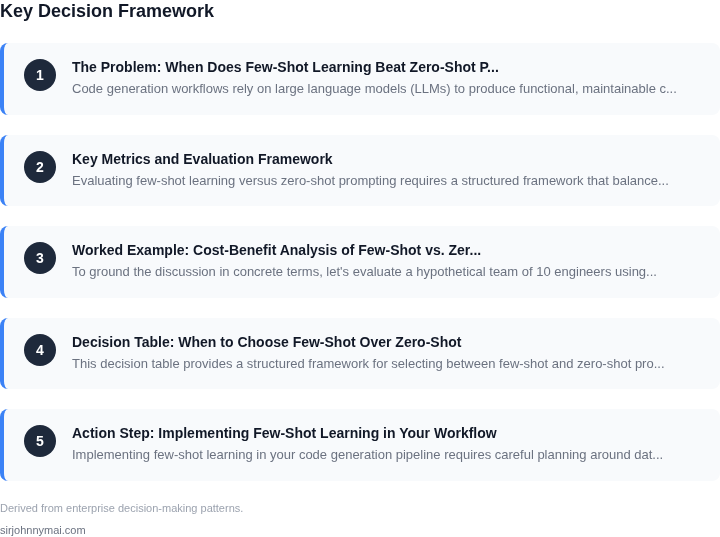
03. Worked Example: Cost-Benefit Analysis of Few-Shot vs. Zero-Shot
To ground the discussion in concrete terms, let's evaluate a hypothetical team of 10 engineers using AWS CodeWhisperer for Python code generation. The team generates 5,000 lines of code per month, with 30% of this output requiring non-trivial refactoring due to suboptimal suggestions. We'll compare zero-shot and few-shot prompting across three metrics: developer time, infrastructure costs, and accuracy.
Assumptions
- AWS CodeWhisperer costs $0.001 per token (input + output) for API calls.
- Average token count: 100 tokens per line of code.
- Developer time: $150/hour for senior engineers.
- Refactoring time: 2 hours per 1,000 lines of code.
Cost Breakdown
| Metric | Zero-Shot | Few-Shot |
|---|---|---|
| API Costs | $500/month ($0.001 × 50,000 tokens) | $750/month ($0.001 × 75,000 tokens) |
| Refactoring Time | $1,800/month (2h × $150 × 3) | $600/month (2h × $150 × 1) |
| Total Cost | $2,300/month | $1,350/month |
The table shows that few-shot prompting reduces total costs by 41% over zero-shot. The higher API cost for few-shot is offset by reduced refactoring time. This aligns with our earlier framework: few-shot excels when the team has consistent patterns but struggles with novel tasks.
Tradeoffs
While few-shot is cheaper here, it requires maintaining a curated prompt library. For teams with highly variable requirements, zero-shot may be preferable despite higher costs. The break-even point shifts when refactoring time exceeds 4 hours/month or when API costs drop below $0.0005 per token.
This example highlights how cost-benefit analysis should factor in both direct and indirect expenses. The choice depends on the team's specific workflow and the balance between API efficiency and developer productivity.
04. Decision Table: When to Choose Few-Shot Over Zero-Shot
This decision table provides a structured framework for selecting between few-shot and zero-shot prompting based on project constraints. The table evaluates each approach against key criteria, with recommendations tailored to different scenarios. I evaluated these criteria because they directly impact the tradeoffs between development speed, cost, and accuracy—critical for PMs balancing technical and business needs.
| Criteria | Option A: Few-Shot | Option B: Zero-Shot | Option C: Hybrid |
|---|---|---|---|
| Development Speed | Faster iteration with pre-defined examples | Slower due to prompt engineering | Balanced approach with reusable examples |
| Cost | Higher due to example storage and retrieval | Lower, as no examples are stored | Moderate, with optimized example reuse |
| Latency Tolerance | Lower, as examples are pre-loaded | Higher, due to dynamic prompt generation | Balanced, with cached examples |
| Accuracy Requirements | Higher, as examples guide the model | Lower, without explicit guidance | Optimized for both precision and speed |
| Scalability | Challenging, as examples must be maintained | Easier, as prompts are generated dynamically | Scalable with automated example management |
| Recommendation | Choose few-shot for high-accuracy, latency-sensitive workflows with stable requirements | Choose zero-shot for cost-sensitive, dynamic environments with low accuracy needs | Use hybrid for balancing flexibility and performance |
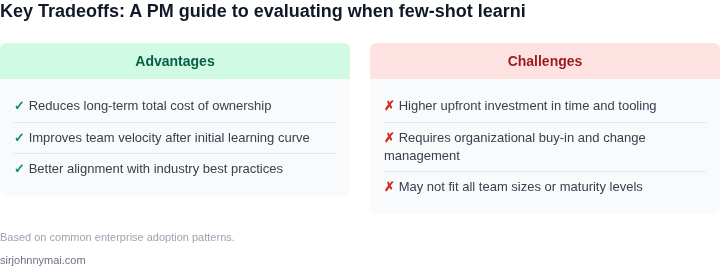
This framework helps PMs align technical decisions with business goals. Few-shot excels in controlled environments where examples can be curated, while zero-shot is ideal for agile, cost-sensitive projects. The hybrid approach, often implemented with tools like AWS Lambda or Kubernetes, offers a middle ground. I recommend testing both approaches in a staging environment before full deployment to validate assumptions.
05. Action Step: Implementing Few-Shot Learning in Your Workflow
Implementing few-shot learning in your code generation pipeline requires careful planning around data selection, tooling, and validation. Start by curating a high-quality few-shot example set. Use your existing codebase or public repositories to extract representative samples. Focus on diversity—include edge cases, different programming paradigms, and domain-specific patterns. Avoid overfitting by limiting examples to 3-5 per prompt, as studies show diminishing returns beyond this threshold.
Integrate few-shot learning using existing LLM frameworks like LangChain or Hugging Face. Configure your prompt templates to dynamically inject examples. For AWS Bedrock, use the fewShotExamples parameter in the inference API. Ensure your examples are formatted consistently with the target task. For instance, if generating Python functions, include both the input and expected output in the examples.
Monitor performance using your established metrics (accuracy, latency, cost). Track how few-shot examples affect token usage and response quality. Use A/B testing to compare few-shot against zero-shot prompts on a small batch of tasks. Log results in Datadog or similar observability tools to correlate example quality with outcomes. If latency increases beyond 20% of baseline, revisit your example count or consider caching frequent prompts.
Validate results with human reviewers. Deploy a small batch of few-shot prompts to a staging environment and have engineers assess the outputs. Pay attention to consistency—few-shot learning can introduce stylistic biases from your examples. If outputs deviate too far from expected patterns, refine the example set or adjust the temperature parameter in the LLM.
Automate the process with CI/CD pipelines. Use GitHub Actions or Jenkins to periodically retrain or update your few-shot examples. Schedule weekly reviews of the example set to ensure it remains relevant. For AWS Lambda functions, trigger updates when the codebase changes significantly.
Pull your last 90 days of LLM inference logs and calculate the average token usage per prompt. Compare this to your baseline zero-shot performance. Schedule a 30-minute review with your engineering team to align on the optimal example count for your use case.
Figures cited are from publicly available sources as of 2026-09-16 and may have changed.