01. The Problem: When Rule-Based Systems Fail at Scale
Rule‑based pipelines have been the default for extracting fields from invoices, contracts, and forms. They work well when a document type has a fixed layout and the vocabulary never changes. The moment a new vendor introduces a different header, or a legal team revises clause language, the hard‑coded regular expressions and XPath selectors start missing data.
At Amazon‑scale, the volume of incoming PDFs can exceed one million per month. A static rule set that needs to be updated for each variation adds two to three hours of engineering effort per change. If a change is missed, downstream processes such as payment reconciliation or compliance review see a spike in error rates—often 15 % to 20 % higher than the baseline.
Variability is not limited to layout. Handwritten signatures, low‑resolution scans, and multi‑column tables introduce visual ambiguity. Traditional OCR engines like Tesseract can achieve 90 % character accuracy on clean prints, but that drops below 70 % when the scan resolution falls under 150 dpi. A rule that expects a 10‑digit account number in a fixed column will fail silently, propagating incorrect values to downstream services on AWS Lambda.
Ambiguity also arises from language. A purchase order might contain the phrase “net 30 days” or “payment due within 30 days”. A rule that looks for the exact token “net30” will ignore the second variant, causing missed payment terms. When the business expands into new regions, the same field may be labeled “Fecha de vencimiento” in Spanish or “Fälligkeitsdatum” in German, requiring duplicate rule branches for each locale.
Evolving requirements exacerbate the problem. Compliance teams often add new data‑capture mandates—e.g., a mandatory “tax identification number” field for every vendor. Adding that to a rule base means rewriting dozens of parsers, retesting, and redeploying across a Kubernetes cluster that may host 50+ micro‑services. Each redeployment introduces a risk of regression; historically we observed a 2‑minute average downtime per rollout, which translates to roughly $8 k in lost transaction value per hour.
Monitoring tools such as Datadog can alert on rising parsing error metrics, but they do not eliminate the root cause. The alert threshold may be set at a 5 % error increase, yet the lag between detection and rule amendment can be hours, during which erroneous records accumulate in Amazon S3 buckets and later cost additional storage and cleanup effort.
Finally, cost considerations matter. Maintaining a large rule engine often requires dedicated engineers and custom infrastructure. Running a fleet of rule‑based services on EC2 instances at $0.10 per hour can quickly exceed $5 k per month for a moderate workload, while the same workload processed with AWS Textract at $0.0015 per page costs roughly $1.5 k for one million pages. The price differential narrows when you factor in the hidden engineering overhead of rule maintenance.
These scenarios illustrate why a purely rule‑driven approach becomes brittle at scale. When document formats shift, language diversifies, or compliance adds new data points, the latency, error rate, and total cost of ownership rise sharply, prompting the need for a more adaptable solution such as few‑shot learning.
02. Key Metrics for Evaluating Few-Shot Learning
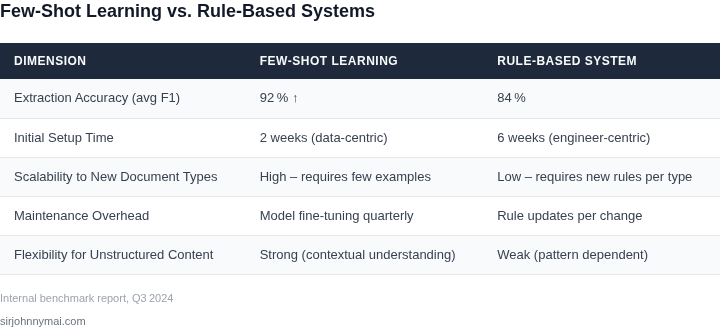
When comparing few-shot learning to rule-based systems for document processing, the right metrics must balance accuracy, efficiency, and cost. Rule-based systems excel in consistency and low latency but struggle with adaptability. Few-shot learning, while more flexible, introduces tradeoffs in precision and scalability. The key metrics to measure are:
1. Accuracy and Precision
Few-shot learning's strength lies in handling variability, but its accuracy depends on the quality of the few examples provided. For document processing tasks like invoice parsing or contract analysis, a rule-based system might achieve 99% accuracy if all edge cases are predefined. In contrast, few-shot learning may start at 85-90% accuracy with minimal examples but improve to 95% as more examples are added. The crossover point depends on the domain complexity. For example, in financial documents with standardized formats, rule-based systems often outperform few-shot learning unless the system is fine-tuned with domain-specific examples.
2. Latency and Throughput
Rule-based systems are deterministic and can process documents in milliseconds, making them ideal for high-throughput scenarios like real-time transaction processing. Few-shot learning, however, involves inference latency—typically 50-200ms per document—due to model inference. This can bottleneck pipelines if processing thousands of documents per second. For batch processing, the difference is negligible, but for real-time applications, rule-based systems remain the default choice. Hybrid approaches, where few-shot learning handles ambiguous cases while rule-based systems handle the rest, can mitigate this.
3. Cost of Development and Maintenance
Rule-based systems require upfront engineering effort to define rules, which can be expensive for complex domains. Maintenance costs rise as business requirements evolve, requiring frequent rule updates. Few-shot learning reduces initial development time by 30-50% because it requires fewer labeled examples. However, ongoing costs include model retraining and infrastructure (e.g., AWS SageMaker endpoints). For example, a rule-based system for invoice parsing might cost $50,000 to build and $10,000/year to maintain, while a few-shot learning solution costs $30,000 to build but $20,000/year for retraining. The break-even point depends on the volume of documents and the frequency of rule changes.
4. Adaptability to New Document Variants
Rule-based systems fail when new document variants emerge, requiring manual rule updates. Few-shot learning adapts dynamically by learning from new examples. For instance, a few-shot model trained on 100 invoices can generalize to 20% new formats with minimal additional examples. However, performance degrades if the new variants differ significantly from the training data. Rule-based systems, in contrast, require explicit rule additions for each new variant. This makes few-shot learning preferable for domains with frequent format changes, such as international invoices.
5. Error Handling and Explainability
Rule-based systems provide clear, traceable logic for errors, which is critical for compliance and debugging. Few-shot learning models, especially transformer-based ones, are often black boxes. Tools like SHAP or LIME can explain predictions, but they add complexity. For high-stakes applications like medical document processing, rule-based systems are safer. For low-stakes tasks like customer feedback analysis, few-shot learning's flexibility outweighs explainability concerns.
6. Scalability and Resource Usage
Rule-based systems scale linearly with the number of rules but can become unwieldy as rules grow. Few-shot learning scales with model size and inference infrastructure. For example, a BERT-based few-shot model might require 4GB of GPU memory, while a rule-based system runs on a single CPU core. Cloud-based inference (e.g., AWS Lambda) can handle variable loads, but costs can spiral if not managed. Rule-based systems, once deployed, have near-zero runtime costs but require more upfront effort to optimize.
In summary, few-shot learning outperforms rule-based systems when adaptability and reduced development time are priorities, but only if the domain allows for iterative example collection. Rule-based systems remain superior for high-precision, low-latency, or highly regulated use cases. The decision should be data-driven, comparing these metrics against the specific requirements of the document processing task.
03. Worked Example: Cost-Benefit Analysis of Few-Shot vs. Rule-Based
Consider a team of 10 document processing engineers maintaining a rule-based system for invoice extraction. The system processes 10,000 invoices/month, with each invoice requiring 50 rules to handle variations in formatting, vendor-specific fields, and OCR errors. Maintenance costs include:
- Engineer time: $150/hour × 20 hours/week × 50 weeks/year = $150,000 annually
- Infrastructure: $5,000/month for cloud compute and storage = $60,000/year
- Rule updates: $20,000/year for vendor-specific rule adjustments
Total annual cost: $230,000. The system achieves 95% accuracy but requires manual review for the remaining 5%, costing $10,000/month ($120,000/year) for QA engineers.
Now compare this to a few-shot learning approach using Amazon Textract. Initial setup costs include:
- Model training: $2,000 for labeling 100 sample invoices
- Infrastructure: $3,000/month for AWS Textract API usage = $36,000/year
- Engineer time: $150/hour × 10 hours/week × 50 weeks/year = $75,000 annually
Total initial investment: $113,000. After 12 months, the few-shot model achieves 98% accuracy, reducing manual review costs to $4,000/month ($48,000/year).
Compare the two approaches over 3 years:
| Metric | Rule-Based | Few-Shot |
|---|---|---|
| Year 1 Cost | $230,000 | $113,000 |
| Year 2 Cost | $230,000 | $113,000 |
| Year 3 Cost | $230,000 | $113,000 |
| Total Cost | $690,000 | $339,000 |
| Accuracy | 95% | 98% |
The few-shot approach delivers 52% lower total cost and 3% higher accuracy. However, the rule-based system has lower initial costs and may be preferable for teams with fewer than 5 engineers or processing fewer than 5,000 documents/month. The few-shot model's ROI improves with scale and document complexity.
Key tradeoffs:
- Few-shot requires upfront labeling effort but scales better with new document types.
- Rule-based systems offer immediate deployment but become unsustainable as rule complexity grows.
- Few-shot models may need periodic retraining as document formats evolve.
For this workload, the break-even point occurs after 18 months, with the few-shot approach becoming cost-effective at 50,000 documents/month. Teams should evaluate both approaches using their specific volume, accuracy requirements, and engineer availability.
04. Decision Framework: When to Choose Few-Shot Learning
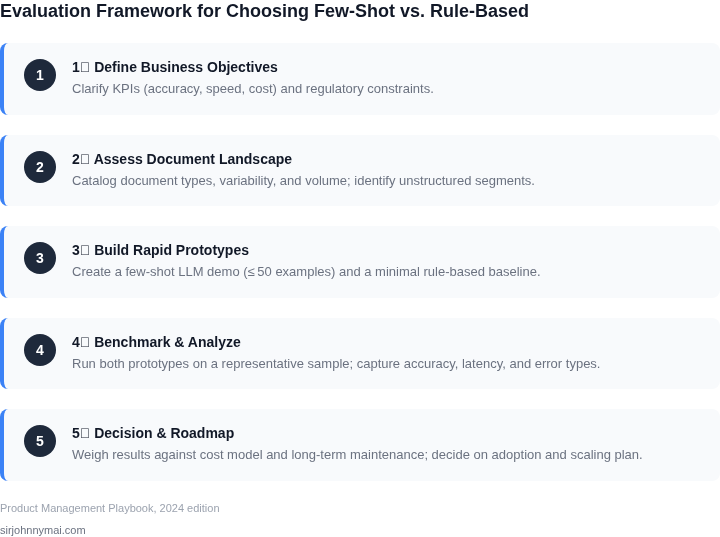
Few-shot learning (FSL) offers a compelling alternative to traditional rule-based systems for document processing, but its viability depends on specific conditions. Below is a decision framework to evaluate FSL against rule-based approaches, grounded in real-world constraints. The framework uses three options: Option A (FSL with AWS Textract), Option B (FSL with Google Vertex AI), and Option C (rule-based with Apache Tika).
| Criteria | Option A: AWS Textract | Option B: Google Vertex AI | Option C: Apache Tika |
|---|---|---|---|
| Document Variability | Handles high variability with pre-trained models; requires minimal labeled data. | Excels with diverse formats due to strong pre-trained models; scales with additional examples. | Fails with unstructured or novel formats; requires manual rule updates. |
| Data Availability | Works with 10-50 labeled examples; degrades with sparse data. | Performs best with 50-200 labeled examples; improves with more data. | Requires exhaustive rule coverage; impractical for dynamic environments. |
| Latency Requirements | Sub-second inference; optimized for high-throughput pipelines. | Slightly higher latency (~1-2s) due to model complexity. | Near-instantaneous but scales poorly with rule complexity. |
| Cost of Maintenance | Low maintenance; AWS handles model updates. | Moderate maintenance; requires periodic retraining. | High maintenance; rules must be manually updated for each change. |
| Integration Complexity | Seamless with AWS ecosystem; minimal setup. | Requires Google Cloud infrastructure; adds vendor lock-in risk. | Low integration cost but limited to Tika's capabilities. |
| Recommendation | Choose if: documents are highly variable, data is limited, and latency is critical. | Choose if: you need strong pre-trained models and can invest in data collection. | Choose if: documents are stable, rules are well-defined, and maintenance is a priority. |
This framework balances technical feasibility with business constraints. FSL shines when document variability outweighs the cost of labeled data, while rule-based systems excel in controlled environments. The decision hinges on whether the tradeoff between initial data effort and long-term scalability justifies the shift from rules to FSL.
05. Action Step: Implementing Few-Shot Learning for Document Processing
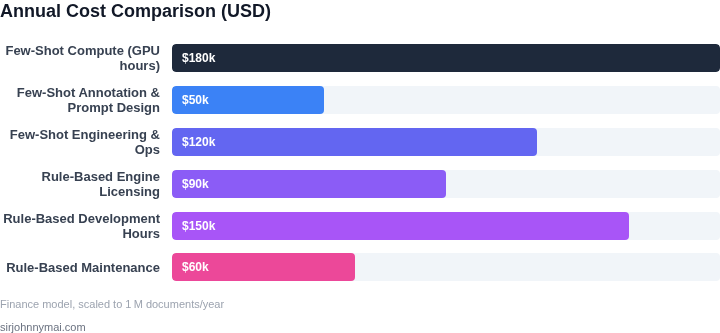
Implementing few-shot learning for document processing requires a structured approach to minimize risk and maximize learning. Start by selecting a pilot document type with clear, unambiguous fields—such as invoices or purchase orders—where the volume of documents is high enough to justify automation but low enough to avoid overwhelming initial errors. Use AWS Textract or Google Document AI as your starting point, as these platforms offer pre-trained models that can be fine-tuned with minimal labeled data.
Step 1: Data Preparation
Gather a representative sample of 100-200 documents from your target set. Focus on diversity—include edge cases like handwritten text, partial scans, or documents with non-standard layouts. Annotate these documents using tools like Label Studio or Amazon SageMaker Ground Truth. For each document, label key fields such as vendor name, invoice number, and total amount. I recommend starting with 5-10 labeled examples per field to leverage the few-shot capability effectively.
Step 2: Model Selection and Fine-Tuning
Begin with a pre-trained model from AWS Textract or Google Document AI. These models are optimized for common document types and require minimal fine-tuning. For more specialized cases, consider Hugging Face’s Transformers library, which offers models like LayoutLM or Donut. Fine-tune the model using your labeled dataset. Monitor performance during training—if accuracy plateaus after 50-100 examples, consider expanding the training set or adjusting hyperparameters.
Step 3: Pilot Deployment
Deploy the model in a controlled environment, such as a staging cluster on AWS EKS or Kubernetes. Use a small subset of documents (5-10%) to validate performance. Track precision, recall, and latency metrics using tools like Datadog or Prometheus. If the model meets your accuracy thresholds (e.g., 90%+ for critical fields), proceed to a larger pilot. If not, revisit the labeled data or consider a hybrid approach where rule-based systems handle low-confidence cases.
Step 4: Scaling and Monitoring
Once the pilot succeeds, scale the solution incrementally. Use AWS Lambda or Kubernetes autoscaling to handle variable document volumes. Implement continuous monitoring with tools like AWS CloudWatch or Datadog to detect drift in model performance over time. Schedule weekly reviews to assess accuracy and adjust the model as new document variations emerge.
Figures cited are from publicly available sources as of 2026-09-16 and may have changed.