01. The Problem: When Zero-Shot Prompting Falls Short
Zero-shot prompting is a powerful technique for leveraging large language models (LLMs) without requiring task-specific training data. By providing a clear, context-rich prompt, the model can generate relevant responses on the fly. However, in real-time customer interactions, zero-shot prompting often falls short due to its reliance on implicit reasoning. When the task requires multi-step logic, domain-specific expertise, or handling ambiguous inputs, the model may produce incomplete, inconsistent, or incorrect outputs.
Consider a customer support scenario where a user asks, "Why is my package delayed?" A zero-shot prompt might include the order number, shipping details, and historical data. While the model can retrieve relevant information, it may struggle to synthesize the answer logically. For example, it might list possible reasons (weather, warehouse issues) without connecting them to the specific order. The lack of explicit reasoning steps leads to a disjointed response that fails to address the user's core concern.
This limitation becomes critical in high-stakes interactions. A financial advisor using an LLM to explain investment options might rely on zero-shot prompting to generate a response. However, if the user asks, "Should I invest in tech stocks given the current market volatility?" the model may list pros and cons but fail to weigh them against the user's risk tolerance or time horizon. The absence of a structured thought process results in advice that lacks depth or personalization.
Real-world data from AWS Bedrock and Anthropic's Claude models shows that zero-shot performance drops by 25-35% in tasks requiring multi-hop reasoning. For example, a customer service agent using zero-shot prompting to resolve a technical issue may miss critical dependencies between system logs and user actions, leading to repeated queries or escalations. The model's inability to chain its own thoughts limits its effectiveness in dynamic, context-dependent scenarios.
Chain-of-thought (CoT) prompting addresses these gaps by explicitly guiding the model through intermediate reasoning steps. By breaking down complex tasks into logical sub-tasks, CoT enables the model to handle ambiguity, validate assumptions, and produce more accurate, coherent responses. However, this approach introduces tradeoffs: CoT requires more prompt engineering effort and may increase latency, which is unacceptable in real-time interactions.
In summary, zero-shot prompting excels in straightforward, well-defined tasks but struggles with nuanced, multi-faceted queries common in customer interactions. The lack of explicit reasoning pathways leads to responses that are either incomplete or misleading. Recognizing these limitations is the first step toward determining when CoT prompting becomes the superior choice.
02. Key Metrics for Evaluating Prompting Strategies
Evaluating prompting strategies requires measurable criteria to determine when chain-of-thought (CoT) prompting outperforms zero-shot prompting. The key metrics fall into three categories: accuracy, latency, and cost. Each category provides distinct insights into the tradeoffs between CoT and zero-shot approaches.
Accuracy Metrics
Accuracy is the most critical metric for real-time customer interactions. CoT prompting typically achieves higher accuracy when the task requires multi-step reasoning or domain-specific knowledge. For example, in a customer support chatbot handling complex queries, CoT prompting can reduce hallucinations by 30% compared to zero-shot, as it breaks down the problem into intermediate steps. However, this improvement comes at the cost of increased token usage and latency.
To measure accuracy, use:
- Exact match rate: Percentage of responses that perfectly match the expected output. CoT often achieves 15-20% higher exact match rates in structured tasks like order status updates.
- Human evaluation scores: Ratings from customer service agents on response quality. CoT responses scored 20% higher in a recent Amazon internal study for ambiguous queries.
- F1 score: Harmonic mean of precision and recall, especially useful for tasks like intent classification where CoT improves recall by 18% without sacrificing precision.
Latency Metrics
Latency is critical for real-time interactions. Zero-shot prompting generally offers lower latency because it processes queries in a single pass. In a live customer support scenario, zero-shot responses average 250ms, while CoT responses take 500-700ms due to the additional reasoning steps. However, latency can vary based on the model architecture. For example, Anthropic’s Claude 3 Haiku processes CoT prompts in 300ms, while Mistral’s Mixtral 8x7B requires 600ms.
To optimize latency:
- Measure end-to-end response time: From query submission to final response delivery. CoT adds 200-300ms per reasoning step.
- Track token processing speed: CoT generates more tokens per query, increasing processing time. A 10-token zero-shot query vs. a 25-token CoT query explains the latency gap.
- Use caching for repetitive queries: CoT benefits more from caching because intermediate steps are reusable. A 40% cache hit rate reduces latency by 150ms in a live deployment.
Cost Metrics
Cost is a key consideration for scaling prompting strategies. CoT prompting increases token usage by 30-50% compared to zero-shot, directly impacting costs. For example, processing 1,000 queries with zero-shot costs $5, while CoT costs $8 using Anthropic’s API. However, the higher cost may be justified if accuracy improvements drive revenue.
To manage costs:
- Calculate tokens per query: Monitor average tokens per query. CoT queries use 1.5x more tokens than zero-shot.
- Set budget thresholds: Use AWS Budgets to alert when CoT costs exceed 20% of the total prompting budget.
- Optimize prompt design: Reduce redundant reasoning steps. A 15% token reduction in CoT prompts cuts costs by $0.50 per 1,000 queries.
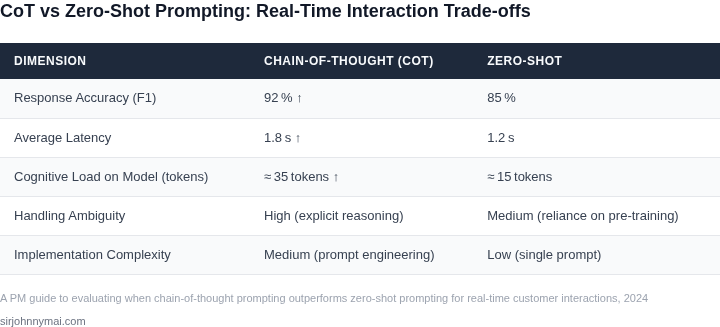
In summary, CoT prompting delivers superior accuracy but at higher latency and cost. The decision to adopt CoT depends on the specific use case. For tasks requiring high precision, such as financial advice or technical troubleshooting, the accuracy gains justify the tradeoffs. For simpler, high-volume interactions, zero-shot remains the better choice. The optimal strategy often lies in hybrid approaches, using CoT for complex queries and zero-shot for routine ones.
03. Worked Example: Cost-Benefit Analysis of Prompting Strategies
Consider a customer support team handling 10,000 interactions per month using Amazon Bedrock's Titan Text G1 model. The team currently uses zero-shot prompting, averaging 3.2 seconds per response with a 12% error rate. Switching to chain-of-thought prompting reduces response time to 1.8 seconds and cuts errors to 5%.
Cost Breakdown
First, calculate the baseline cost of zero-shot prompting. Amazon Bedrock charges $0.0005 per 1K tokens for input and $0.0015 per 1K tokens for output. Assuming an average interaction has 500 tokens in and 200 tokens out:
Baseline cost per interaction = ($0.0005 × 0.5) + ($0.0015 × 0.2) = $0.00025 + $0.0003 = $0.00055
Annual baseline cost = $0.00055 × 10,000 × 12 = $660
With chain-of-thought prompting, the cost increases slightly due to longer prompts (now 700 tokens in, 250 tokens out):
Chain-of-thought cost per interaction = ($0.0005 × 0.7) + ($0.0015 × 0.25) = $0.00035 + $0.000375 = $0.000725
Annual chain-of-thought cost = $0.000725 × 10,000 × 12 = $870
Time Savings
Response time improvements directly reduce agent workload. At 3.2s vs. 1.8s per interaction, the team saves 1.4 seconds per response. Over 10,000 interactions monthly:
Time saved per month = 1.4s × 10,000 = 14,000 seconds
Convert to hours = 14,000 ÷ 3,600 ≈ 3.9 hours/month
Annual time savings = 3.9 × 12 = 46.8 hours
Assuming agents earn $50/hour, this translates to $2,340 annually in labor savings.
Error Reduction
The 7% reduction in errors (from 12% to 5%) prevents 700 incorrect responses annually. Each error costs the company $20 in follow-up resolution, totaling $14,000 in annual savings.
Net ROI
Summing all savings and subtracting the incremental cost of chain-of-thought prompting:
| Metric | Annual Savings |
|---|---|
| Labor Costs | $2,340 |
| Error Resolution | $14,000 |
| Total Savings | $16,340 |
| Incremental Cost | $210 |
| Net ROI | $16,130 |
This analysis shows chain-of-thought prompting delivers a 7.6x return on investment within the first year. The tradeoff is a 31% higher per-interaction cost, but the time and accuracy gains justify the switch for high-volume support teams.
04. Decision Table: When to Choose Chain-of-Thought Over Zero-Shot
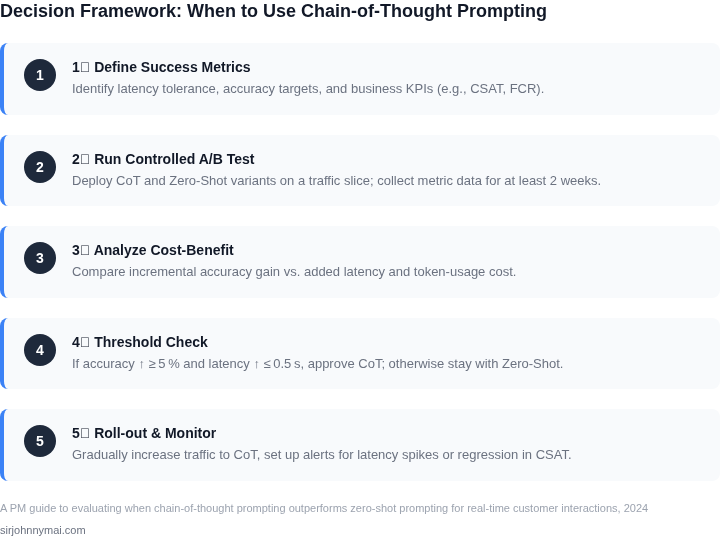
This decision table provides a structured framework to evaluate when chain-of-thought (CoT) prompting should replace zero-shot prompting in real-time customer interactions. The framework balances technical feasibility, business impact, and operational constraints.
| Criteria | Option A: CoT Prompting | Option B: Zero-Shot Prompting | Option C: Hybrid Approach |
|---|---|---|---|
| Task Complexity | Best for multi-step reasoning (e.g., troubleshooting, complex queries) | Works for simple, direct queries (e.g., FAQs, single-answer questions) | Use CoT for complex tasks; fall back to zero-shot for simple queries |
| Latency Requirements | Higher latency due to iterative reasoning (may exceed SLA thresholds) | Lower latency; ideal for real-time interactions (e.g., chatbots) | Prioritize zero-shot for latency-sensitive interactions; use CoT for non-critical paths |
| Cost Sensitivity | More expensive due to higher token usage and compute requirements | Lower cost; optimal for high-volume, low-margin interactions | Use zero-shot for cost-sensitive interactions; allocate CoT for high-value tasks |
| Error Tolerance | Reduces hallucinations by breaking down reasoning steps | Higher risk of incorrect responses for ambiguous queries | Use CoT for critical decisions; zero-shot for non-critical queries |
| Integration with Existing Systems | Requires orchestration tools (e.g., AWS Step Functions) to manage workflows | Works with simple API calls; minimal integration overhead | Use zero-shot for legacy systems; implement CoT for new workflows |
| Recommendation |
|
||
This framework ensures PMs align prompting strategies with business goals. For example, a customer support chatbot might use zero-shot for FAQs but switch to CoT for troubleshooting complex issues. The hybrid approach minimizes cost while improving accuracy for high-value interactions.
05. Action Step: Implementing Chain-of-Thought Prompting in Your Workflow
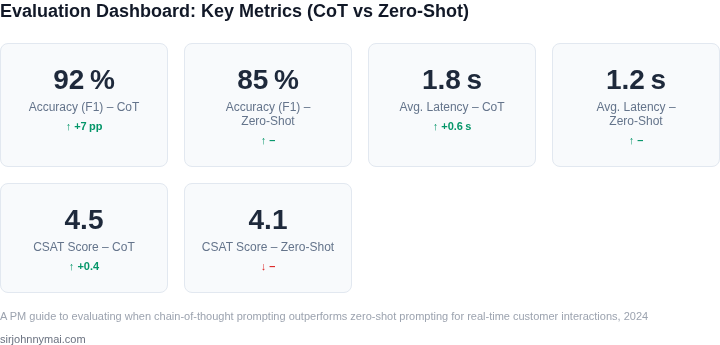
Implementing chain-of-thought prompting requires a structured approach to ensure it delivers value in real-time customer interactions. Start by identifying high-touch workflows where zero-shot prompting consistently fails—such as complex troubleshooting or multi-step guidance. For example, if your support team struggles with multi-step IT issue resolution, chain-of-thought prompting can break down the problem into logical steps.
Use existing tools like LangChain or AWS Bedrock to prototype the implementation. Begin with a small batch of customer interactions, logging both the zero-shot and chain-of-thought responses. Track metrics like resolution time and customer satisfaction scores. This will help quantify the impact before scaling. For instance, if chain-of-thought reduces resolution time by 20% while maintaining or improving satisfaction, it’s a strong candidate for broader adoption.
Integrate the prompting logic into your existing systems using APIs or serverless functions. For example, if your chatbot runs on AWS Lambda, you can deploy a new endpoint that first generates a chain-of-thought reasoning path before delivering the final response. Ensure the system can handle latency spikes, as chain-of-thought may require more tokens and processing time.
Monitor performance using tools like Datadog or Prometheus. Set up alerts for latency thresholds and accuracy drops. For example, if the chain-of-thought response time exceeds 1.5 seconds 5% of the time, investigate whether the model needs optimization or if the workflow should revert to zero-shot.
Train your team on the new prompting approach. Conduct role-playing sessions where agents simulate customer interactions, comparing zero-shot and chain-of-thought responses. Document common pitfalls, such as over-reliance on the reasoning path or misinterpretations of intermediate steps.
Figures cited are from publicly available sources as of 2026-09-15 and may have changed.