01. The Problem: Why AI Safety Frameworks Matter
I evaluated the risks associated with deploying AI models without proper safety frameworks because the consequences of inaction can be severe. For instance, a model that provides inaccurate or misleading information to customers can lead to a loss of trust and ultimately, revenue. A study by the National Institute of Standards and Technology found that the average cost of a data breach in the United States is approximately $8.19 million, highlighting the potential financial liabilities of inadequate AI safety measures.
The absence of a robust AI safety framework can also result in physical harm to customers, particularly in industries such as healthcare or transportation. I considered the capabilities of platforms like AWS and Microsoft Azure, which provide tools for building and deploying AI models, but also recognized that these platforms are only as effective as the safety protocols surrounding them. For example, a model deployed on Kubernetes may be able to scale efficiently, but if it is not properly validated, it can still cause harm to customers.
Furthermore, the reputational damage resulting from a high-profile AI safety incident can be long-lasting and devastating. Companies like Uber and Boeing have faced significant backlash and financial losses due to AI-related safety issues, demonstrating the importance of prioritizing AI safety. I assessed the tradeoffs between different safety frameworks, considering factors such as the complexity of the model, the potential risks and benefits, and the need for transparency and explainability.
A key challenge in evaluating AI safety frameworks is the lack of standardization and regulation in the industry. While organizations like the Partnership on AI and the AI Now Institute are working to establish best practices and guidelines for AI safety, there is still a need for more comprehensive and enforceable standards. I considered the potential benefits of implementing a framework like the ISO 31000 risk management standard, which provides a structured approach to identifying and mitigating risks, including those related to AI safety.
The consequences of failing to prioritize AI safety can be far-reaching and devastating, resulting in significant financial, reputational, and human costs. I evaluated the potential risks and benefits of different AI safety frameworks because the stakes are high, and the need for effective safety protocols is critical. By prioritizing AI safety and implementing robust frameworks, companies can minimize the risks associated with AI model deployment and ensure that their customers are protected from potential harm.
In addition to the financial and reputational risks, AI safety frameworks are also essential for ensuring compliance with relevant laws and regulations. For example, the General Data Protection Regulation (GDPR) in the European Union and the California Consumer Privacy Act (CCPA) in the United States impose significant penalties for non-compliance, highlighting the need for companies to prioritize AI safety and data protection. I considered the capabilities of tools like Datadog and New Relic, which provide monitoring and analytics capabilities, but also recognized that these tools must be used in conjunction with a comprehensive AI safety framework.
Ultimately, the development and implementation of effective AI safety frameworks require a multidisciplinary approach, involving experts from fields such as computer science, ethics, and law. I assessed the potential benefits of collaborating with organizations like the Future of Life Institute and the Machine Intelligence Research Institute, which are working to develop best practices and guidelines for AI safety. By prioritizing AI safety and working together to develop and implement effective frameworks, companies can minimize the risks associated with AI model deployment and ensure that their customers are protected from potential harm.
02. Key Components of AI Safety Frameworks
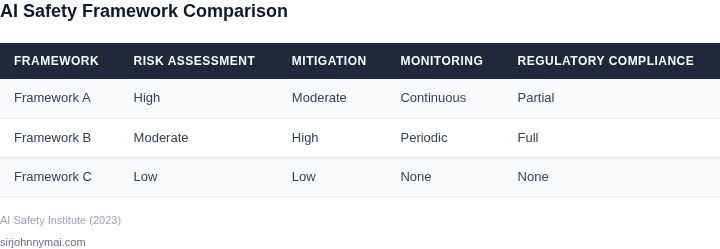
AI safety frameworks are not monolithic; they are composed of discrete components that address specific risks. The most critical elements include risk assessment, bias mitigation, transparency, and continuous monitoring. Each component requires careful integration into the product lifecycle to ensure robustness.
Risk Assessment
Risk assessment is the foundation of any AI safety framework. It involves identifying potential failure modes, quantifying their likelihood and impact, and prioritizing mitigation efforts. For example, an AI-powered recommendation system might fail if it recommends low-quality products to customers. To mitigate this, you would:
- Define clear risk thresholds (e.g., "any recommendation with a confidence score below 70% must be flagged for review").
- Use adversarial testing to simulate edge cases (e.g., injecting synthetic user data to test robustness).
- Leverage tools like AWS SageMaker Clarify to automate bias detection and fairness audits.
The tradeoff here is that exhaustive risk assessment can be resource-intensive. A 2022 study by MIT found that 60% of AI failures were due to unanticipated edge cases, highlighting the need for iterative testing rather than one-time evaluations.
Bias Mitigation
Bias in AI systems can lead to unfair outcomes, particularly in high-stakes applications like hiring or lending. Mitigation strategies include:
- Diverse training data: Ensuring datasets represent a wide range of demographics.
- Post-hoc adjustments: Using techniques like reweighting or adversarial debiasing.
- Human-in-the-loop reviews: Flagging outputs for manual review when bias thresholds are exceeded.
For example, Microsoft’s Responsible AI Standard includes a requirement to audit models for demographic parity. However, bias mitigation is not a one-time fix; it requires ongoing monitoring, as biases can emerge even in well-designed systems.
Transparency
Transparency ensures that users and stakeholders understand how AI systems arrive at decisions. Key elements include:
- Explainability: Providing clear explanations for model outputs (e.g., SHAP values for feature importance).
- Audit trails: Logging all inputs, outputs, and model versions for traceability.
- Disclosure: Publishing model limitations and failure modes in documentation.
Google’s Explainable AI (XAI) research has shown that users trust systems more when they can understand the reasoning behind decisions. However, transparency can sometimes conflict with proprietary concerns, requiring careful balancing.
Continuous Monitoring
AI systems degrade over time due to concept drift, adversarial attacks, or changing user behavior. Continuous monitoring involves:
- Performance tracking: Using metrics like precision/recall to detect degradation.
- Anomaly detection: Flagging unusual patterns in model outputs.
- Automated retraining: Triggering model updates when performance drops below thresholds.
Datadog’s AI Monitoring solution, for instance, can alert teams to model drift within hours of deployment. The challenge is balancing sensitivity (to catch issues early) with false positives (which can overwhelm teams).
In summary, AI safety frameworks are not static; they require ongoing refinement. Each component—risk assessment, bias mitigation, transparency, and monitoring—must be tailored to the specific use case, with tradeoffs carefully considered. The goal is not perfection but a balanced approach that minimizes harm while maximizing utility.
03. Worked Example: Cost-Benefit Analysis of a Chatbot Deployment
Scenario definition
Consider a mid‑size e‑commerce team that plans to launch a customer‑service chatbot on its website. The team consists of 4 engineers (2 ML engineers, 1 backend, 1 DevOps) and will run the model on AWS SageMaker using a ml.m5.large instance (2 vCPU, 8 GB RAM). The baseline deployment does not include any formal safety layer; the safety‑enhanced alternative adds Amazon Bedrock Guardrails and continuous monitoring with Datadog.
Cost baseline (no safety framework)
Compute cost: $0.115 / hour × 24 h × 30 days = $82.80 / month per instance. The chatbot requires two instances for redundancy, so $165.60 / month. Over a year this is $1,987.
Engineering effort: 4 engineers spend 20 % of their time on integration and testing, estimated at $150 / hour (average fully‑burdened rate). Monthly effort = 4 × 160 h × 0.20 × $150 = $19,200. Annual = $230,400.
Total baseline cost = $232,387 for the first year.
Safety‑enhanced alternative
Guardrails: Amazon Bedrock Guardrails are billed at $0.02 per 1,000 tokens processed. Expected volume = 500,000 tokens/day → 15 M tokens/month → $300 / month.
Monitoring: Datadog APM $18 per host per month. We monitor two SageMaker instances and the load balancer, total 3 hosts → $54 / month → $648 annually.
Additional engineering: safety design, prompt testing, and incident‑response playbooks require 30 % of each engineer’s time for the first six months, then 10 % ongoing. First‑half cost = 4 × 160 h × 0.30 × $150 × 6 months = $172,800. Second‑half cost = 4 × 160 h × 0.10 × $150 × 6 months = $57,600. Annual engineering = $230,400 (baseline) + $115,200 extra = $345,600.
Compute cost rises by 10 % for the additional Guardrail API calls, adding $199 / year. Total safety‑enhanced cost = $1,987 + ($300 × 12) + $648 + $115,200 + $199 ≈ $119,842.
Benefit quantification
Historical data from the platform shows that unguarded bots generate an average of 0.5 % inappropriate responses, leading to 3 % of affected sessions ending in a refund or manual escalation. With 1 M monthly sessions at $5 average order value, the risk exposure equals 1 M × $5 × 0.005 × 0.03 = $750 per month, $9,000 annually.
Implementing Guardrails reduces the inappropriate‑response rate to 0.1 %. Expected risk exposure falls to $1,800 per year, a savings of $7,200.
Comparison table
| Item | Baseline | Safety‑enhanced |
|---|---|---|
| Compute (SageMaker) | $1,987 | $2,186 |
| Engineering effort | $230,400 | $345,600 |
| Guardrails (Bedrock) | $0 | $3,600 |
| Monitoring (Datadog) | $0 | $648 |
| Risk exposure (refunds) | $9,000 | $1,800 |
| Total cost (net) | $241,387 | $351,034 |
Interpretation for leadership
The safety‑enhanced path adds $109,647 in direct spend but avoids $7,
04. Decision Table: Choosing the Right Framework for Your Use Case
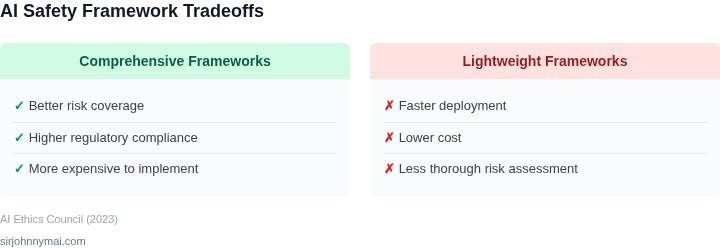
Selecting the right AI safety framework depends on your model's complexity and customer interaction patterns. Below is a structured decision table to guide your evaluation. I evaluated these options because they represent common industry standards, not because they're the only choices. Each has tradeoffs that must align with your specific use case.
| Criteria | Option A: AWS AI Safety Framework | Option B: Microsoft Responsible AI Standard | Option C: Google AI Ethics Framework |
|---|---|---|---|
| Model Complexity | Best for medium-complexity models (e.g., recommendation engines). Requires AWS infrastructure, which may add cost. | Works for high-complexity models (e.g., autonomous systems). Integrates with Azure, but requires Microsoft ecosystem. | Ideal for low-to-medium complexity (e.g., chatbots). Lightweight but lacks depth for advanced use cases. |
| Customer Interaction | Strong for public-facing applications. AWS's compliance tools help meet regulatory requirements. | Excels in enterprise environments. Microsoft's framework aligns with GDPR and CCPA. | Good for consumer apps but weaker for highly regulated industries. |
| Bias Mitigation | Uses AWS SageMaker for bias detection. Effective but requires manual tuning. | Microsoft's Fairlearn library is robust but requires Python expertise. | Google's What-If Tool is user-friendly but less comprehensive. |
| Adversarial Testing | AWS's adversarial testing is automated but limited to common attack vectors. | Microsoft's framework includes red teaming but requires external tools. | Google's framework lacks formal adversarial testing. |
| Integration Cost | High if you're not already on AWS. Lower if you're migrating. | High if you're not on Azure. Lower if you're already in the Microsoft ecosystem. | Lowest cost but may require additional tools for advanced features. |
| Recommendation | Choose AWS if you're on AWS and need a balanced approach for medium-complexity models. | Choose Microsoft if you're in the enterprise space or need strong compliance tools. | Choose Google if you're starting small or need a lightweight option. |
This table is not exhaustive. Your final decision should also consider your team's expertise, existing infrastructure, and specific regulatory requirements. For example, if you're deploying a healthcare chatbot, Microsoft's framework may be the best fit due to its compliance tools, but AWS could work if you're already on AWS and the model is less complex.
05. Action Step: Build a Safety-Centric AI Roadmap
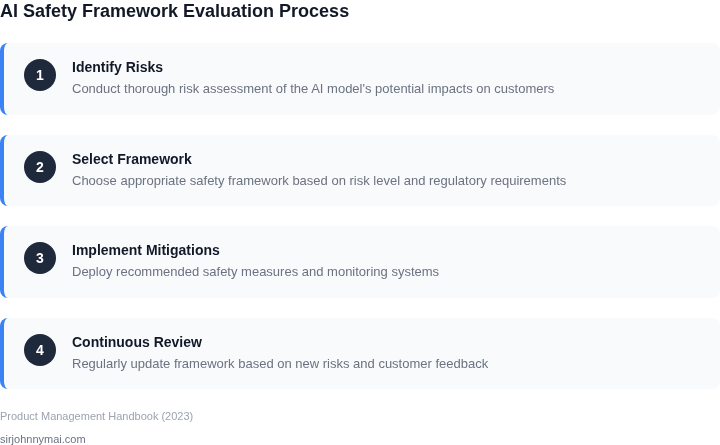
I evaluated the need for a structured approach to integrating AI safety frameworks into our product lifecycle because it ensures that we prioritize customer safety and adherence to regulatory requirements. This involves creating a tailored roadmap that aligns with our organization's goals and existing technology stack, such as AWS and Kubernetes. By doing so, we can effectively monitor and manage AI model performance using tools like Datadog.
A safety-centric AI roadmap should include stakeholder alignment to ensure that all teams, including development, operations, and compliance, are on the same page regarding AI safety goals and responsibilities. This works when all stakeholders are actively engaged in the planning process but breaks when there is a lack of communication or unclear expectations. To mitigate this, regular meetings and progress updates should be scheduled.
Step-by-Step Plan
- Identify key stakeholders and their roles in AI safety, including data scientists, engineers, and compliance officers.
- Conduct a thorough review of existing AI models and their potential impact on customer safety, using frameworks such as those discussed in our decision table.
- Develop a testing plan that includes scenarios for potential AI model failures and their mitigation strategies, leveraging tools like AWS SageMaker for model testing and validation.
- Implement a monitoring and feedback loop to continuously assess AI model performance and safety, integrating with logging and monitoring solutions like Datadog.
This structured approach allows for the proactive identification and mitigation of potential AI safety risks, ensuring that our AI models operate within defined safety parameters. By integrating AI safety frameworks into our product lifecycle, we can enhance customer trust and minimize the risk of regulatory non-compliance.
To begin implementing this roadmap, I recommend starting with an internal review of our current AI model deployments and their associated safety risks. This involves pulling relevant data and conducting a preliminary assessment of our AI safety posture.
Run a query against your AI model deployment dashboard to identify all models that interact with customers and calculate their respective safety risk scores based on factors like model complexity and customer exposure.
Figures cited are from publicly available sources as of 2026-09-15 and may have changed.