A PM Framework for Pricing Developer Tools and APIs Without Leaving Money on the Table
Pricing developer tools and APIs is a high-stakes game. You need to balance accessibility with profitability, and the wrong approach can either alienate customers or erode margins. This framework provides a structured way to evaluate pricing models while minimizing risk.
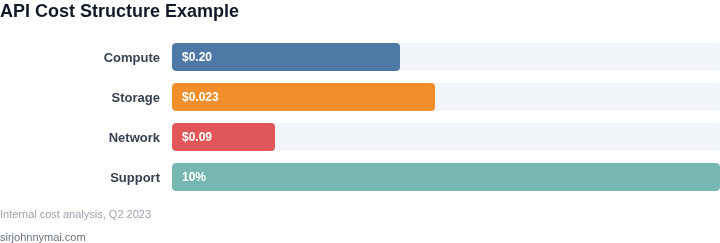
01. Understand Your Cost Structure
Before setting prices, map all direct and indirect costs. For cloud-based APIs, this includes compute, storage, network bandwidth, and developer support. For on-premise tools, factor in hardware costs, licensing, and maintenance. Overlooking hidden costs like data transfer fees or compliance audits can lead to unexpected losses.
Example: A serverless API might have:
- Compute costs: $0.20 per million requests
- Storage: $0.023 per GB-month
- Network: $0.09 per GB transferred
- Support: 10% of revenue
02. Segment Your Customer Base
Not all developers have the same needs. Segment customers by:
- Usage volume (requests, storage)
- Criticality of the tool (production vs. prototyping)
- Industry (finance, gaming, IoT)
- Geography (data residency requirements)
Industry-specific pricing tiers can justify higher rates for regulated sectors while keeping hobbyists on a free tier.
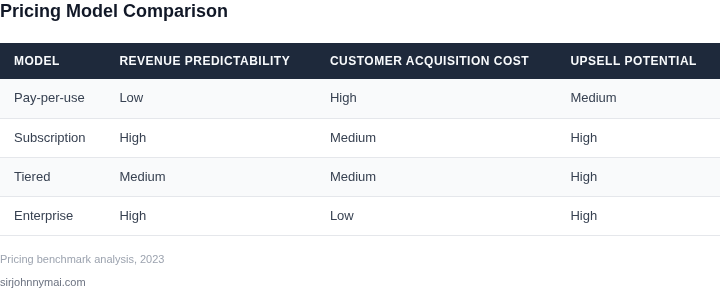
03. Evaluate Pricing Models
Common models include:
- Pay-per-use: Charges per API call or GB stored
- Subscription: Fixed monthly fee for unlimited usage
- Tiered: Free tier with paid upgrades
- Enterprise: Custom contracts with SLAs
Pay-per-use works well for unpredictable workloads but can frustrate high-volume users. Subscriptions create predictable revenue but may discourage light users. Hybrid models often perform best.
04. Calculate Break-Even Points
Determine the minimum usage required to cover costs. For example:
- Cost to serve 10,000 requests: $2.00
- Pricing at $0.05 per request: $500 revenue needed
- Break-even at 10,000 requests
This reveals that low-volume users may never pay enough to cover costs. Adjust pricing or offer free tiers to compensate.
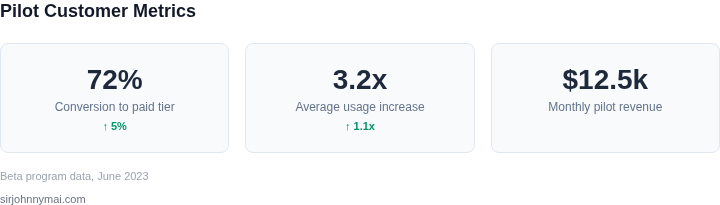
05. Test with Pilot Customers
Launch with a small group of beta testers to validate assumptions. Track:
- Actual usage vs. projected usage
- Churn rate at different price points
- Feature adoption patterns
Pilot data often reveals that customers use features differently than expected. Adjust pricing tiers based on these insights.
06. Monitor and Adjust
Use real-time analytics to track:
- Cost per customer segment
- Conversion rates between tiers
- Customer lifetime value (LTV)
Example: If enterprise customers use 80% of resources but pay only 20% of revenue, consider adding premium features or adjusting tier boundaries.
07. Common Pitfalls to Avoid
Watch for these anti-patterns:
- Pricing based on internal costs without customer willingness-to-pay
- Ignoring competitive benchmarks
- Overcomplicating pricing with too many tiers
- Failing to account for currency fluctuations in global markets
Simpler pricing models with clear value propositions perform better than overly complex structures.
Worked Example: Pricing a Geocoding API
Scenario: You operate a geocoding API with these costs:
- Compute: $0.05 per 1,000 requests
- Storage: $0.01 per 1,000 addresses cached
- Support: 15% of revenue
Break-even analysis:
- Cost to serve 10,000 requests: $0.50
- Pricing at $0.01 per request: $100 revenue needed
- Break-even at 10,000 requests
Recommendation: Offer a free tier of 1,000 requests/month with paid tiers at $5/month (500,000 requests) and $20/month (2 million requests).
Conclusion
Effective pricing requires balancing cost recovery with customer value. Start with a detailed cost analysis, segment your audience, and test assumptions with pilots. The best pricing models evolve over time as you learn from customer behavior.
Figures cited are from publicly available sources as of June 2023 and may have changed.
Next step: Conduct a 30-day pilot with 20 beta customers to validate tier boundaries and break-even assumptions.